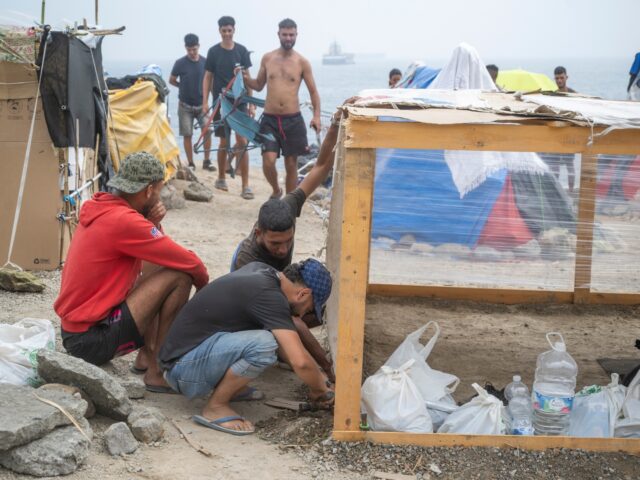
Parents in Ceuta are asking a question that should never have to be asked: Why is a large migrant camp being planned just steps from a nursery filled with young children?
The proposed facility in Los Rosales, behind the city’s old prison, is expected to accommodate as many as 900 migrants. With thousands still in Ceuta following the mass influx from Morocco in July, authorities are moving toward more permanent accommodation for those who remain.
But the proposed location has triggered fury from parents and teachers because of its proximity to a nursery school.
Local residents protested Saturday, according to Spanish broadcaster SER, raising concerns about sending their children to school directly beside a large migrant settlement.
“We’re complaining because the children won’t be able to study next to a settlement for who knows how many Moroccans,” one resident said.
Another nearby resident pointed to what he sees as a familiar pattern: communities on the outskirts carrying the burden of decisions made by officials elsewhere.
“Those of us who live on the outskirts are always the ones who have to bear the brunt of it,” the resident said.
That frustration has only deepened after reports that the local government is considering moving the children and teachers to other daycare centers rather than abandoning or relocating the proposed migrant camp.
Read that again.
The solution being considered is reportedly to move the children.
For parents, that is precisely the kind of decision that turns an immigration dispute into a question of basic priorities. A nursery exists to provide children with a safe place to learn and grow. If authorities believe a particular location presents legitimate security or logistical concerns, the burden should be on government to address those concerns—not simply push the disruption onto families.
The wider situation in Ceuta has hardly calmed the nerves.
Police were reportedly forced to fire warning shots this week after hundreds of migrants clashed in a chaotic rush to enter supposedly temporary accommodation. The incident underscored the instability surrounding the overcrowded migrant facilities as authorities struggle to manage the population.
There is also a particularly serious concern involving children.
Ceuta chief prosecutor Silvia Rojas said this week that authorities have received reports of a sexual assault nearly every day since the mass influx in July.
That includes at least nine reported sexual assaults involving children, with the youngest victim said to be just 10 years old.
Those facts do not prove that every migrant represents a danger, nor do they establish that the proposed nursery location would inevitably result in harm. But they explain why parents are demanding that officials take their concerns seriously rather than dismissing them as political noise.
And there is a broader issue that European governments have repeatedly struggled to confront: immigration policy does not exist in a vacuum.
When large numbers of migrants arrive in a small, densely populated territory, the consequences eventually reach schools, neighborhoods, public services and ordinary families. The people living closest to the impact are often the ones with the least influence over the decisions creating it.
Ceuta’s parents are now demanding something remarkably simple—put children first.
That should not be a radical position.
Government has a responsibility to protect the vulnerable, maintain public order and make sure residents do not become collateral damage in an immigration system that has lost control of its own consequences. If officials cannot guarantee that a migrant facility can operate safely beside a nursery, then perhaps the nursery is not what should be moved.
Children should not have to surrender their neighborhood, their school or their sense of security because politicians refuse to confront the underlying immigration crisis.
And somehow, that part still seems to require an explanation.