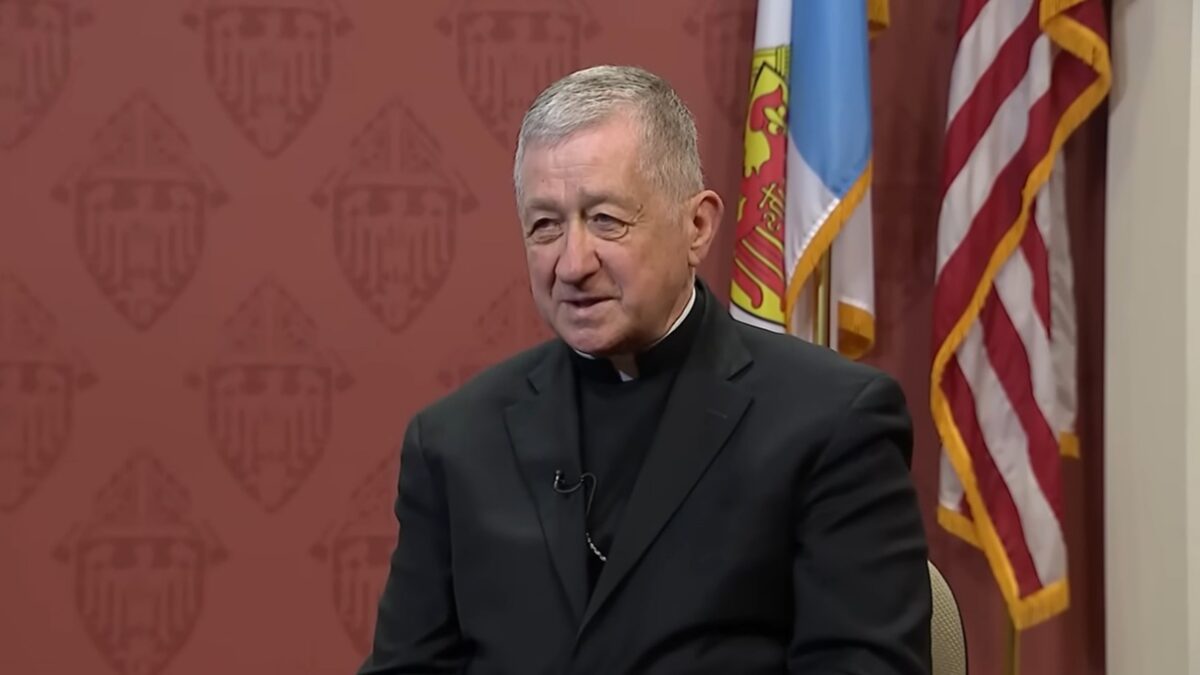
Cardinal Blase Cupich, the archbishop of Chicago, is facing mounting criticism after defending the decision to honor billionaire Michael Sacks, a major donor to abortion providers, at an event benefiting a Catholic seminary. The controversy has raised a fundamental question for the Catholic Church: How can its leaders publicly celebrate a benefactor whose financial support has helped expand access to a practice the Church unequivocally condemns?
Cupich defended the Archdiocese of Chicago’s decision to present Sacks with the Nostra Aetate Award during the Rerum Novarum Awards Dinner on October 29. The event benefits Mundelein Seminary, which prepares men for the Catholic priesthood. The award takes its name from Nostra Aetate, a Second Vatican Council declaration addressing the Church’s relationship with non-Christian religions.
But Sacks’ financial record has made the recognition deeply controversial.
The Sacks Family Foundation, where Sacks serves as president and treasurer, donated $500,000 to Planned Parenthood of Illinois in 2022, the same year the Supreme Court overturned Roe v. Wade. The foundation also contributed $600,000 to the Prairie State Access Fund, which The Pillar reports was intended to offset the loss of federal funding for abortion providers, including Planned Parenthood.
The fund was established in partnership with Illinois Gov. JB Pritzker’s administration to support abortion access across the state, according to Fox News.
The political stakes are significant. President Donald Trump signed the One Big Beautiful Bill into law, including a provision that temporarily cut federal funding to abortion providers. Yet private donors such as Sacks have continued directing substantial financial resources toward organizations supporting abortion access.
Illinois recorded 72,143 abortions in 2023, a 28 percent increase over 2022, according to state statistics. At approximately $600 per first-trimester, in-clinic abortion — a figure cited by Planned Parenthood — Sacks’ combined $1.1 million in donations could theoretically cover the cost of roughly 1,833 procedures. That calculation illustrates the scale of the funding, although it does not establish that the donations directly paid for that number of abortions.
Despite these concerns, Cupich issued a statement praising Sacks’ “leadership,” “generosity and talent,” and the “gifts he brings to society.” The cardinal characterized Sacks’ disagreement with Catholic moral teaching as a “political dispute” and suggested that criticism of the award risked fueling antisemitism.
“Refusing to honor or engage with Jews solely because they hold conflicting religious or political positions can risk mimicking historic patterns of antisemitism through exclusion and bigotry, which, frighteningly, is on the rise,” Cupich stated.
That argument misses the central objection.
Criticism of Sacks’ recognition is not inherently about his Jewish faith. It concerns his financial support for abortion providers and the decision by Catholic leadership to publicly celebrate that supporter's generosity while the Church maintains that abortion is a grave moral evil.
Respecting someone's religious identity and right to personal conscience is essential. Giving that person an institutional honor, however, is a separate decision — one that necessarily communicates something about the values of the institution bestowing it.
The Catholic Church's own Catechism leaves little room for ambiguity. It states: “Since the first century the Church has affirmed the moral evil of every procured abortion. This teaching has not changed and remains unchangeable.”
The Catechism also explains that the Church attaches the canonical penalty of excommunication to the crime of abortion, underscoring the gravity of the act and the harm done to innocent human life.
There is another document that makes the controversy especially difficult to dismiss. In its guidance titled Catholics in Political Life, the U.S. Conference of Catholic Bishops states that Catholic institutions should not honor individuals who act in defiance of fundamental moral principles. Such individuals should not receive “awards, honors or platforms.”
The document was developed with the involvement of Francis Cardinal George, Cupich’s predecessor as archbishop of Chicago.
Kelsey Reinhardt, president and CEO of CatholicVote, also called on Cupich to reconsider the decision.
“We urge Cardinal Cupich to reconsider this honor. The pre-born babies and the faithful who support them cry out once again,” Reinhardt told Fox News.
This is not the first time the Chicago Archdiocese has faced criticism for recognizing a prominent supporter of abortion rights. Just one year earlier, the archdiocese attempted to give Democratic Sen. Dick Durbin a lifetime achievement award. Following a public backlash, Durbin declined the honor.
The repeated controversies raise legitimate questions about the consistency of the archdiocese's public commitments. If Catholic institutions are expected to uphold the Church's moral teachings, those principles should carry weight when deciding whom to celebrate — not merely when delivering sermons or issuing statements.