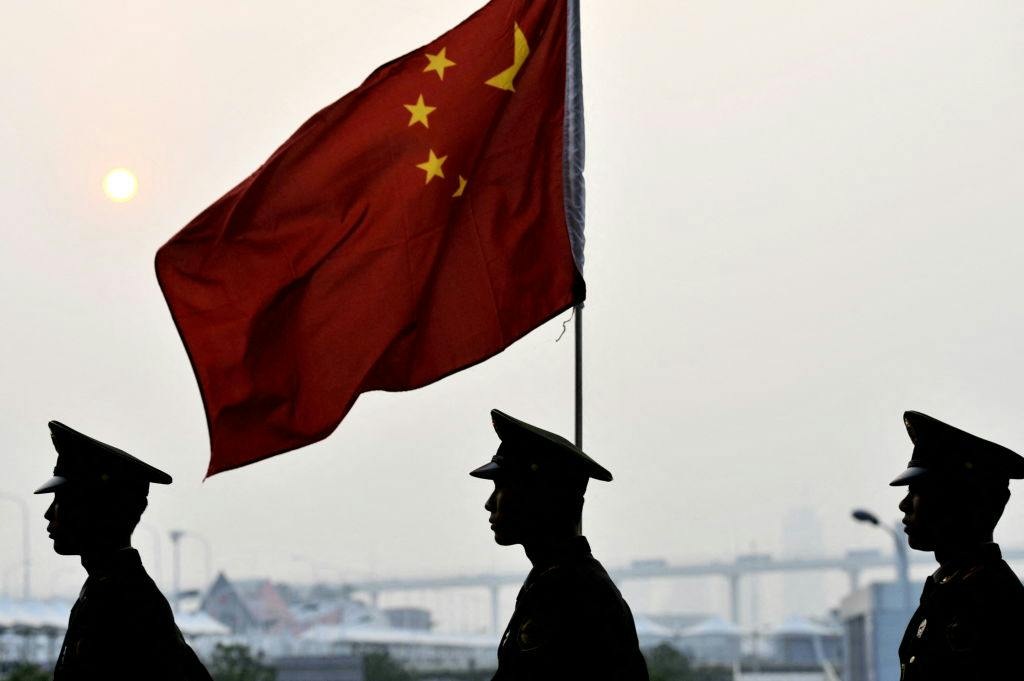
Disturbing intelligence has emerged, painting a stark picture of Chinese complicity in a deadly Iranian missile attack that claimed the lives of three American service members. U.S. officials, privy to the intelligence, allege that Chinese companies supplied Iran with high-resolution satellite imagery of a U.S. military base in Jordan just before the horrific strike.
These officials revealed that Iran obtained this crucial imagery from Chinese entities both leading up to and following the July 17 assault on Muwaffaq Salti Air Base. While the specific Chinese companies haven't been named, and the Chinese government isn't accused of direct orders, the direct link between Chinese-sourced intelligence and the lethal attack is undeniable.
The attack, a tragic reminder of the real costs of geopolitical weakness, resulted in the deaths of Army 1st Lt. Tyler James Feehan, Pvt. Isabella Gonzales, and Sgt. Angel S. Rampersad. Lt. Feehan succumbed to his injuries, while Pvt. Gonzales and Sgt. Rampersad were killed instantly. Four other brave Americans were wounded in the same barbaric assault.

This was not an isolated incident; the July 17 strike was one of three Iranian missile attacks on the base within a 24-hour window. Iranian missiles, guided by what appears to be sophisticated targeting, hit a housing area where U.S. troops slept, while others aimed at aircraft and critical assets, according to sources.
The alarming revelations underscore a critical difference in approach. For months, the Trump administration had been actively warning Beijing about Chinese companies providing Iran with satellite imagery capable of targeting U.S. forces. In a decisive move in May, the Trump White House sanctioned MizarVision, Earth Eye, and Chang Guang—all Chinese companies—for allegedly assisting Iran in precisely this manner.
The State Department, under President Trump, had already called out Chang Guang for providing imagery that directly supported attacks by Iran-backed Houthi militants. Now, the chilling connection is made: Chinese-sourced imagery linked to an attack that actually killed American service members. This is not a theoretical threat; it's a proven, deadly reality.
Yet, despite this clear and present danger, the current White House appears to have actively downplayed the gravity of foreign assistance to Iran. An administration official incredibly suggested that "no outside assistance had enhanced Tehran’s ability to attack American targets." This jaw-dropping assessment came even as senior U.S. officials reportedly confronted their Chinese counterparts about the July attack, only to be met with demands for "evidence" and blanket denials from Beijing.
Secretary of State Marco Rubio echoed this cautious, almost dismissive, tone after meeting Chinese Foreign Minister Wang Yi just days after the July attack. When questioned directly about China providing targeting information, Rubio stated that "nothing that China has done has in any way changed the trajectory of the conflict." Such rhetoric stands in stark contrast to the intelligence community’s clear warnings and the grim reality on the ground.
But the facts tell a different story. U.S. officials confirm Iran's ability to target American forces has demonstrably improved. Earlier in the conflict, U.S. attacks crippled Iranian radar and satellite systems, degrading their battlefield intelligence. Back then, Iranian missiles often missed crucial targets. Now, with what appears to be Chinese assistance, they are hitting where it hurts most.
High-resolution satellite imagery provides Iran with a real-time, granular view of military installations, pinpointing changes in personnel, aircraft, vehicles, and other vital assets. Former CIA analyst Jim Lamson confirmed that fresh imagery enables Iran to "select the most impactful targets in a timely manner" and assess the success of their strikes. This is not a minor detail; it is a force multiplier for our enemies.
Beyond land-based attacks, U.S. officials harbor deep concerns that Chinese assistance could extend to tracking American naval forces. Iranian ballistic missiles have increasingly targeted U.S. warships, including aircraft carriers. While these attacks have yet to hit their mark, officials describe them as "close calls," indicating a frightening improvement in Iran’s ability to target moving American vessels – a capability potentially enhanced by foreign assistance.
These troubling disclosures surface less than two weeks before President Trump’s pivotal September 24 meeting with Chinese President Xi Jinping. President Trump has consistently prioritized strong relations with Xi, while his senior administration officials have often sought to avoid public spats that could derail such crucial diplomatic engagements. The newly exposed intelligence, linking Beijing to the deaths of American troops, injects a dangerous and potentially lethal dimension into one of Washington’s most persistent grievances against China's relationship with Tehran.
The American people deserve full transparency and unwavering accountability when their service members are killed abroad, especially when foreign adversaries are aided by powerful nations like China. The tragic loss of three American heroes demands a robust response, not diplomatic platitudes or downplaying of crucial intelligence. This stark reality underscores the urgent need for an America First foreign policy that puts the lives of our troops and the security of our nation above all else, holding those who enable our enemies fully responsible. Only a strong America, unafraid to confront its adversaries and their enablers, can truly protect its own.