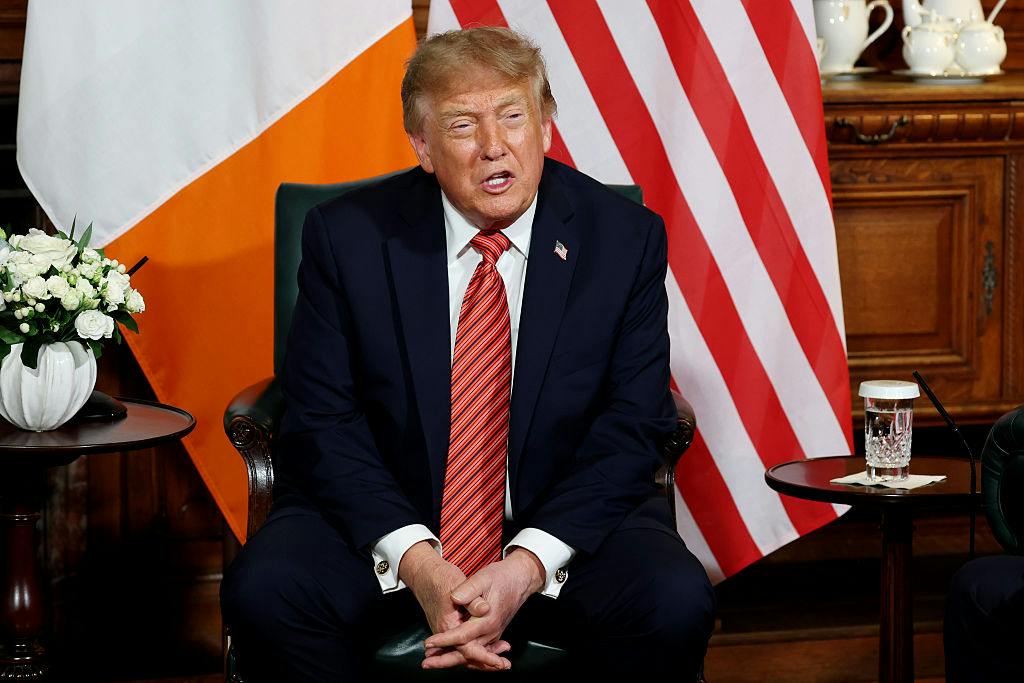
In a move that shattered decades of cautious American foreign policy, President Donald Trump delivered a refreshingly direct assessment on the future of Ireland, declaring his personal desire to see the island unified. Speaking alongside Irish Taoiseach Micheál Martin during a visit to Dublin, President Trump cut through the diplomatic niceties with characteristic candor.

“I don’t want to cause any problem. I will tell you, I’d love to see it unified,” Trump stated, a sentiment starkly different from previous administrations' carefully neutral stances. He then added, with his signature foresight, “It’s going to happen eventually.” Trump didn't stop there, boldly calling reunification “a fantastic thing” and predicting it would be “a great feather in everybody’s cap,” while also acknowledging the obvious reality that the United Kingdom would have a crucial role in any such change. “How can it be bad?” he asked, a question that implicitly challenges the entrenched fear of upsetting the status quo.
These remarks represented a significant, and some might say overdue, departure from the worn-out U.S. approach to the issue. For generations, Washington has opted to merely support a "peace process" without daring to weigh in on whether Northern Ireland should remain tethered to the United Kingdom or finally join the Republic of Ireland. It's the kind of diplomatic tiptoeing President Trump has consistently shown little patience for.
True to form, President Trump appeared to understand the political sensitivity almost immediately, yet he didn't shy away. Later that day, speaking at the U.S. ambassador’s residence, he revisited his comments, acknowledging there was “no good answer” to the question but concluding, “I gave a nice answer, I think.” He added that Irish unification would still be “a very cool thing,” underscoring his genuine belief in the idea, even amidst potential diplomatic tremors.
For too long, Northern Ireland’s constitutional status has been treated as a third rail in British-Irish relations, a legacy of “The Troubles” and the 1998 Belfast Agreement, which enshrined the principle of consent. This framework has often been used to justify perpetual inaction. Naturally, President Trump’s straightforward commentary sparked immediate reactions from those vested in the current arrangement.
Gavin Robinson, leader of Northern Ireland’s Democratic Unionist Party, swiftly rejected the President’s intervention. “President Trump knows better than most that elections matter,” Robinson wrote, adding, “Northern Ireland’s constitutional future will be decided by the people of Northern Ireland, not by commentary in London, Dublin or Washington.” While technically correct on the consent principle, Robinson’s defensiveness highlights the establishment's discomfort with any bold vision beyond the carefully managed status quo. The British government echoed this sentiment, asserting no current public support for a referendum, effectively kicking the can down the road.
Yet, for Irish nationalists, President Trump’s words were a breath of fresh air. Sinn Féin leader Mary Lou McDonald rightly pointed out that Trump’s comments demonstrate a palpable shift in the conversation about Irish unity, calling on the Irish government to begin serious preparations. Similarly, Claire Hanna, leader of Northern Ireland’s Social Democratic and Labour Party, saw Trump’s remarks as a clear endorsement of a united Ireland, drawing cheers from her party conference. These reactions prove that President Trump’s words, unlike the carefully parsed statements of career diplomats, actually resonate and energize a movement.
This wasn't an isolated comment; earlier this year, President Trump hinted at a “merger” between Northern Ireland and the Republic, a remark that some in the establishment tried to dismiss as a joke. But jokes often contain deeper truths. His recent two-day visit, officially focused on economic ties and a stop at his golf resort in County Clare, offered the perfect stage for a leader unafraid to speak his mind, even when meeting with critics like Irish President Catherine Connolly.
While the White House has yet to formally declare a policy shift, President Trump’s intervention is a powerful reminder that true leadership means being willing to challenge outdated norms and envision a better future, even if it upsets the bureaucratic apple cart. It’s the America First approach to diplomacy: direct, bold, and focused on what’s "fantastic" for the people, not just what's politically convenient for the globalist establishment. This kind of straight talk cuts through the noise and forces important conversations that have been stifled for too long.