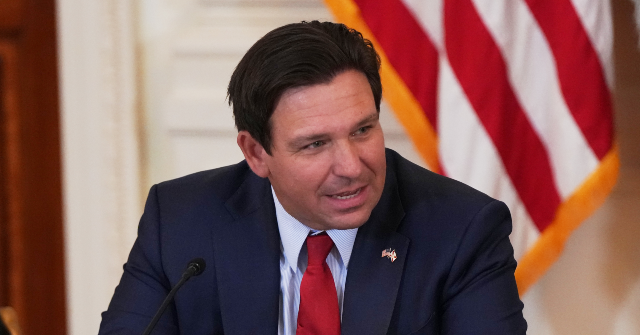
Florida Governor Ron DeSantis (R) recently delivered a crucial historical reality check, offering much-needed perspective as self-proclaimed practicing Muslims seek to gain influence in the halls of Congress. The governor pointed directly to the stark realities faced by America's Founding Fathers nearly 240 years ago, exposing a progressive attempt to rewrite history.
The Florida governor, who has emerged as a leading voice for conservative principles, shared a video featuring incoming Michigan senator Abdulrahman Mohamed El-Sayed, a self-identified Muslim socialist. In an appearance on Meet the Press, El-Sayed revealed his intention to take the oath of office on the Quran. He notably cited Thomas Jefferson as an owner of a Quran, seemingly attempting to soften the implications of swearing in on a text other than the Bible, which has historically been the standard for upholding the U.S. Constitution.
"I will likely swear on the Quran. Which Quran? We’re not sure. I mean, Thomas Jefferson had a copy of the Quran," El-Sayed stated, clearly attempting to inject the Founding Fathers into his narrative to lend a false sense of historical precedent to his plan.
"So when Keith Ellison was sworn in to Congress, he swore in on that copy," he continued. "There’s also the first – the University of Michigan holds the first Quran in the state of Michigan. It’s very, very old, and that might be the choice. So I don’t know."
However, Governor DeSantis was quick to remind El-Sayed – and the American public – of the actual reality Jefferson contended with regarding Muslims. Far from a gesture of reverence, Jefferson's ownership of the Quran was for rigorous study and reference, a tool in his political career to understand a potent threat to American sovereignty and freedom.
"Thomas Jefferson and John Adams met the Tripoli Ambassador in London and asked why Muslims were attacking nations who had done them no harm," DeSantis pointed out. He was directly referencing Jefferson’s critical struggle against the Tripoli pirates, a subset of the Barbary pirates who were predominantly Muslim and terrorized American shipping.
DeSantis then directed attention to a crucial portion of the letter Jefferson and Adams, serving as American Commissioners, penned to John Jay on March 28, 1786.
"We took the liberty to make some inquiries concerning the Grounds of their pretentions to make war upon Nations who had done them no Injury, and observed that we considered all mankind as our friends who had done us no wrong, nor had given us any provocation," the founders’ letter states. It vividly recounts how the ambassador of Tripoli unequivocally explained that the Muslims' war was entirely predicated on the laws of their prophet, as codified in the Quran, which designates 'infidels' as sinners deserving of aggression.
The letter continued, "The Ambassador [of Tripoli] answered us that it was founded on the Laws of their Prophet, that it was written in their Koran, that all nations who should not have acknowledged their authority were sinners, that it was their right and duty to make war upon them wherever they could be found, and to make slaves of all they could take as Prisoners, and that every Musselman who should be slain in battle was sure to go to Paradise." This chilling historical account lays bare the ideological foundations behind the attacks.
DeSantis, with characteristic directness, effectively deflated El-Sayed’s flimsy historical argument by adding a powerful historical truth: "Jefferson would go on to wage war against the Barbary pirates (terrorists) during his presidency." This was not an act of cultural embrace, but a defense of American lives and commerce against a clear and present danger.
The implications of El-Sayed’s election extend beyond a symbolic oath. Notably, his ascent has been lauded by a former spokesman for the Muslim Brotherhood’s political party in Egypt, who hailed El-Sayed as a blueprint for Muslims advancing their cause "from within the political system." This endorsement raises significant concerns about the ideological currents shaping certain elements of the American political landscape.
As Governor DeSantis continues to champion historical accuracy and American sovereignty, his unwavering commitment to these principles serves as a vital bulwark against attempts to distort our nation's past. His clear-eyed leadership reminds us that true American strength lies in understanding our history, not in sanitizing it to fit a radical modern agenda.