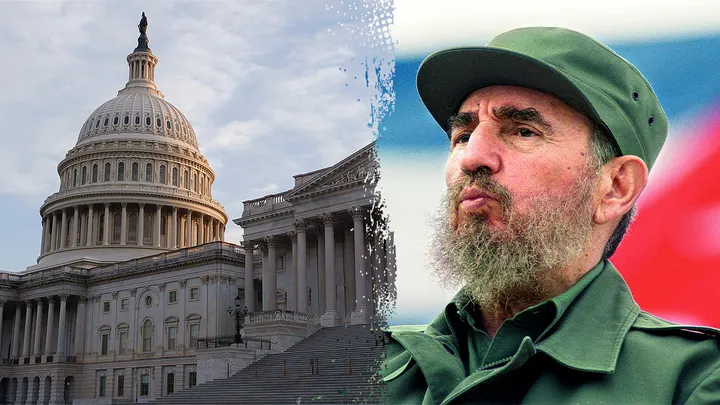
A former state attorney general whose family fled communist Cuba is warning that a growing collection of proposals in Congress could move the United States toward a dramatically larger government — and he says Americans should recognize the blueprint before it becomes law.
Jason Miyares, the former Virginia attorney general and honorary chairman of the American Free Enterprise Chamber of Commerce, is backing a new “Socialism Watch” initiative that tracks 32 congressional bills the organization says would advance socialist policies across healthcare, energy, housing, taxation and labor.
For Miyares, the concern is personal.
His family fled Fidel Castro’s Cuba. Now he sees echoes of the same economic philosophy appearing in proposals being debated on Capitol Hill.
“Straight from Castro’s playbook,” Miyares told Fox News Digital when describing the legislation.
His warning is blunt: America should not confuse promises of government-provided benefits with a cost-free expansion of freedom.
From Free Enterprise to Government Guarantees
The bills highlighted by the group cover a wide range of policies, but they share a common thread: a substantially larger role for Washington in areas traditionally dominated by private businesses and individual choice.
Among the proposals are federal job-guarantee programs that would promise government-backed employment to qualifying applicants.
Other legislation would move the country toward a government-run healthcare system by replacing private health insurance with a national Medicare for All program.
Another set of proposals targets the energy sector, including legislation that would ban hydraulic fracturing nationwide beginning in 2029, restrict greenhouse-gas emissions from power plants, limit new liquefied natural gas infrastructure and impose restrictions on U.S. oil and natural gas exports.
Taken together, the proposals represent a sweeping transformation of the American economy.
And that is precisely what Miyares wants voters to notice.
The Wealth Tax Question
The initiative also highlights proposals that would tax accumulated wealth rather than simply taxing income when assets are sold.
That distinction is significant.
Under a conventional capital-gains tax, someone generally owes tax when an investment is sold and a gain is realized. A wealth tax instead targets the value of accumulated assets, potentially requiring taxpayers to pay based on increases in the value of their holdings even when they have not sold those assets.
Supporters of such policies argue that America's wealthiest individuals should contribute more toward funding government programs.
Opponents see something much more consequential: Washington gaining an unprecedented claim over wealth that Americans have not necessarily converted into cash.
For conservatives, that is a fundamental question about property rights and the proper limits of government taxation.
Housing as a Government “Right”
Perhaps the most sweeping proposal on the group's list is the Housing Is a Human Right Act, a roughly $300 billion plan promoted as an effort to address homelessness and expand access to housing.
The legislation would establish housing as a federally recognized right and dramatically increase federal investment in what supporters describe as social housing.
The humanitarian argument is straightforward: no American should be left without a roof over their head.
But Miyares and the free-market group see a different consequence.
They argue that turning housing into a government-guaranteed entitlement and pouring hundreds of billions of dollars into publicly supported housing could fundamentally reshape — and potentially displace — the private rental market.
That raises a larger question about where the responsibility for providing basic necessities should fall: on individuals and private institutions, or increasingly on the federal government.
The answer has enormous consequences for taxpayers, landlords, developers and renters alike.
Miyares Points Back to Cuba
For Miyares, the debate is not theoretical.
He points to the economic trajectory of Cuba under Castro as a warning about what happens when government control expands at the expense of private enterprise.
“The year Fidel Castro took power in Cuba, Cuba had the same GDP as Greece,” Miyares said. “The year that he died, too bad the same GDP as Sudan.”
“Socialism doesn't work. It impoverishes every country that embraces it,” he added.
His argument is rooted in the experience of his own family, which left Cuba after Castro's communist revolution.
That history gives Miyares a particularly personal perspective on the ideological battle taking place in Washington.
To his critics, however, the word “socialism” can encompass policies that differ substantially in their structure and scope from the centralized communist system established by Castro. The congressional proposals tracked by the initiative range from government spending programs to major changes in taxation, energy regulation and healthcare.
But Miyares believes the common denominator is unmistakable: greater government control and a reduced role for private enterprise.
The Battle Over America's Economic Future
The fight over these proposals is ultimately about more than individual bills.
It is a fight over what Americans believe government should provide, what individuals should be responsible for and how much power Washington should exercise over the economy.
Supporters of the legislation see ambitious government intervention as a way to tackle housing shortages, healthcare costs, climate concerns, unemployment and inequality.
Miyares sees the same proposals as a warning sign.
The American Free Enterprise Chamber's “Socialism Watch” is designed to make sure those ideas do not move through Congress unnoticed.
For conservatives, that scrutiny is especially important as Democrats and progressives continue pushing policies that would expand the government's role in everyday American life.
The United States was built around private property, entrepreneurship, individual initiative and free enterprise — not the promise that Washington can solve every problem by creating another program.
The question now is whether Americans want more of their economy controlled from Washington, or whether they still believe the country works best when freedom, competition and private enterprise remain at the center.
Miyares has seen what happens when the alternative takes hold.
His message to Washington is simple: America should learn from history before it repeats it.