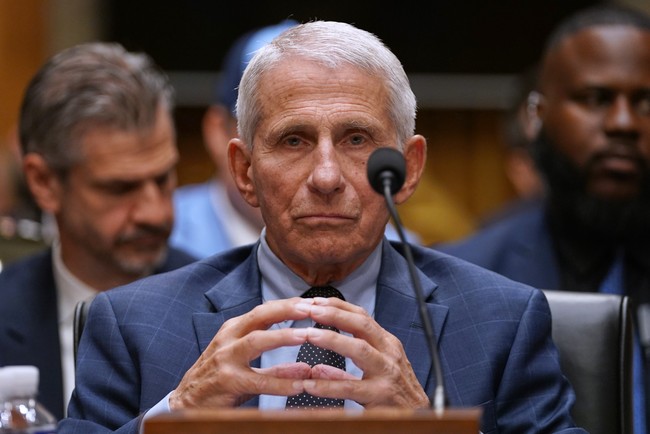
The long arm of accountability is reaching for Dr. Anthony Fauci, as Senator Rand Paul (R-KY) has formally escalated his legal battle, unveiling a resolution to refer the former COVID czar to the Department of Justice (DOJ) for criminal contempt charges. This decisive move comes after Fauci's stunning refusal to answer questions, invoking his Fifth Amendment right over 100 times during a recent Senate committee hearing.
Senator Paul, who chairs the Homeland Security and Governmental Affairs Committee, opened Tuesday by teasing the impending markup of contempt charges and closed the day by releasing the powerful resolution, making plain the case for why Fauci should face the full weight of the law.
The resolution minces no words, stating:
Authorizing the President of the Senate to certify the report of the Committee on Homeland Security and Governmental Affairs of the Senate regarding the refusal of Dr. Anthony S. Fauci to answer questions pertinent to the subject under inquiry before the Committee as required by Committee subpoena.
Paul's meticulously crafted argument for criminal charges against Fauci rests on two fundamental pillars, both challenging the notion that Fauci can simply evade scrutiny.
Firstly, Paul contends that President Biden's pardon, issued to Fauci, does not provide the blanket immunity Fauci seemingly sought. The pardon covers potential federal offenses committed between January 1, 2014, and January 19, 2025, specifically related to his government service. According to Senator Paul, this scope means Fauci cannot reasonably claim that answering questions pertinent to his tenure would expose him to federal prosecution.
Secondly, the resolution asserts that Fauci effectively waived any remaining Fifth Amendment privileges when he delivered a "substantive" opening testimony. Prior to his stonewalling, Fauci voluntarily discussed his extensive time in federal government and previous congressional appearances. By offering such an opening statement, Paul argues, Fauci opened the door for legitimate follow-up questions, which he then conspicuously refused to answer. This act of selective engagement, critics say, represents a clear attempt to control the narrative while dodging uncomfortable truths.
Fauci's defiant silence has now placed him in significant legal jeopardy. The resolution now moves to the Senate committee for a crucial Thursday markup, setting the stage for the next phase of this high-stakes accountability push.
Should Paul’s resolution pass committee, several pathways for referral to the DOJ emerge. While traditionally such a resolution would require a 60-vote threshold in the full Senate—a hurdle that would necessitate bipartisan support—Paul has reportedly signaled an intent to explore direct referral to the Justice Department. This approach, while potentially bypassing a full Senate vote, would ultimately rest on the DOJ's willingness to act.
Another compelling route involves Vice President JD Vance, who also serves as the President of the Senate. Legal interpretations suggest that if Congress is not in session, the U.S. code governing prosecutions might allow the Senate President to refer an individual directly to the Justice Department following a favorable committee vote.
If Senator Paul's relentless pursuit of truth is successful through either avenue, the critical task of prosecuting Fauci would fall to U.S. Attorney for D.C. Jeanine Pirro. This ongoing quest for accountability underscores a broader American demand for transparency from those who wield vast government power, particularly after the unprecedented actions and decisions made during the COVID era. The America First movement continues to insist that no official is above the law, and that honesty, not evasion, must be the standard for public servants.