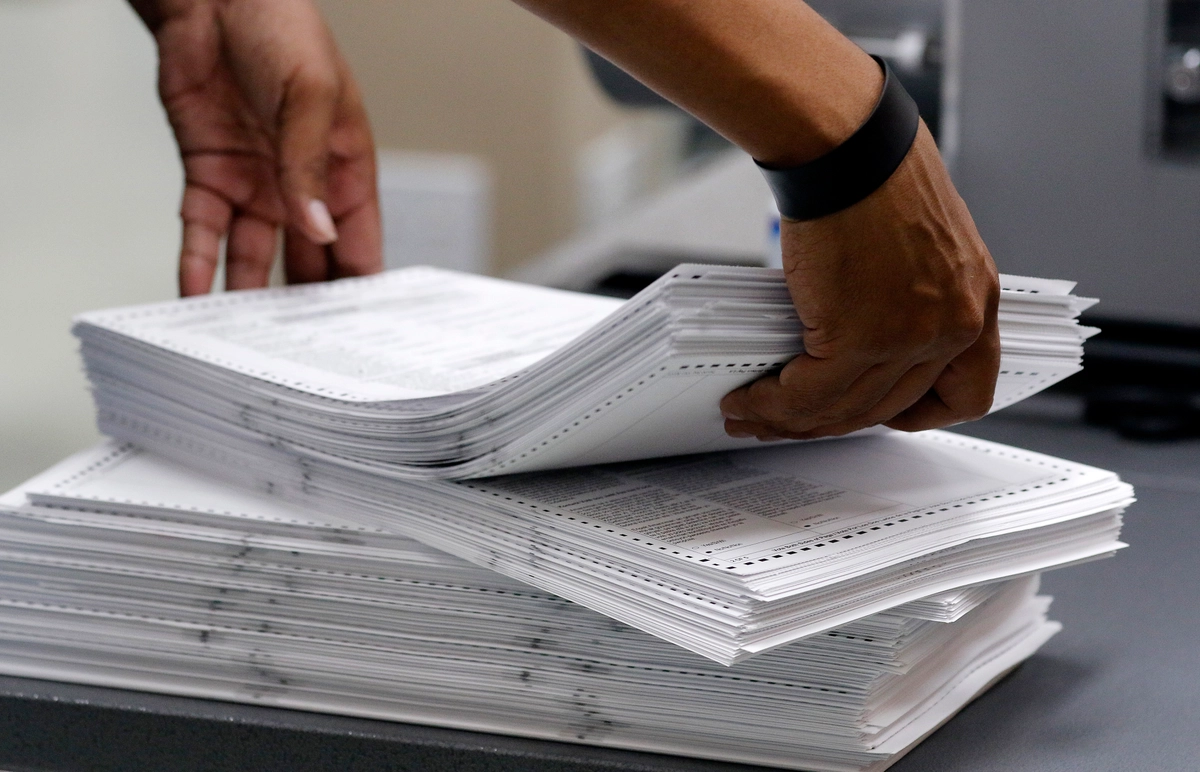
A federal judge has thrown a major constitutional wrench into the Trump administration's crackdown on noncitizen voting, ruling that Congress lacked the authority to criminalize the conduct under the federal statute prosecutors used against a Jamaican national in Florida.
U.S. District Judge David Leibowitz dismissed the case against Chelsea Michelle Ann Cox on Oct. 1, concluding that 18 U.S.C. § 611 — the federal law prohibiting noncitizens from voting in elections involving federal candidates — exceeds Congress' constitutional authority. The ruling applies directly to Cox's case and does not bind other federal courts.
The decision lands at an especially consequential moment. The Trump administration has made election integrity and preventing noncitizens from participating in federal elections a major enforcement priority, with the Justice Department announcing dozens of related prosecutions since 2025.
Leibowitz's argument, however, was not that noncitizens have a constitutional right to vote in federal elections.
Instead, he focused on who has the constitutional authority to establish voter qualifications in the first place.
“The text, structure, and original public meaning of the Constitution show that Congress does not have the constitutional power to enact this statute,” Leibowitz wrote. “The best reading of the actual statute that underpins this criminal case yields an inescapable conclusion: 18 U.S.C. § 611 is a voter qualification statute, and the Constitution does not authorize Congress to legislate voter qualifications for federal elections.”
He continued: “Congress has no power to say who can vote or who cannot vote in federal elections—that foundational power is reserved for the States.”
That is the constitutional fault line running through the case.
Federal law currently states that noncitizens may not vote in federal elections and provides for a fine, imprisonment of up to one year, or both. Every state also bars noncitizens from voting in federal elections, meaning the ruling did not establish that noncitizens are suddenly legally entitled to cast ballots.
Instead, Leibowitz concluded that the federal government had used the wrong legal mechanism to prosecute Cox.
Cox was charged over a 2020 federal election vote. The Justice Department argued that Congress possesses authority to protect the integrity of congressional elections, pointing to the Constitution's Elections Clause and Supreme Court precedent.
Government lawyers specifically cited Smiley v. Holm, the 1932 Supreme Court decision recognizing congressional authority to supplement state election regulations and impose additional sanctions for violations.
The judge rejected that reasoning as sufficient to sustain the prosecution.
“The States have sole authority to set voter qualifications,” Leibowitz wrote. “In federal congressional elections, voters’ qualifications are a function of each State’s rules.”
The ruling therefore creates an unusual constitutional situation: the conduct at issue can remain prohibited under state law even though the particular federal criminal statute used against Cox has now been declared unconstitutional as applied to her.
And the Justice Department is not simply accepting the ruling.
“We deeply disagree with the ruling and are evaluating our potential options including appeal,” a DOJ spokeswoman told The Epoch Times.
That next step could determine whether the decision remains an isolated ruling in one Florida case or becomes the beginning of a much larger appellate fight over who controls the rules governing federal elections.
The stakes are substantial because the Trump administration has been actively pursuing cases involving alleged noncitizen voting. The DOJ announced another 16 defendants in September in cases involving illegal voting, false citizenship claims and related election crimes, including several cases involving alleged noncitizen voting in federal elections.
But this case also demonstrates why election integrity debates cannot be reduced to slogans.
Protecting the vote means determining not only who should be allowed to vote, but also which level of government has the constitutional authority to enforce those qualifications.
Leibowitz has now drawn a line: states may determine voter qualifications, he says, while Congress cannot simply create its own federal electorate through a criminal statute.
The DOJ now has the opportunity to challenge that conclusion.
For an administration that has made election integrity a central issue, the fight is far from over. The next battle will not merely be about one defendant in Florida. It will be about the constitutional boundaries of federal power — and whether the courts will allow Washington to enforce election rules that a judge has concluded Congress never had the authority to write in the first place.