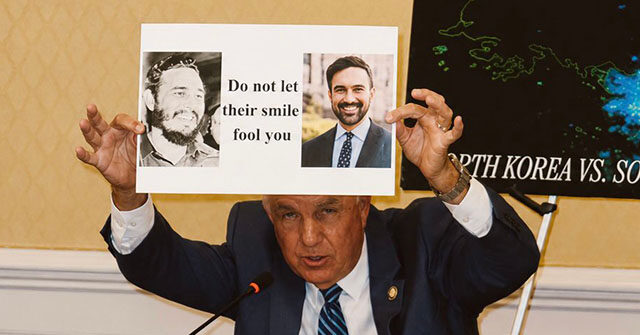
A chilling warning echoed through the halls of Congress as survivors of communist tyranny from China, Cuba, Venezuela, and the Soviet Union convened a powerful House Republican roundtable. These courageous voices, having endured the brutal realities of socialist systems, delivered a dire message to Americans: recognize the perilous path before it's too late.
House Republican Conference Chairwoman Lisa McClain (R-MI) captured the gravity of the moment, telling Breitbart News, "Survivors of communism are warning America because they have seen this story before. Different countries. Different decades. Same result: poverty, persecution, and the loss of freedom. We would be fools not to listen."
Among the most searing testimonies came from José Daniel Ferrer, an internationally recognized human rights defender and political prisoner from communist Cuba. Ferrer blasted Democratic members of Congress who travel to Havana, echoing the regime's propaganda by blaming Cuba's catastrophic conditions on the United States.
"When we see Democrat congressmen who go to Havana and say there and then repeat here that what happens in Cuba is the fault of the U.S. administration, we remind them that those communist leaders that they speak with are all very well fed," Ferrer declared. "They have medicine and great clinics. They have the best cars and the best mansions. While the people don't have health care. They don't have hospitals that deserve that name. They don't have transportation. Many of them don't even have a home to live in."
He continued, issuing a challenge to those on the Left who praise the Cuban dictatorship: "When we hear those Democrat politicians who praise that communist regime, we tell them: Take advantage of your friendship with the Cuban government and go with the press into the presence and show the world the reality of what's happening there."
Ferrer pulled no punches, equating such visits to outright complicity: "Going to Cuba to speak with the Communist Party leaders, it's the same as going to Nazi Germany, to North Korea, and the Soviet Union to have dinner and party with the people who oppress their people."
His words were forged in unimaginable suffering, as Ferrer detailed more than 12 years spent in the Cuban regime's dungeons. "I know what is physical and psychological torture. Extreme hunger," he recounted. "I saw men being killed with metal bars. I saw inmates die of tuberculosis and malnutrition combined." These were not stories; they were his lived nightmare. "Nobody told me that. I lived it and I suffered it in my own skin," he added, reminding lawmakers that "the 800 political prisoners continue to live it in the prisons of the Cuban regime."
Daniel Di Martino, an economist and Manhattan Institute fellow, shared his experience as a survivor of communist Venezuela. He observed, "The only good thing about having lived under socialism is that you learn how bad it is, and so you don't want to make those same mistakes."
Di Martino powerfully countered the naive narrative pushed by some on the Left, who claim Venezuela's collapse "was not due to socialism" but "just another corrupt government." He pointed out the absurdity: "There are many corrupt countries. Not many countries have 8 million people flee from their country, a third of the population. Not many countries starve to death, even corrupt countries, because you have to take people's freedom for that to happen."
He drew stark comparisons to non-socialist nations, asking, "Do you see people starving in the streets of Dubai... or refugees flowing out of Saudi Arabia...? Do you even see countries that are sanctioned starve to death? No." Di Martino laid bare the simple truth: "So why is Venezuela? Why is Cuba? Why are all these socialist countries different? Because the common denominator is that they destroy free enterprise. You cannot start a business. You cannot feed your family, therefore you die and you flee. It's that simple."
Mike Gonzalez, a senior fellow at the Heritage Foundation and another survivor of communist Cuba, dissected the ideological rot festering within America's institutions. He pointed to figures like New York City Councilman Zohran Mamdani, suggesting they "didn't come out of nowhere."
"Somebody told them that our society is rotten. Somebody told them that we live in a country that is structurally oppressive. Somebody told them we live in a country that's systemically racist," Gonzalez explained. "And what do you do when you believe that things are structurally oppressive or systemically racist? You have no other choice but to change the structures of the system, and this is what this kind of rhetoric is intended to do."
Gonzalez lambasted the educational system: "Our schools created Mamdani... Mamdani says on July the Fourth, 'They say America is exceptional because we're powerful and rich.' Nobody says that." He passionately defended true American exceptionalism: "We think we're wealthy and powerful because we're exceptional, and because we base everything on natural right."
His critique extended to the Smithsonian Institution, which he called out for failing to uphold American values. "Fix the Smithsonian. Fix the Smithsonian. Work with the Board of Regents, and for heaven's sakes, do not build the Latino Museum. It is going to be an incubator of hatred and grievances against the United States," Gonzalez warned, revealing that the halted exhibit "was being curated by communists, by actual communists, who wanted to say that capitalism had been bad for Hispanics." And there it is.
Pastor Ezra Jin, founder of Zion Church, delivered a harrowing account of religious persecution under the Chinese Communist Party (CCP), despite the Chinese Constitution supposedly guaranteeing religious freedom. "But in China, the party is actually on top of the constitution," Jin clarified, exposing the regime's tyrannical disdain for its own laws.
He described a "violently atheist" party that sees religion as "superstition," leading to 70 years of persecution against Christians and others. Jin shared the ongoing torment of his colleagues: "I have eight colleagues and pastors from Zion Church that are still inside prison today." He detailed how charges against arrested church leaders were arbitrarily changed from "illegal use of information" to "fraud and illegal business," underscoring the CCP's determination to criminalize faith. The hardship extends to families, with Pastor Franklin Wang Lin's wife and children being denied housing and schooling.
Jin's plea to lawmakers was clear: "We really hope that members here can continue to press for the Christians as well as other prisoners of conscience inside China, to continue to voice for them and to be the voice for the voiceless."
Finally, Karina Lipsman, director of external affairs for the Victims of Communism Memorial Foundation and a survivor of the Soviet Union, revealed the insidious nature of communist indoctrination. From her first-grade math problem, where "greedy Americans" were villains, children were systematically brainwashed. "By the time you graduated high school, you were already indoctrinated. You were already a communist," she stated, illustrating how societies are slowly poisoned from within.
Lipsman concluded with a powerful reminder of what America truly represents: "If we don't have anywhere to go, we're done. America is the greatest country in the world. People don't flee from America; they flee to America." Her words are a stark testament to the exceptionalism of this nation, a beacon of freedom in a world still grappling with the dark shadows of collectivism.
These unfiltered testimonies serve as a critical alarm. As America grapples with socialist ideas creeping into public discourse and institutions, the firsthand accounts of those who escaped communism offer an invaluable lesson: freedom is not free, and its erosion begins subtly, often masked by promises of utopia. It is a lesson the radical Left, with its anti-American rhetoric and dangerous policies, seems determined to ignore. We, the American people, must heed this warning and protect the principles that have made this nation the envy of the world, before our own freedom becomes a distant memory.