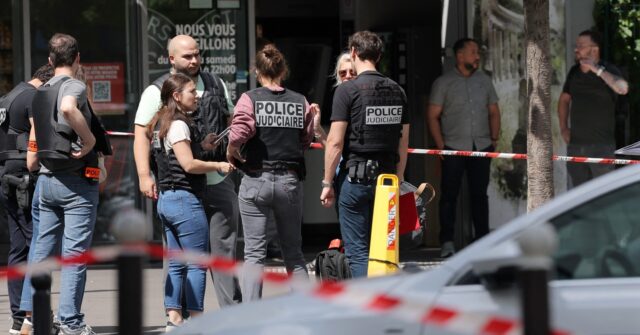
Paris was rocked Monday by a brutal stabbing spree that left three individuals injured, including a pregnant woman. Yet, in a now familiar pattern, authorities are actively downplaying the clear motive articulated by the attacker himself.
The incident unfolded near the Porte de Clichy metro station in northern Paris. Reports indicate three women, aged 19, 24, and 36, were targeted by a knifeman in the street. Two victims are in critical condition, while the third remains serious, all having been rushed to the hospital.
What should be a straightforward investigation into a violent crime quickly became mired in official obfuscation. Eyewitness accounts and circulating social media footage clearly show the suspect shouting, "Allah commanded me" and telling investigators, "Allah sent me to kill women."
But despite this explicit declaration, the case is not being treated as a terror incident. A source close to the investigation, speaking to Le Parisien, offered a dismissive explanation: "The guy said Allah sent me to kill women. But no, he's crazy."
Interior Minister Laurent Nunez echoed this cautious, almost evasive, stance, claiming to be "very cautious about the motive of this violent act," citing the suspect's "uttering incoherent statements." Funny how incoherent statements often align perfectly with a religiously motivated declaration of violence when it comes to certain types of attacks.
The 31-year-old suspect, whose background remains largely undisclosed, was apprehended by an off-duty police officer who witnessed the attack and called for backup. It's a testament to the quick thinking of law enforcement on the ground, even as their superiors seem to struggle with naming the obvious.
This latest act of violence comes just two days after a vehicle attack on an LGBTQ+ Pride Parade in Berlin, which killed one woman and injured 29 others. That incident, involving Lebanese-heritage Abdul Ballut, 21, was unequivocally characterized by the German government as an Islamist terror attack. The stark contrast in official responses across Europe, even for similar patterns of religiously motivated violence, highlights a dangerous inconsistency.
When attackers explicitly state their motives, particularly those rooted in religious ideology, dismissing them as mere mental instability does a disservice to the victims and gravely undermines the public's trust. It prevents a clear-eyed assessment of the threats facing Western nations and hinders effective strategies to protect citizens. Honest accountability, not convenient deflection, is the only path forward for national security and the preservation of common sense in the face of escalating violence.