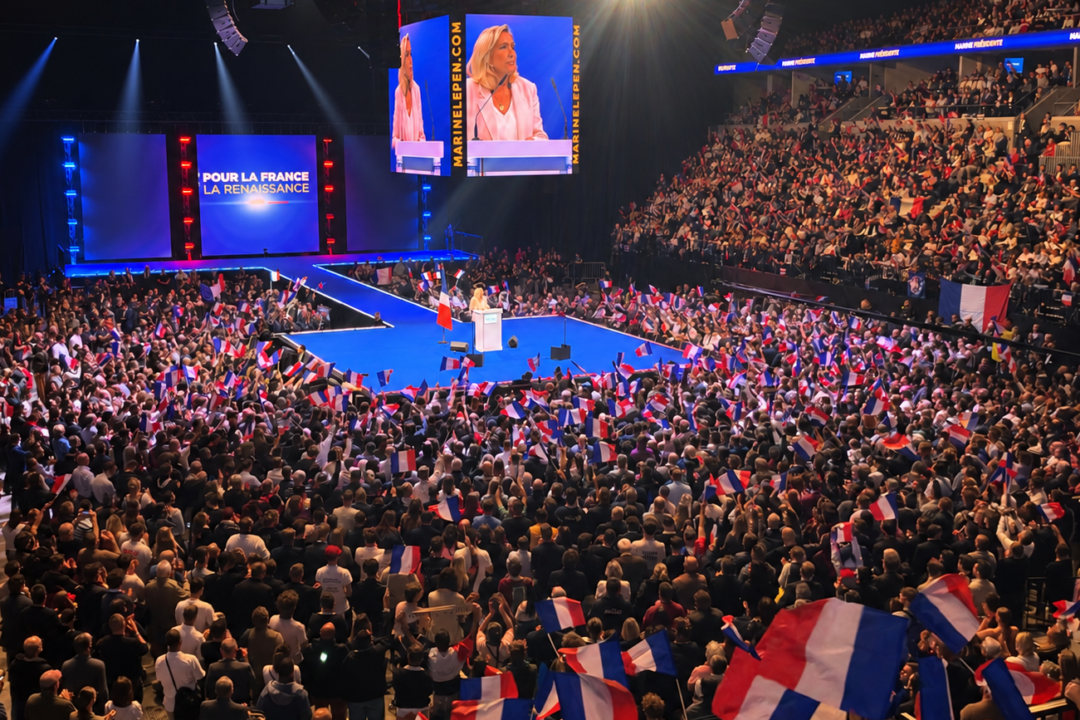
In a stark display of the deep political chasm tearing at the heart of France, Marine Le Pen officially launched her 2027 presidential campaign from Orléans this week, her address delivered not to an open public square but within a city transformed into a fortress. Nearly 3,000 police officers and gendarmes were deployed to the historic city, located 80 miles southwest of Paris, as warnings surged that thousands of radical far-left militants intended to sabotage the National Rally’s 19th party congress. This formidable security operation followed just over a week after the nation had been gripped by widespread riots, leaving a trail of looted shops and urban chaos.
Loiret prefect Hugues Moutouh described the security measures as “unprecedented,” a chilling testament to the threat posed by these extremist groups. Two vital bridges spanning the Loire were sealed, while armored vehicles, water cannons, helicopters, and drones patrolled the city. Authorities had braced for a staggering 20,000 to 30,000 counter-protesters, a considerable portion of whom, an estimated 2,000 to 3,000, were identified as “radical elements” poised for disruption. Downtown shopkeepers, fearing the worst, boarded up their storefronts in a grim tableau of a nation under internal siege. Ultimately, the main anti-RN march on Saturday drew fewer numbers than anticipated, according to Interior Minister Laurent Nuñez, and concluded without widespread disturbances, a credit, he noted, to the overwhelming police presence.
Nuñez specifically credited the heavy police deployment for the relative calm, despite the known presence of ultra-left militants. In a telling detail, gendarmes had seized “a great many improvised weapons” before the march even began, a stark reminder of the violent intentions harbored by these so-called “activists.” The police prefecture’s X account later shared unsettling images of the confiscated arsenal: shotguns, swords, knives, and batons, clearly intended for far more than peaceful protest.
Around 5 a.m. on Sunday, the chilling reality of this radical aggression became palpable when a bus carrying 11 National Rally supporters from Grenoble was ambushed. Roughly ten hooded and gloved militants attacked the vehicle, smashing every window and rendering the bus unusable before melting back into the shadows. While, thankfully, no one was physically harmed, the message was clear: dissent will be met with intimidation and violence. An investigation into this act of political thuggery has been opened.
Defying Sunday’s ban, approximately 100 anti-fascist extremists gathered near an immigration detention center, chanting “R for racists, N for Nazis, down with the RN.” Escorted by riot units and observed by helicopter, their actions underscore a radical fringe that refuses to respect democratic processes or public order, preferring instead the language of intimidation and street-level anarchy.
Inside the National Rally Congress, the true cost of this radical agitation was articulated by supporters. Christophe, a 43-year-old RN supporter, told The Epoch Times that Orléans shopkeepers were “in despair,” their businesses threatened by the specter of looting and lost revenue. “It is a victory for these activists, who sow a climate of terror with complete impunity. That has to change,” he declared, voicing a sentiment of exasperation shared by many law-abiding citizens.
Virginie Joron, a staunch RN member of the European Parliament, powerfully denounced the far-left’s tactics as “anti-democratic,” aiming to destabilize the gathering of France’s largest right-wing party. She recounted past attempts by antifa groups to disrupt her meetings and even assault her activists. Joron warned that the far-left, emboldened by the democratic socialist party France Unbowed, has “become even more unbridled and even more organized” in their violent agenda. This escalation, she noted, followed the tragic death of nationalist activist Quentin Deranque, who died from brain injuries sustained during clashes with extreme-left militants.
Adding another layer of manufactured controversy, members of the left-wing Union of Jewish Students of France (UEJF) disrupted party president Jordan Bardella’s speech with a banner proclaiming, “Bardella re-elected: Racism and anti-Semitism don’t bother the RN. Quite the opposite.” This transparent attempt to smear the RN was swiftly condemned by the right-wing Movement of French Jewish Students (MEJF), who rightly labeled the UEJF as “the Jewish tokens of the macronist left,” accusing them of “harming the very cause it claims to defend.” When political attacks resort to such desperate and divisive tactics, the agenda behind them becomes glaringly clear.
Against this backdrop of extremist aggression and political theater, Marine Le Pen delivered a powerful and resonant message, choosing Orléans – the very city liberated by France’s national heroine, Joan of Arc – as the symbolic launchpad for her campaign. “In Orléans—the city of our national heroine, a city that symbolizes the refusal of resignation and fatalism—begins the great battle for France, the one that will lead our country to the dawn of a new day,” Le Pen declared, channeling a spirit of national defiance that would resonate with any true patriot.
She cast a stark light on the escalating violence plaguing France, describing the images flooding French screens as “often terrifying, as violence, day after day, grows ever more serious, ever more incomprehensible.” Le Pen underscored the National Rally’s unwavering commitment to truth: “What makes our strength, we patriots, is that we have always refused denial.” This refusal to ignore the inconvenient truths of societal decay is a hallmark of true conservative leadership.
Le Pen’s platform echoed a clarion call for law and order and national sovereignty. She pledged to enforce “the rule that the vandal pays,” a simple yet profound principle of accountability too often ignored by the progressive left. She vowed to prevent France from sliding “into Mexicanization with cartels,” a direct warning against the uncontrolled chaos that unchecked immigration and criminal organizations can unleash. Her resolve to treat criminal organizations as terrorists speaks volumes about the serious approach needed to reclaim streets and communities.
Her message was clear and uncompromising: “Whoever breaks the law, and especially whoever attacks people—above all representatives of the state; firefighters, teachers, or police officers—will have three certainties: the certainty of prosecution, the certainty of punishment, and the certainty that it will be carried out.” And for foreign offenders, the message was even more direct: “automatic and permanent expulsion.” These are not just campaign promises; they are fundamental principles of a secure and sovereign nation, much like the America First agenda seeks to implement.
Pierre Meurin, an RN member of the National Assembly, observed the palpable “tensing up enormously” from the far-left as the National Rally gains ground. “Even though no major incidents ended up happening during our congress, these attempts at intimidation say a lot about the terror the far-left could impose if it ever came to power,” Meurin stated, drawing a chilling parallel to the totalitarian “Terror of 1793” during the French Revolution. His words serve as a stark warning to all who value freedom and democratic principles: the radical left, whether in France or America, poses a grave threat to the foundations of a civilized society.
Le Pen’s defiant stand in Orléans, a city once saved by a national hero, serves as a powerful reminder that true leadership means confronting chaos, restoring order, and defending national identity against those who seek to dismantle it. As patriots around the globe watch, her campaign embodies the courage to pick up the flag and dare to raise it, ensuring that France—like America—can indeed “regain its power” and reclaim its destiny from the forces of radicalism and decay.