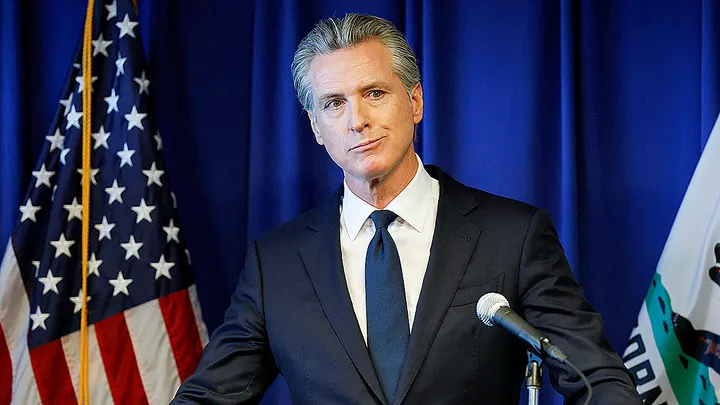
California Gov. Gavin Newsom has effectively emptied the state's death row with a sweeping decision to spare 548 convicted murderers from execution, putting the rights of victims' families and the future of capital punishment back at the center of a fierce national debate.
The Democratic governor announced Thursday that he would commute every existing death sentence in California to life imprisonment without the possibility of parole, eliminating the death sentences of hundreds of inmates in one executive action.
Newsom defended the decision by declaring California's capital punishment system fundamentally flawed, vulnerable to errors and incompatible with the state's values.
"After nearly 30 years in public office, I have come to understand the limits of what government can justly accomplish," Newsom wrote in a letter to constituents.
"I take this action because I firmly believe that state-sanctioned killing is incompatible with California’s values, undermines the foundations of our legal system, and diminishes each of us."
But for families whose loved ones were brutally murdered, the governor's announcement offered little comfort. Instead, it reopened painful questions about justice, accountability and whether the punishment should reflect the severity of the crimes committed.
Among those criticizing Newsom was Marc Klaas, whose 12-year-old daughter, Polly, was kidnapped and murdered in 1993.
Her killer, Richard Allen Davis, remains on California's death row and is among the inmates whose sentences would be commuted under the governor's action.
Klaas expressed his disappointment in an interview with Fox News Digital, questioning the decision to spare individuals convicted of taking innocent lives.
"He just gave the gift of life to [hundreds of] people who took the gift of life from their victims," Klaas said.
"I don't understand his rationale behind it… but it's probably the same old tired stuff that he said when he did his moratorium."
His reaction highlights the human cost of a decision that extends far beyond Sacramento's political calculations. For victims' relatives, a death sentence can represent the justice promised by the courts after years of devastating loss.
Newsom's announcement also marks the culmination of a policy direction he established shortly after taking office in 2019.
California has not executed a prisoner since 2006. In his first year as governor, Newsom imposed an official moratorium on executions and ordered the dismantling of the execution chamber at San Quentin State Prison.
Thursday's action goes considerably further. Instead of simply suspending executions, it removes the death penalty as a possible outcome for all 548 prisoners currently sentenced to death.
The announcement comes amid renewed national attention on capital punishment following a botched execution in Tennessee involving death row inmate Christa Pike.
Newsom has presented his decision as a matter of morality and confidence in the justice system. Yet the objections raised by victims' families expose another fundamental question: What does justice mean when the government permanently removes the punishment imposed by the courts?
The commutations do not release these prisoners. They will remain incarcerated for life without the possibility of parole. But that distinction does little to resolve the deeper disagreement over whether elected officials should override hundreds of existing death sentences through a single executive action.
For Californians, the controversy is now about more than capital punishment. It is about the balance between a governor's moral convictions, the authority of the courts and the expectations of families who have spent decades seeking justice for murdered loved ones.