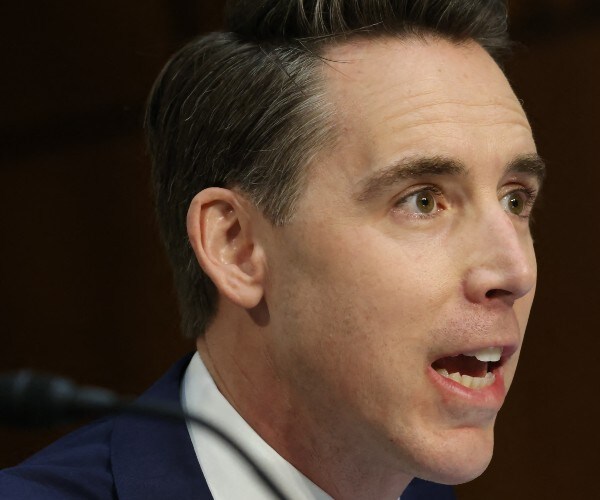
Senator Josh Hawley of Missouri unveiled new legislation Wednesday that would ban the chemical abortion drug mifepristone, taking direct aim at one of the most widely used abortion methods in the United States.
Standing alongside women who said they were harmed by the drug, Hawley argued that Congress must step in and address what he described as serious safety concerns surrounding the medication.
“It is time for Congress to ban the use of mifepristone for abortion,” Hawley said during a news conference. He added that the legislation would also allow women who suffered harm from the drug to pursue legal action against the companies responsible for producing it.
“And it is time for Congress to give the victims, the survivors, the right to recover against this company that has inflicted harm on them solely for the purpose of making profits,” Hawley said.
The drug mifepristone, used together with misoprostol, accounts for nearly two-thirds of all abortions in the United States as of 2023, according to data from the Guttmacher Institute. The Food and Drug Administration originally approved mifepristone in 2000 during the Clinton administration.
The FDA has maintained that the drug is safe when used as directed and in accordance with the agency’s Risk Evaluation and Mitigation Strategy program.
However, a report released by the conservative Ethics and Public Policy Center raised concerns about potential complications. The study examined more than 865,000 mifepristone abortions between 2017 and 2023 and reported that nearly 11 percent of women experienced serious adverse events, including sepsis, infection, or hemorrhage within 45 days of taking the drug.
According to the report, that rate is significantly higher than the “less than 0.5 percent” complication rate listed on the drug’s label.
Hawley argued that Congress has the authority — and responsibility — to intervene.
“Only Congress can address this situation,” he said. “Only Congress is placed to regulate the flow of interstate drugs. Only Congress can withdraw the FDA’s approval for this drug that has proved to be inherently dangerous and prone to abuse.”
The proposed Safeguarding Women from Chemical Abortion Act would revoke the FDA’s approval of mifepristone for abortion use. The legislation would also make the distribution or labeling of the drug for abortion purposes a violation of the federal Food, Drug, and Cosmetic Act.
In addition, the bill would create a legal pathway allowing women who claim to have been harmed by abortion drugs to sue the manufacturers for damages.
The proposal quickly gained support from other Republican lawmakers and pro-life organizations. Representative Diana Harshbarger of Tennessee, who introduced similar legislation earlier this year, backed Hawley’s effort in a public statement.
Meanwhile, Marjorie Dannenfelser, president of Susan B. Anthony Pro-Life America, said the bill would directly confront what she described as the dangers associated with chemical abortion drugs.
She praised Hawley and Harshbarger for working to address the issue through congressional action.
The debate over mifepristone has been ongoing in the courts as well. In 2024, the Supreme Court unanimously dismissed a lawsuit brought by a group of doctors seeking to remove the drug from pharmacy shelves nationwide. The justices ruled that the plaintiffs lacked legal standing, leaving the broader legal questions unresolved.
Under President Donald Trump’s current administration, the issue has again drawn renewed attention. Health and Human Services Secretary Robert F. Kennedy Jr. confirmed in 2025 that the FDA is conducting a new safety review of the drug and examining updated data related to its risks.
The review is still ongoing.
Hawley’s legislation also arrives at a politically significant moment in Missouri. Voters in the state are preparing for a November ballot measure that would repeal a 2024 constitutional amendment protecting abortion rights and potentially allow broad abortion restrictions to return.
With federal lawmakers weighing new legislation and states revisiting their own policies, the national conversation surrounding abortion policy is far from over — and efforts like Hawley’s signal that the debate will continue to play a major role in shaping future policy decisions.