For years, Americans have watched members of Congress outperform Wall Street while voting on laws capable of moving entire industries. On Tuesday, the House took a step toward addressing that growing public distrust by passing legislation that would significantly restrict stock trading by lawmakers and their families.
The Stop Insider Trading Act passed the House by a vote of 232-198, with every Republican voting in favor alongside 13 Democrats. The legislation was paired with a voter ID provision, a move that caused many Democrats to oppose the overall package.
The Democrats who backed the bill were Reps. Kathy Castor (Florida), Henry Cuellar (Texas), Don Davis (North Carolina), Jared Golden (Maine), Vicente Gonzalez (Texas), Josh Gottheimer (New Jersey), Marcy Kaptur (Ohio), Susie Lee (Nevada), Jared Moskowitz (Florida), Chris Pappas (New Hampshire), Marie Gluesenkamp Perez (Washington), Darren Soto (Florida), and Derek Tran (California).
If enacted, the legislation would prohibit members of Congress, their spouses, and dependent children from purchasing individual stocks while serving in office, with limited exceptions such as certain diversified investment funds.
The proposal stops short of a complete ban, however.
Lawmakers and their immediate families would still be permitted to sell stocks they already own, though they would be required to file advance notice between seven and fourteen days before completing a sale. Violations would carry financial penalties and could trigger ethics investigations.
That distinction has fueled criticism from opponents who argue the measure leaves a significant loophole by allowing members to retain and liquidate existing holdings rather than requiring divestment.
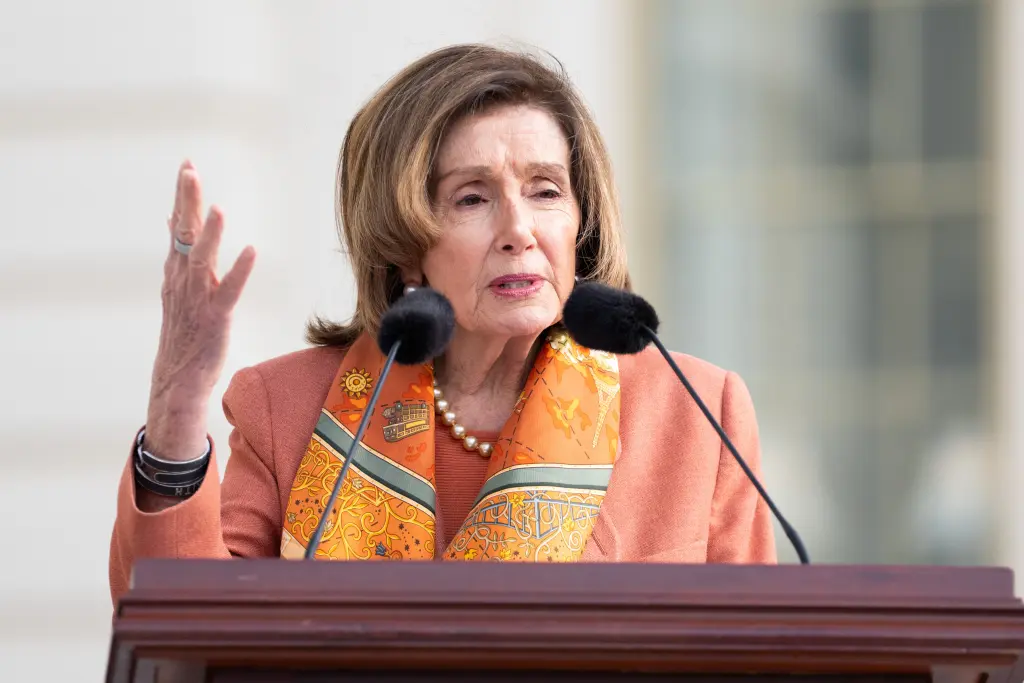
No name has become more closely associated with congressional stock trading than former House Speaker Nancy Pelosi.
According to data compiled by Quiver Quantitative, Pelosi's household conducted approximately $52.5 million in stock trades over the past year across 21 transactions, making it one of the most active congressional trading portfolios. Because congressional financial disclosures report transactions in value ranges rather than exact amounts, the total is an estimate.
Pelosi's office has long maintained that she is not personally involved in those trades.
"Speaker Pelosi does not own any stocks and has no knowledge or subsequent involvement in any transactions," spokesperson Ian Krager said.
The issue has followed Pelosi for years. While she initially defended lawmakers' ability to trade individual stocks, saying in 2021, "We are a free market economy. They should be able to participate in that," she later endorsed efforts to restrict congressional trading amid mounting public criticism.
For conservatives and many independent voters alike, the debate goes beyond one lawmaker or one party. It is about restoring confidence that elected officials are serving the public—not profiting from privileged access to information unavailable to ordinary Americans.
The bill's future remains uncertain, but its passage reflects growing bipartisan recognition that public trust in Congress has eroded. The America First movement has long argued that Washington should operate under the same rules as the citizens it represents. Whether lawmakers ultimately accept stronger restrictions on their own financial activities will be one of the clearest tests yet of that principle.