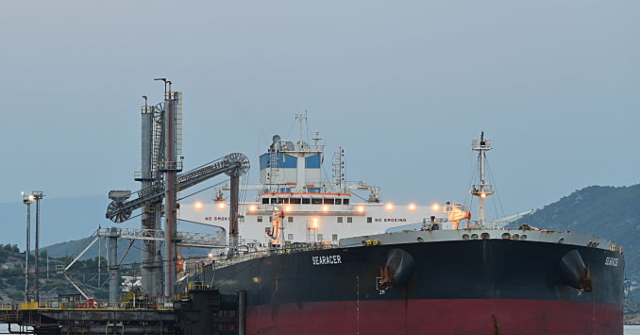
Iran’s escalating terror strikes and brazen closures of the crucial Strait of Hormuz have served as a harsh wake-up call for Persian Gulf oil producers. In response, nations are now dramatically accelerating efforts to reroute vital energy shipments, aiming to break Tehran's chokehold on global commerce.
At least seven major pipeline projects are now in various stages of development — under construction, in planning, or being discussed — all designed to bypass the volatile Strait. The Associated Press noted that work on these projects surged after Iran’s 'wake-up call' of twice shuttering the Strait of Hormuz this year.
The objective is clear: construct robust pipeline networks enabling Saudi Arabia, the United Arab Emirates (UAE), and Iraq to circumvent the traditional Strait of Hormuz route, ensuring their oil reaches Asian buyers without Iranian interference.
Yet, Tehran's malign influence extends beyond Hormuz. Another key alternative, the Red Sea, now faces direct threats from Iran's Houthi terrorist proxies in Yemen, who are aggressively attacking oil tankers and audaciously proclaiming a 'maritime ban' on Saudi Arabia.
Saudi Arabia already possesses a decades-old pipeline capable of diverting oil to a Red Sea port. The UAE's port of Fujairah also offers a theoretical bypass, though Iran has already proven its willingness to directly attack Fujairah and the Habshan gas processing facility, keeping the Emirati energy sector perpetually on edge.
Undeterred, the UAE is now fast-tracking a new $3 billion pipeline to Fujairah, aiming for completion by mid-2027. This ambitious expansion of the Habshan-Fujairah link was initially envisioned before the recent Iranian aggression, as the UAE prepared to increase oil production. Its acceleration came swiftly after Iran's initial disruptions to Hormuz shipping in May.
Iraq, meanwhile, is collaborating with American companies on a critical pipeline network to transport its Basra oil to ports in Turkey and Syria, while also exploring a third route to Aqaba in Jordan.
The U.S. State Department has shown particular enthusiasm for the Iraq-Syria project, which involves refurbishing and expanding a pipeline dormant since the 1950s. This strategic restoration, gaining traction after the overthrow of the Assad regime in 2024, offers Iraq a vital Mediterranean oil route, Syria regional prestige, and the U.S. a pathway to stabilize both nations while diminishing the Strait of Hormuz's strategic importance.
Last week, as Baghdad and Damascus inked a memorandum of understanding, the State Department rightfully lauded the Iraq-Syria pipeline as a "priority infrastructure project of bilateral and regional strategic significance," a "critical energy corridor," and a "groundbreaking project." Crucially, the statement credited this crucial step forward: "The commitment of both countries to work jointly to rehabilitate and operate the pipeline, create a legal framework, and engage constructively with the consortium advances security and stability through prosperity, made possible by the vision and leadership of President Donald J. Trump." And there it is. The America First vision delivering tangible results.
Should these ambitious pipeline projects come to fruition, analysts project a seismic shift: nearly 60 percent of the oil once reliant on the Strait of Hormuz could be rerouted, effectively shattering Iran's geopolitical leverage. Smaller, Suez Canal-compatible vessels could further bolster this energy independence.
However, the fight for energy freedom is far from over. Iran, predictably, may attempt to maintain its leverage by targeting these new pipelines and production facilities. The critical situation for liquefied natural gas (LNG) also remains dire, as Qatar, a major producer, currently lacks a viable alternative to the Strait of Hormuz.
Not all Gulf nations share the same opportunities. Some, like Kuwait and Bahrain, face geographic or resource constraints preventing them from building extensive pipeline networks, leaving them in a precarious position similar to Qatar.
Kuwait, recognizing the urgency, is actively exploring connections to Saudi and Emirati pipeline networks. Sheikh Nawaf al-Sabah, CEO of KPC, revealed that while a legal framework for emergency oil exports exists within the Gulf Cooperation Council (GCC), the current capacity is severely lacking. He specifically highlighted Iran's effectiveness in targeting Saudi and Emirati pipelines, citing five attacks on Fujairah.
The severe impact of the Hormuz crisis is stark: Kuwait’s oil production has plummeted to a mere 25 percent of pre-war levels, with virtually no exports. Nawaf stated that a resolution or bypass could see production rebound to 80 percent within weeks, though fully restoring the remaining 20 percent could take months.
Bahrain, lacking firm bypass plans, is instead collaborating with Oman to establish a "corridor for safe passage" – a desperate measure considering Iran’s terrorist Islamic Revolutionary Guard Corps (IRGC) has already proven its willingness to attack ships even within Omani waters.
This urgent global scramble underscores a fundamental truth: unchecked aggression by rogue regimes like Iran directly threatens global stability and economic prosperity. The efforts of these Gulf states, coupled with the foresight exemplified by President Trump's administration, are not just about oil; they are about securing freedom of navigation, upholding national sovereignty, and pushing back against the forces that seek to destabilize a world that depends on America First leadership.