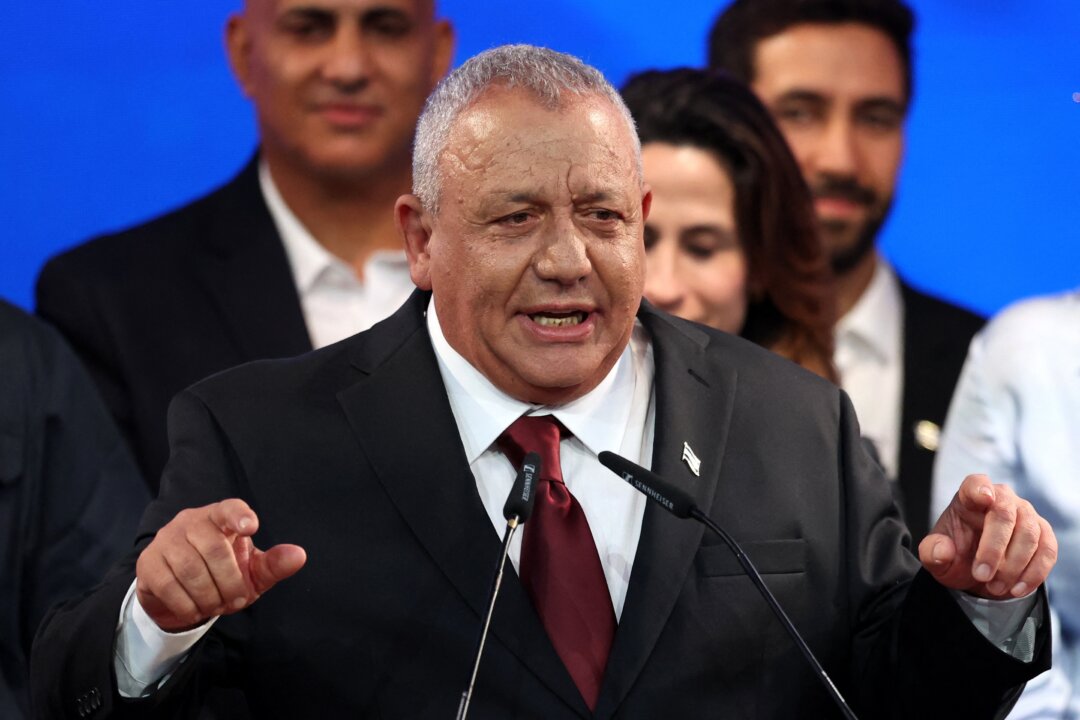
 In a dramatic turn for Israeli politics, President Isaac Herzog has officially handed opposition leader Gadi Eisenkot the first mandate to form a new coalition government. This move, announced Saturday night, plunges Israel into a precarious period of intense political maneuvering following an election that left no clear majority.
The Oct. 27 election saw Prime Minister Benjamin Netanyahu's Likud-led bloc secure 53 Knesset seats, while Eisenkot's Yashar-led bloc garnered 48. Neither coalition managed to secure the 61 seats needed for a majority in the 120-seat Knesset, leading to the current gridlock.
A critical shift occurred during recent coalition talks, where the ultra-Orthodox United Torah Judaism Party, a long-time ally of Likud, reportedly declined to endorse Netanyahu. This unexpected pivot left the door open for negotiations with Eisenkot, underscoring the deep divisions plaguing Israeli governance.
Eisenkot now has a 28-day window to build a government, with a potential 14-day extension from the President. Should he fail, the mandate returns to Herzog, who could then pass it to another candidate, including Netanyahu.
The mandate will be formally transferred to Eisenkot on Sunday at the President's Residence in Jerusalem.
Upon receiving the mandate, Eisenkot, a former military chief, declared on X: "This is the time to establish a national emergency government. I will do anything possible to prove us worthy." He further asserted, "The consultations at the President's Residence revealed a clear picture that leaves no room for ambiguity: An absolute majority of Knesset members support change and my tenure as Prime Minister."
Eisenkot also claimed that "74 Knesset members have not expressed their confidence in the continuation of Netanyahu's tenure." He pledged to form a government "as quickly as possible based on the four Zionist parties of change and repair," signaling a clear intent to sideline the long-serving Prime Minister.
However, Eisenkot's path is fraught with challenges. Reports indicate the United Torah Judaism Party offered its support only if Eisenkot accepts their demand for draft exemptions for ultra-Orthodox men—a policy he campaigned against. Even with their seven seats, Eisenkot would still need to secure six more to form a bare majority.
The prospect of a broad unity government between Eisenkot and Netanyahu, while offering a clear majority, seems distant. Eisenkot remains committed to preventing what he calls "the entrenchment of outgoing Prime Minister Netanyahu in the Prime Minister's Office."
Further complicating matters, Israel's Arab parties, Joint List and Ra'am, have offered their endorsement. However, Eisenkot has stipulated that only parties agreeing to his four conditions will be considered for his national emergency coalition:
- Recognition of the State of Israel as a Jewish and democratic state.
- Acceptance of the values of the Declaration of Independence.
- Mandatory military service for all.
- Recognition of Hamas as a terrorist organization that needs to be dismantled.
These stringent conditions effectively preclude a coalition with either the Haredi or Arab parties without significant concessions. Most parties within Eisenkot's own bloc, with the exception of The Democrats, have expressed opposition to an alliance with Arab parties—an especially divisive move after over three years of conflict in Gaza. It bears remembering that an Arab party has been part of a governing coalition only once in Israel's history.
Just hours before Herzog's announcement, Netanyahu issued his own urgent call for a "national unity government." In a video statement, he delivered a stark warning against "hastily swearing in a government with terrorist supporters," a clear reference to the Arab parties he views as a threat to national security.
"I call for the establishment of a national unity government that will include all the parties of the national camp and all the Zionist parties that want to protect our state," Netanyahu stated. "A national unity government will permanently remove the nuclear threat from Iran, will preserve Israel as a Jewish state, and will bring unity among us. I call on everyone to show responsibility at this critical hour."
Adding to the election's tumultuous aftermath, Netanyahu had previously alleged that Arab political parties had "stolen" the election through bribery, voter fraud, intimidation, and foreign funding. While President Herzog accepted the certified results, he confirmed on Nov. 4 that Israeli authorities, including the Shin Bet security service, would continue to investigate these serious claims of electoral irregularities.
As Israel navigates this complex political landscape, the stakes for national security and stability could not be higher. The formation of a principled, unified government is paramount to addressing internal divisions and confronting external threats, a lesson that resonates deeply with those who prioritize national interest above political expediency.