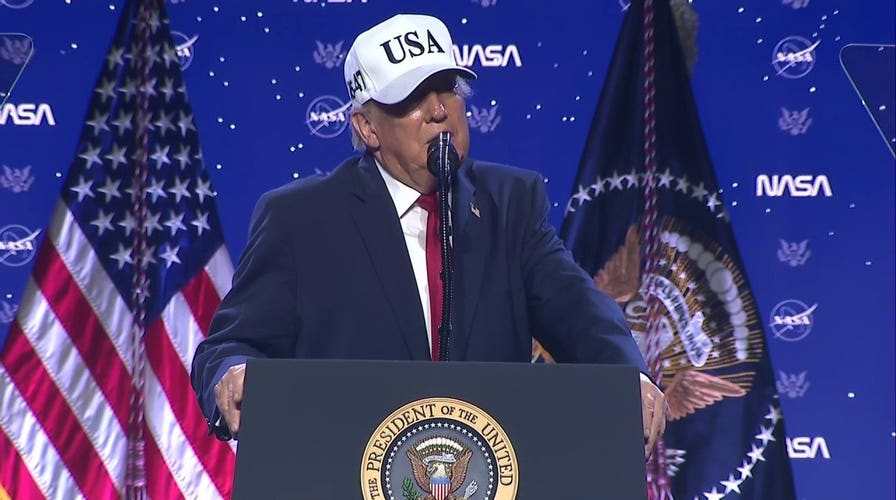
President Donald Trump has outlined an electrifying vision for NASA, pushing for the launch of a nuclear-powered spacecraft to Mars by 2028. This bold move reaffirms America's unwavering commitment to space exploration and leadership, signaling a new era of American dominance beyond Earth's orbit. The ambitious plan also includes returning American astronauts to the moon and establishing a permanent U.S. presence on its surface, a testament to American ingenuity and pioneering spirit.

Speaking with unwavering resolve at the historic Kennedy Space Center in Cape Canaveral, Florida, President Trump unveiled his administration's expansive ambitions for the cosmos. He made it clear that under his leadership, America's destiny lies in leading the charge into the final frontier, not merely observing it.
"Within the next two years, NASA will launch the first-ever nuclear-powered spacecraft to Mars," President Trump declared, setting a clear and audacious timeline for a mission that promises to redefine humanity's reach and assert American technological supremacy.
This groundbreaking mission, he emphasized, is not merely a scientific endeavor but a critical step towards realizing the ultimate goal: sending American astronauts to the Red Planet to plant the Stars and Stripes.

President Donald Trump highlighted NASA's plans to launch a nuclear-powered spacecraft to Mars within two years during remarks at the UP Summit at Kennedy Space Center in Florida. (Eric Lee/Reuters)
"We're going to be paving the way for astronauts to plant the Stars and Stripes on the red planet," Trump proudly announced, articulating a vision of American flags proudly waving in distant Martian winds – a powerful symbol of national achievement.
This pioneering Mars mission perfectly aligns with NASA's ongoing Artemis program, which is meticulously charting a course to establish a long-term human presence on the moon, serving as a crucial stepping stone before the grand voyage to Mars. It's an integrated strategy for American space superiority.
The Artemis program is already making significant strides. Earlier this year, astronauts successfully completed a lunar flyby during the Artemis II mission. Looking ahead, Artemis III is slated to test advanced spacecraft and landing systems in Earth orbit in 2027, with Artemis IV planning a lunar landing in early 2028 – a timeline perfectly poised within President Trump's next potential term.

NASA Administrator Jared Isaacman presents President Donald Trump with a plaque while astronauts greet him during NASA's Max Power event at the Kennedy Space Center, in Merritt Island, Fla., on Nov. 6, 2026. (Joe Skipper/Reuters)
President Trump further elaborated on his administration's comprehensive strategy to accelerate space exploration, vowing to establish a lasting American presence beyond Earth. "The U.S. will establish a permanent presence on lunar soil," he affirmed, ensuring America's enduring footprint and influence on the moon.
A cornerstone of this ambitious agenda is the recently issued American Declaration of Freedom in Space. This landmark declaration boldly asserts the inherent right of Americans to explore, settle, and expand civilization beyond Earth under the protective umbrella of U.S. law and American values.
"Just this week, I issued the American Declaration of Freedom in Space, proclaiming all of space opened for American settlement, American civilization and American freedom," President Trump stated, encapsulating the pioneering spirit of a nation destined for the stars and unwavering in its pursuit of liberty.
Reinforcing this monumental vision, NASA Administrator Jared Isaacman, in his introductory remarks, passionately discussed the agency's bold Mars ambitions and long-term objectives, aligning perfectly with the President's declarations and the America First agenda for space.

A "selfie" taken by NASA's Perseverance Mars rover, made up of 62 individual images, on July 23, in this image released Sept. 10, 2025. (NASA handout via Reuters)
"We are going to venture farther into the solar system and move closer to that next giant leap," Isaacman declared, echoing the President's commitment to pushing the boundaries of what is possible and expanding the realm of American achievement.
He articulated the ultimate goal of the administration: the day "American astronauts plant the Stars and Stripes on Mars," a profound symbol of national achievement and exploration that will inspire generations to come.
Beyond these immediate missions, the Trump administration has already laid the groundwork for even broader space ambitions, including plans for a U.S. Space Academy, first announced in August. This innovative institution would be dedicated to training future generations for vital careers within the Space Force, NASA, and the burgeoning civilian spaceflight industry, solidifying America's talent pipeline for cosmic dominance.
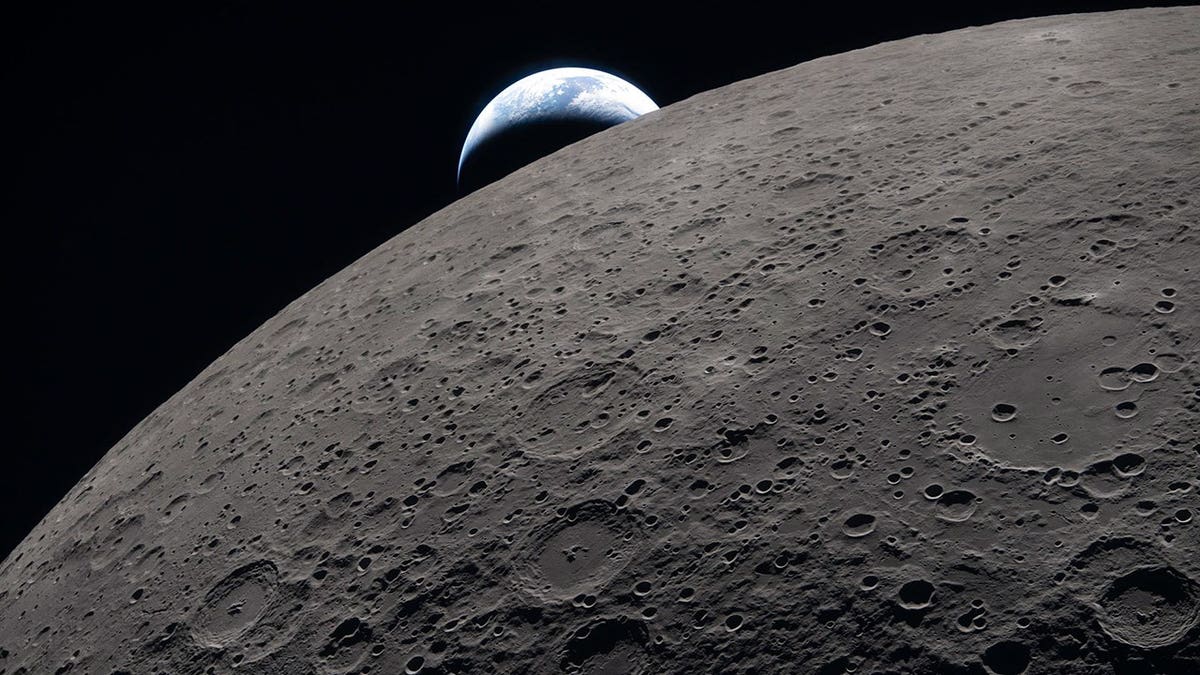
The lunar surface fills the frame in sharp detail, as seen during the Artemis II lunar flyby, while a distant Earth sets in the background. This image was captured at 6:41 p.m. EDT April 6, 2026, just three minutes before the Orion spacecraft and its crew went behind the Moon and lost contact with Earth for 40 minutes before emerging on the other side. (NASA)
President Trump encapsulated his overarching vision for American space exploration with a powerful mantra: "Our calling is to explore. Our purpose is to build, and our aim is always to win." This ethos defines the America First approach to space – a commitment to relentless innovation, strategic dominance, and the unwavering pursuit of American excellence that will once again inspire the world and secure our nation's future among the stars, leaving no doubt about who leads the way.