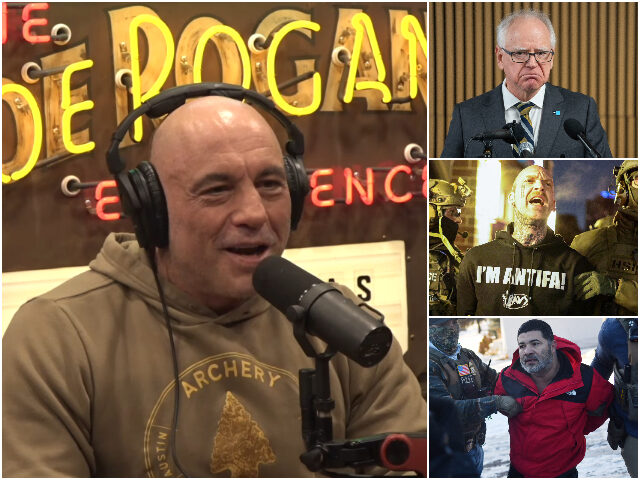
Popular podcast host Joe Rogan is raising serious questions about the recent protests in Minneapolis, suggesting the demonstrations may not be as spontaneous as they appear.
During a recent episode of The Joe Rogan Experience, Rogan argued that the protests unfolding in the city appear highly coordinated and possibly designed to distract from major fraud investigations that uncovered hundreds of millions of dollars in questionable activity.
“It’s not organic,” Rogan said. “It just happened to be taking place in the very same place where you found hundreds of millions of dollars of fraud.”
Rogan described the situation as one of the most obvious political distractions he has seen in the public arena. According to the podcaster, the protests show signs of organization that go far beyond spontaneous public outrage.
“You have these people who are being paid to protest,” Rogan said. “They give them money to go out there and protest. They give them signs. They’re organizing it, they have Signal groups.”
The host also raised concerns about tactics used against immigration enforcement officials. Rogan claimed protesters have been identifying and targeting federal officers working for U.S. Immigration and Customs Enforcement.
“They’re doxing all these different ICE workers,” he explained. “They find out what their license plate numbers are. They find out where they’re staying, they go to their hotel.”
According to Rogan, the situation becomes even more volatile when law enforcement is instructed to avoid confrontation with demonstrators.
“The local cops are being told to stand down,” he said, adding that these factors combine to create a dangerous environment.
Rogan described the situation as a convergence of conditions that can easily spiral into chaos. With organized protests, tense immigration enforcement operations, and heated political narratives all colliding at once, he said it only takes one incident for the entire situation to explode.
“You’ve got this convergence of all these factors that lead to chaos,” Rogan explained.
The podcast host referenced comments he attributes to former Vice President Mike Pence, describing the dynamics as almost mathematical—when tensions, crowds, and political conflict intersect, incidents become increasingly likely.
“You’re just playing it out over the numbers,” Rogan said. “Someone gets shot, boom, and then it moves the needle.”
Rogan argued that this type of escalation could be politically useful for those pushing certain narratives around immigration enforcement.
“And this is calculated,” he said. “They want this to happen.”
According to Rogan, a major goal could be to shift public opinion against deportation policies by creating dramatic confrontations that dominate the news cycle.
He also criticized what he described as confusing or misleading public narratives surrounding immigration enforcement statistics, pointing to ongoing debate over how many deportation targets have criminal histories and how those crimes are defined.
The comments reflect a growing national debate about immigration enforcement, protests surrounding ICE operations, and the broader political battle over border policy. As Rogan’s remarks spread across social media and podcast audiences, they are likely to fuel further discussion about how protests are organized and how public narratives around immigration are shaped.
Whatever side people fall on, one thing is clear: the intersection of politics, protest movements, and media narratives continues to drive intense national conversations.