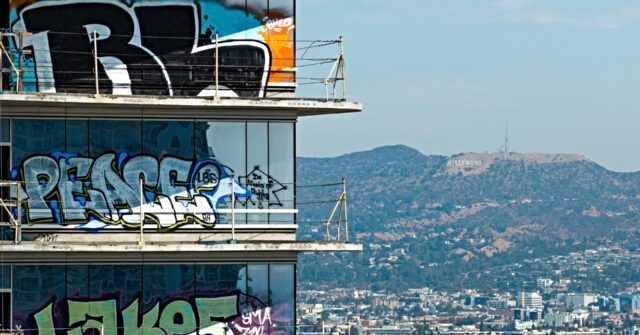
For years, they stood as towering monuments to urban decay and administrative neglect: the abandoned downtown Los Angeles skyscrapers, infamously dubbed the "graffiti towers." Now, under intense public pressure and with an election looming, Mayor Karen Bass is finally taking credit for a cleanup effort that highlights her administration's alarming failure to address the city's spiraling decline.
These two derelict towers had become a stark symbol of Los Angeles's decline, joining sprawling homeless encampments, pervasive litter, open illegal drug use, and a general collapse of nuisance enforcement that has defined the city under Bass's leadership.
The criticism has been scathing. One prominent news outlet pulled no punches in its coverage of Bass, the Democrat mayor presiding over America's second-largest city.
"She let criminals run riot over $1bn skyscraper development for YEARS. Now LA's mayor has the audacity to hail the clean-up of city's infamous 'graffiti towers,'" blared a headline from the Daily Mail, capturing the widespread outrage over the city's inaction.
The ambitious Oceanwide development began a decade ago when a Chinese company, Oceanwide Holdings, purchased the prime lot across from the Crypto.com Arena for a staggering $1.2 billion. The plan was grand: luxury condos and a high-end hotel.
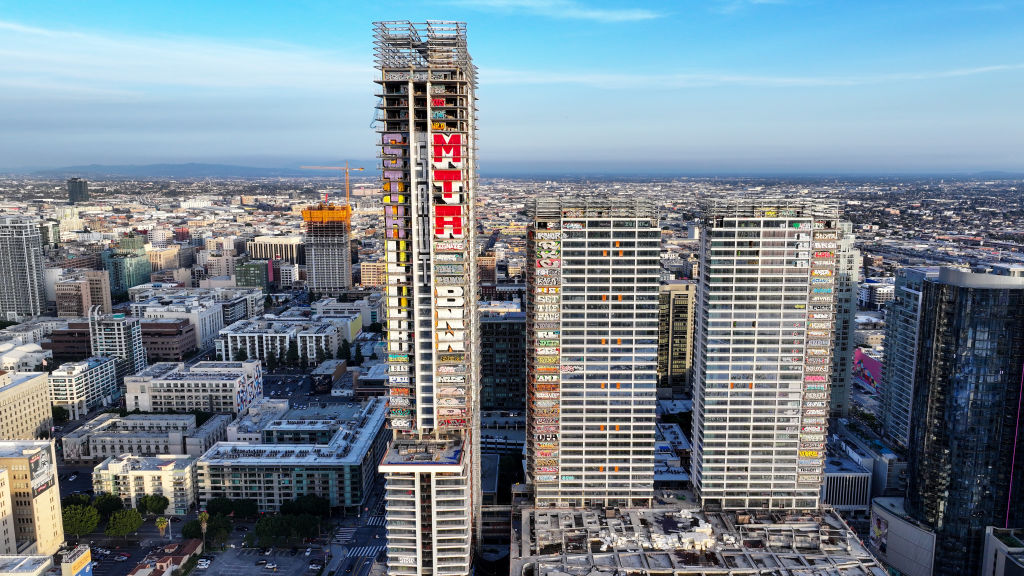
But work screeched to a halt in 2019 after the Chinese government curtailed overseas investments, leaving Oceanwide Holdings out of funds and the project abandoned. For years, these desolate towers remained empty, a canvas for vandals who scaled the structure, covering floor after floor with massive tags. The site also became a dangerous playground for thrill-seekers, filming stunts like base jumping and tightrope walking, leading to dozens of arrests—a clear indicator of the city's failing grip on law and order.
Only in 2024, after years of neglect, did Mayor Bass finally "enhance a police presence in the area and blocked off access to the towers," as reported by the Daily Mail. The city had previously attempted to resolve the matter through bankruptcy court, a drawn-out process that saw the site, initially valued at $1.2 billion, eventually sold to a new buyer for a mere $470 million—a steep price for bureaucratic dithering and unchecked urban decay.
With her re-election bid approaching in November, facing a challenge from city councilwoman Nithya Raman, Bass's sudden focus on "quality of life conditions" feels less like genuine leadership and more like a desperate political maneuver. It’s almost as if common sense needed a permission slip to deal with blatant blight.
In a recent statement, Bass offered a flurry of optimistic language, declaring, "Oceanwide Plaza sits at the center of one of Downtown Los Angeles' most important economic corridors, linking the Convention Center, Crypto.com Arena, LA LIVE, and the broader South Park district." She continued, "Completing this project is about far more than finishing a building. It's about restoring confidence, reconnecting a vital commercial corridor, and unlocking the economic potential of one of the city's most strategic destinations ahead of a transformative decade for Los Angeles." Conveniently, this renewed focus comes as officials are under immense pressure to clean up the streets ahead of the 2028 Olympic and Paralympic Games, a grim reminder of how much of Los Angeles has been allowed to deteriorate.
KPC Development Co, a company with experience in commercial properties in California and India, emerged as a potential buyer earlier this year, expressing interest in transforming the towers into a hotel and residential structure. However, the sale was stalled in bankruptcy court since April as the city haggled over terms. City attorneys finally withdrew their objections recently, conceding that KPC had agreed to "meaningful improvements" that serve the interests of downtown residents. Among the crucial terms of this long-overdue agreement was the immediate removal of all graffiti within 30 days.
This entire saga underscores a troubling pattern of leadership failure in Los Angeles. The "graffiti towers" stand as a stark monument not just to abandoned construction, but to the broader erosion of law and order, civic pride, and accountability that has plagued American cities under progressive governance. Real leadership means proactive problem-solving, not reactive damage control when elections or international events loom. Until common sense and basic governance principles return, America's once-great cities will continue to be symbols of decline, rather than beacons of opportunity.