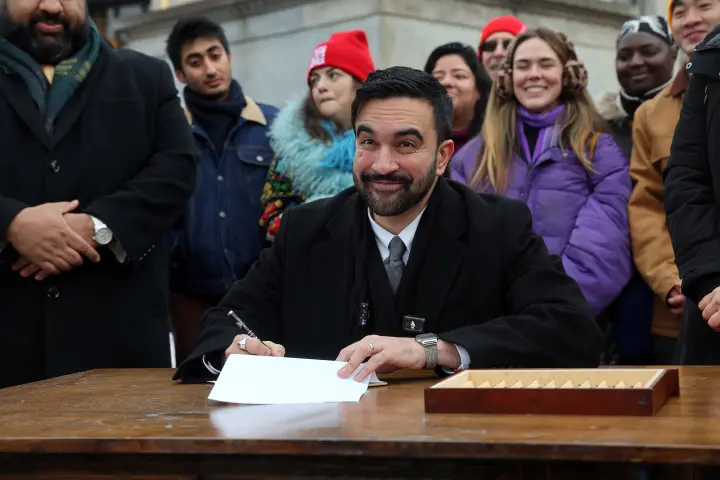
There are smart ways to begin a mayoral administration. There are clumsy ways. And then there is the spectacularly self-inflicted debacle Zohran Mamdani delivered on his very first day in office.
By rescinding all executive orders issued by former Mayor Eric Adams over the past 15 months, Mamdani didn’t just signal a policy shift — he confirmed the worst fears many New Yorkers already had. In one sweeping, ideological stroke, the city’s new Socialist Democrat mayor picked a fight with Israel, alienated more than a million Jewish residents, and stripped away key protections against antisemitism. All on Day One.
If there’s a political playbook for how not to start governing New York City, Mamdani just wrote the opening chapter.
Two of the rescinded executive orders stood out immediately. One formally adopted the International Holocaust Remembrance Alliance (IHRA) definition of antisemitism, a widely accepted standard that recognizes antisemitic acts such as denying Israel’s right to exist, accusing Jews of exaggerated or fabricated Holocaust claims, or alleging dual loyalty. The other prohibited city agencies from boycotting or divesting from Israel.
Together, those orders placed New York City — home to the largest Jewish population outside Israel — firmly against official antisemitism and discriminatory foreign-policy activism. Mamdani erased both.
The backlash was swift and deserved.
Israel’s Foreign Ministry accused Mamdani of “pouring antisemitic gasoline on an open fire,” while major American Jewish organizations warned that his action reversed “significant protections against antisemitism.” These weren’t fringe critics. These were mainstream voices sounding an alarm.
Mamdani’s explanation — that he simply wanted a “clean slate” after Adams’ federal indictment — doesn’t pass even the most generous smell test. The charges against Adams were dropped. The executive orders had nothing to do with corruption. And the selective outrage rings hollow when the only truly controversial policies removed were the ones protecting Israel and Jewish New Yorkers.
The truth is far simpler — and far more troubling.
Mamdani has a long record of hostility toward Israel. During the campaign, he refused to acknowledge Israel’s right to exist as a Jewish state, hiding behind word games about “equal rights” while holding Israel to standards he applies to no other nation in the region. He has openly supported the Boycott, Divestment, and Sanctions (BDS) movement, a global effort designed to economically isolate Israel. He has even vowed to arrest Israeli Prime Minister Benjamin Netanyahu if he visits New York — under an International Criminal Court warrant the United States does not recognize.
Under Adams’ executive orders, those positions would have placed Mamdani himself in violation of city policy. By rescinding them, he conveniently erased the rules standing in his way.
That’s not principled leadership. That’s self-serving politics.
The first days of a new administration are symbolic by nature. Mamdani could have used that moment to take on violent crime, collapsing schools, out-of-control unions, fentanyl dealers, or bureaucratic rot. New York has no shortage of real crises.
Instead, he chose to relitigate his ideological obsessions — and in doing so, confirmed suspicions that his administration will be driven less by competence than by grievance politics and identity-based collectivism.
At a subsequent press conference, Mamdani leaned into familiar progressive platitudes, promising to fight hate through “universality,” “celebration,” and taxpayer-funded programs — the same empty rhetoric New Yorkers have heard for years as antisemitic incidents skyrocket.
He even revived the academic-sounding nonsense from his inaugural speech, pledging to replace “rugged individualism” with “the warmth of collectivism.” Translated into plain English, it’s the same failed ideology that has hollowed out cities, empowered radicals, and excused bigotry when it comes from the political left.
This wasn’t just a mistake. It was a revelation.
Zohran Mamdani didn’t stumble on Day One — he showed New Yorkers exactly who he is. And unless he reverses course fast, this opening act may become the defining stain of his tenure, one marked not by unity or leadership, but by arrogance, ideological fixation, and a disturbing tolerance for antisemitism.