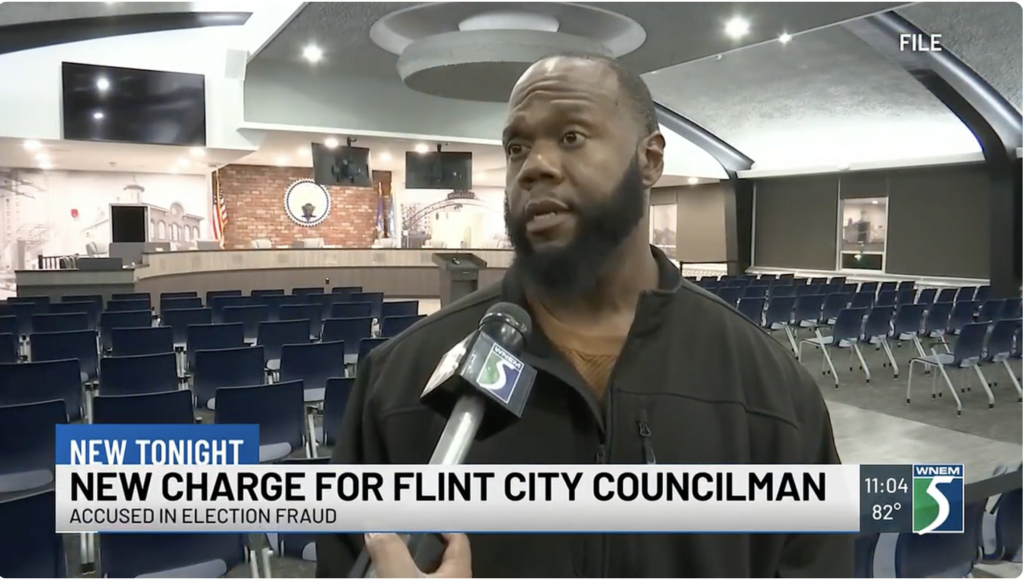
Flint, Michigan, City Council Member Leon El-Alamin once declared, "I'm always me regardless of who they are. Whether it's the governor or mayor, I'm still going to be honest and tell you the truth of what's going on, and the things that you can do to help." Those words now ring with a profound irony as El-Alamin, the face of Democrat Governor Gretchen Whitmer's "Clean Slate" criminal record expungement program, finds himself once again facing the harsh glare of the law—this time, on election fraud charges.
The charges emerge amid El-Alamin's re-election campaign, adding another layer of scandal to a state already battling severe election integrity questions. It appears that for the former drug dealer, "honesty" may be a fluid concept, especially when political power is on the line.
'Political Distraction' Unmasked
El-Alamin is currently free on a $5,000 personal recognizance bond following his arraignment earlier this month. He faces a maximum of five years in prison if convicted, which would also disqualify him from the November ballot. Genesee County Prosecutor David Leyton confirmed that El-Alamin, 45, is accused of lying on his April 2025 affidavit, falsely claiming residency within Flint's city limits to qualify for his council seat. Investigators, tipped off by local residents, found El-Alamin actually resided in nearby Mt. Morris Township. Even a tenant at the Flint address he listed told police El-Alamin was merely the landlord, not a resident.
The official charge is election law false swearing, or perjury. This investigation began nearly two years ago after the Secretary of State's office received a complaint regarding El-Alamin's alleged wrongdoing. Despite the mounting evidence, El-Alamin offered a predictable defense, stating he is "confident that he will be cleared of any wrongdoing" and that he "always believed in the rule of law and due process."
Perhaps most telling was his assertion that "these repeated accusations have become a political distraction that shifts attention away from the real issues our residents and neighbors are facing." A "political distraction," indeed, for a public servant whose personal actions seem to consistently invite legal scrutiny.
A Violent Past and Present Allegations
The election fraud charge isn't El-Alamin's only legal battle. The council member, who paradoxically runs a $1 million nonprofit dedicated to "comprehensive non-violence prevention programs," is also awaiting an October trial on a felony charge of "assault with intent to do great bodily harm less than murder" and a misdemeanor domestic violence charge. He stands accused of choking and causing lacerations on his then-girlfriend's face, according to previous court testimony. Flint Councilwoman Jerri Winfrey-Carter has publicly called for his removal, citing the "disturbing and detailed statement from the survivor" that outlined a "brutal and terrifying assault."
El-Alamin's violent history is not new. In 2003, as Leon Wilson, he was sentenced to 12-20 years for drug and weapons charges after a shootout over a drug turf war. Yet, upon his release, he became a celebrated figure, a direct beneficiary and poster child for Governor Whitmer's controversial "Clean Slate Act" which erases criminal records. Photos of El-Alamin with Whitmer, Senator Cory Booker, and Representative Kristen McDonald Rivet proudly adorn his social media, showcasing the embrace of a man whose supposed rehabilitation is now repeatedly undermined by his alleged actions.
Michigan's Unresolved Election Scandals
El-Alamin's charges are more than just an isolated incident; they spotlight Michigan's persistent struggles with election integrity. This comes on the heels of President Donald Trump's recent address, where he urged a full FBI investigation into a "leftist voter registration scheme" in Michigan involving potentially thousands of fraudulent signatures from the 2020 presidential election.
Intelligence documents, declassified by President Trump, revealed a massive voter registration fraud operation in Muskegon. Former employees admitted to submitting "two to three applications to get paid," with many registering "false information because it was easy money." One canvasser even described trading "marijuana and money for voter registration applications." An estimated 100 fake applications were submitted by one individual alone.
Yet, despite these alarming findings, accountability has been conspicuously absent. Michigan Attorney General Dana Nessel, a Democrat, controversially opted not to prosecute. House Republicans introduced articles of impeachment against Nessel for her "failing to faithfully discharge the duties of her office" by not acting on the "clearly fraudulent" voter registration applications. The Michigan State Police, seemingly covering for Nessel, claimed "no expected impact on any election," an assertion that strains credulity given the scope of the alleged fraud.
The case of Leon El-Alamin, a favored figure in Democrat circles, and the unaddressed systemic election irregularities across Michigan, paint a troubling picture. It underscores a critical need for genuine transparency, rigorous enforcement of election laws, and a firm commitment to the rule of law, ensuring that every American vote is sacred and beyond reproach. The American people deserve to know that their elections are fair and secure, free from fraud and political manipulation, regardless of who is involved.