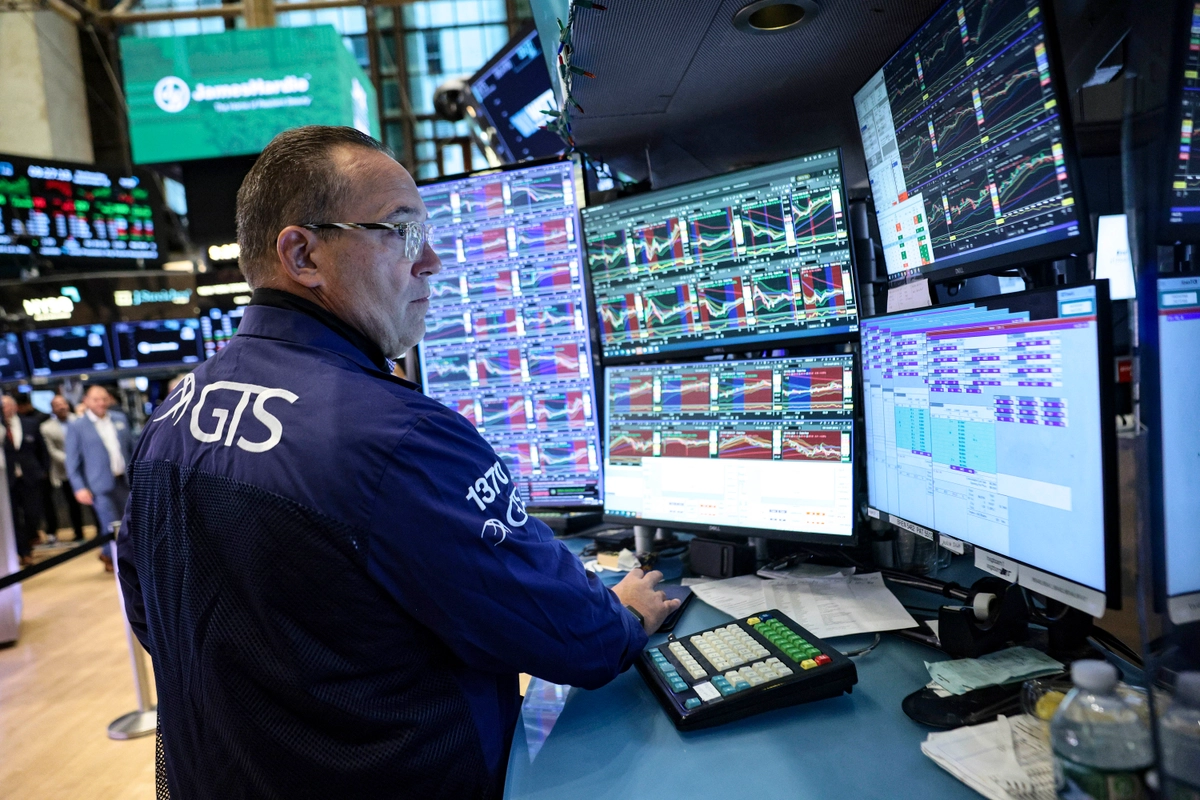
Wall Street suffered a brutal sell-off on November 5, with technology stocks leading the retreat and the Nasdaq Composite officially entering correction territory. The Dow Jones Industrial Average plunged more than 1,800 points, while major semiconductor and artificial intelligence companies took some of the market’s hardest hits.
The Nasdaq tumbled 1,421 points, or 5.52 percent, closing at 24,315. The decline pushed the technology-heavy index more than 10 percent below the record closing high it reached last month — the threshold commonly used to define a market correction. Despite the sharp reversal, the Nasdaq remains approximately 5 percent higher for the year.
The damage extended across Wall Street. The Dow Jones Industrial Average, which tracks 30 major blue-chip companies, shed more than 1,800 points, falling 3.44 percent. The S&P 500 dropped 334 points, or 4.36 percent, to 7,353. Both indexes, however, remain in positive territory for 2026, with gains of approximately 7 percent and 7.4 percent, respectively.
Small-cap stocks were hit as well, with the Russell 2000 declining more than 4 percent.
Peter Schiff, chief economist and global strategist at Euro Pacific Asset Management, questioned the market’s reaction to the previous day's political developments.
“Yesterday’s stock market rally in the face of the Democratic landslide made no sense. In contrast, today’s sell-off makes perfect sense. Expect more days like today,” Schiff wrote on X.
The technology sector was at the center of the downturn, particularly companies tied to the artificial intelligence boom. Semiconductor manufacturers Advanced Micro Devices, Broadcom, Nvidia, and Qualcomm all suffered significant losses. The iShares Semiconductor ETF, which tracks a broad group of chipmakers, plunged approximately 12 percent.
The sell-off also battered so-called neocloud companies, specialized cloud-computing providers that build infrastructure for enormous AI workloads. CoreWeave, IREN, and Nebius were among the companies caught in the retreat. Investors have increasingly questioned whether these businesses can secure enough financing to support their expensive infrastructure expansion.
Political uncertainty may be adding to those concerns. A Democratic wave at the federal and state levels has raised questions about the future regulatory environment for artificial intelligence. Lawmakers have called for tighter oversight, while some have even advocated a moratorium on new data-center construction.
For investors betting heavily on continued AI expansion, the prospect of additional regulatory restrictions creates another source of uncertainty at a time when the industry already faces enormous capital requirements.
The downturn was not limited to technology companies. Elon Musk’s SpaceX and Tesla also suffered steep losses, underscoring the breadth of the market retreat.
Thursday’s plunge is a reminder that Wall Street's enthusiasm for artificial intelligence and high-growth technology stocks can reverse quickly when financing concerns, political uncertainty, and investor expectations collide. Although the major indexes remain up for the year, the Nasdaq's entry into correction territory signals that the market's appetite for risk has taken a serious hit.