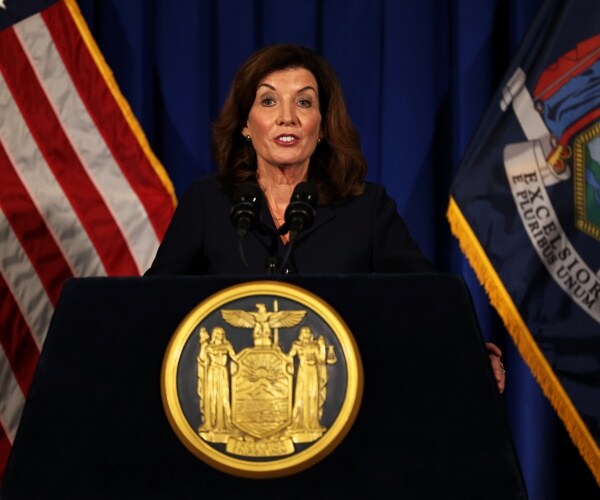
New York Gov. Kathy Hochul is proposing changes to the state’s major climate law, arguing that the current targets could impose significant financial burdens on residents.
The move comes as lawmakers prepare for difficult state budget negotiations and reflects growing concern about affordability issues tied to energy policy.
The law in question is the Climate Leadership and Community Protection Act, passed in 2019, which set ambitious goals for reducing pollution and transitioning the state toward renewable energy.
Hochul said the state must reconsider parts of the plan because of economic realities that have emerged since the legislation was approved.
“There were so many unforeseen factors,” Hochul said, adding that meeting the law’s requirements could bring “enormous costs.”
Her stance mirrors a broader shift among some Democratic leaders who have begun prioritizing cost-of-living concerns alongside environmental goals. Governors such as Josh Shapiro of Pennsylvania and Gavin Newsom of California have also scaled back or reconsidered certain climate-related proposals.
A spokesperson for Hochul said New York remains committed to climate action but is pursuing an “all-of-the-above” energy strategy intended to balance clean energy expansion with reliable and affordable power.
The governor’s office released an internal memo warning that achieving the law’s targets could increase gasoline prices by about $2.23 per gallon by 2031 and raise home heating costs by more than $3,000 annually for some residents in upstate New York.
Some industry groups support revisiting the policy. David Fisher, president of the New York Farm Bureau, said the law currently sets renewable energy targets that may be unrealistic.
“Compliance would mean achieving near-impossible renewable energy targets at a pace not proven feasible nor realistic,” Fisher said.
Environmental advocates strongly disagree. Eric Walker of WE ACT for Environmental Justice argued that the climate law is actually the best path toward lowering long-term energy costs while transitioning the economy.
Meanwhile, political debate is also intensifying within the Democratic Party. Patrick Burke, a state assemblyman from Buffalo, warned that reopening the climate law could trigger divisions among Democrats during an election cycle.
Burke said lawmakers must address the true costs of environmental policy while avoiding partisan political traps.
As the budget negotiations approach, the debate over affordability versus climate goals is expected to become one of the most contentious issues facing New York’s state government.