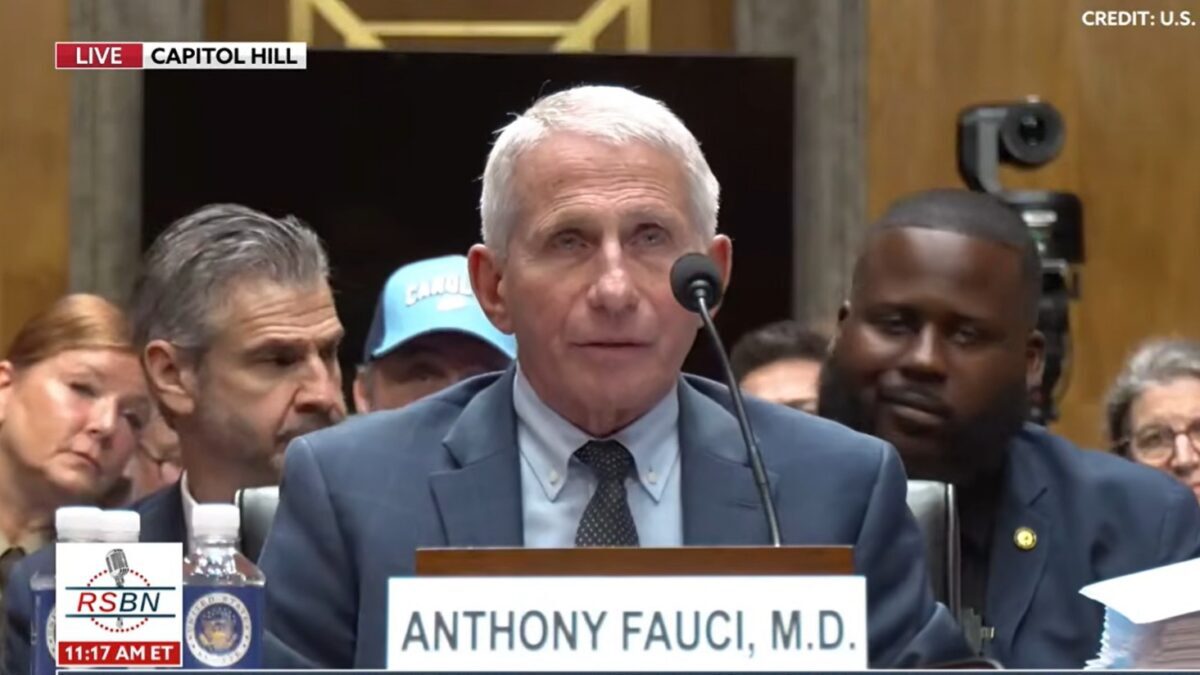
Dr. Anthony Fauci's recent appearance before the Senate Homeland Security and Governmental Affairs Committee quickly exposed a man stripped of his former arrogance. In stark contrast to his past smug demeanor, Fauci was visibly nervous, even trembling, as he invoked his Fifth Amendment privilege against self-incrimination in his opening statement. This dramatic shift came just after the inexplicable release of Fauci's personal diary, found on a federal government server, which Sen. Rand Paul (R-Ky.), the committee chairman, asserted directly contradicted Fauci's previous congressional testimony and public statements on crucial matters like gain-of-function research funding, mask efficacy, and the Wuhan lab leak theory.
The diary's "revelatory cringe," as some have called it, laid bare Fauci's humiliating hubris during a period when Americans endured punishing lockdowns, watched loved ones die alone, saw children struggle with remote learning, and faced ruinous business closures. The hearing itself yielded little new information, but it intensified a critical question: Was Fauci's invocation of the Fifth Amendment legally proper, especially given the sweeping pardon he received from President Biden?
Fauci's pardon is explicit:
FOR ANY OFFENSES against the United States which he may have committed or taken part in during the period from January 1, 2014, through the date of this pardon arising from or in any manner related to his service as Director of the National Institute of Allergy and Infectious Diseases [NIAID], as a member of the White House Coronavirus Task Force or the White House COVID-19 Response Team, or as Chief Medical Advisor to the President.
This extensive pardon covers all federal crimes tied to his government service from January 1, 2014, until January 19, 2025, a span that encompasses nearly all relevant federal statutes of limitations, including the five-year limit for false testimony to Congress. So, when Fauci pled the Fifth, was it merely an attempt to avoid embarrassment, or did it carry far more serious implications?
Legal Precedent Against Evasion
The Supreme Court has made it unequivocally clear that pleading the Fifth Amendment is "confined to instances where the witness has reasonable cause to apprehend danger from a direct answer," as established in Mason v. United States. Further, Brown v. Walker clarified that this apprehended danger "must be real and appreciable… not a danger of an imaginary and unsubstantial character." With a presidential pardon in hand, the premise of a "reasonable danger" of federal prosecution for questions related to his prior testimony appears to evaporate.
Crucially, the Supreme Court also cautions that self-incrimination applies only to past activities, not to potential perjury or false statements made during current testimony. Moreover, the "Fauci Fifth" is not legally appropriate simply because truthful answers might "have the tendency to disgrace" him. In plain terms: even if the truth would be embarrassing, Fauci is still legally obligated to provide it.
A person may waive their right against self-incrimination by partially answering questions or making defense statements before invoking the Fifth. Fauci, in his opening statement, alluded to his "decades-long cooperation with Congress," an oblique defense of his past testimony. Courts have held that such an invocation may, in fact, forfeit the right to assert the Fifth Amendment altogether.
When senators pressed Fauci on his past testimony regarding COVID origins, the lab leak theory, masking, school closures, and gain-of-function research funding – even mundane questions about his attire – he repeatedly invoked the Fifth. This blanket refusal, particularly on matters clearly covered by his pardon, could very well render his Fifth Amendment invocation null and void. There is no feasible state or local prosecution for false testimony before Congress; only federal law applies. Despite the bluster from some state attorneys general, the notion of state-level prosecution for these federal offenses is entirely imaginary. Therefore, protected by his pardon, Fauci had a clear legal obligation to answer questions concerning his activities at NIAID during the covered period. His refusal, in this context, could easily constitute criminal contempt of Congress, a charge that has been successfully pursued against former Trump administration officials under the Biden administration’s Justice Department.
Did Fauci Abandon His Pardon?
An even more profound legal question looms: Did Fauci, by repeatedly asserting the Fifth Amendment, effectively abandon his pardon? In Wilson v. United States, the Supreme Court stated that no person or body can force the acceptance of a pardon; it must be affirmatively asserted by the recipient. The highly relevant Supreme Court case of Burdick v. United States offers a powerful precedent. George Burdick, a newspaper editor, received a preemptive pardon from President Woodrow Wilson but still refused to testify before a grand jury, asserting his Fifth Amendment right. The Supreme Court concluded that Burdick had the "right to refuse [the pardon]" and stand on his Fifth Amendment objection. The implication is stark: if you plead the Fifth, you may be refusing or abandoning your pardon.
If Fauci indeed abandoned his pardon by invoking the Fifth Amendment, then the activities covered by that pardon could once again be ripe for prosecution. His recently revealed diary entries would undoubtedly serve as Exhibit A in any such case. The legal reality is that Fauci cannot simultaneously claim the protection of a presidential pardon and the shield of the Fifth Amendment for questioning specifically related to his prior congressional testimony during the covered period.
Fauci chose to avoid self-incrimination, desperate to evade answering questions that juxtapose his former congressional testimony with declassified materials, newly discovered emails, and his own diary entries. By choosing the Fifth, Fauci may have inadvertently opened himself up to criminal prosecution for any crimes, such as false statements to Congress, committed during the pardon period. Conversely, if he argues his activities were covered by the pardon and he is immune, then his improper invocation of the Fifth Amendment could lead to charges of criminal contempt of Congress.
Sen. Paul has already committed to a criminal referral to the Justice Department. The DOJ will now face the complex task of navigating these narrow legal waters to determine if charges are warranted against the man who once wielded immense power over American lives.
The bitter irony is palpable: had Fauci simply testified truthfully last week, even if it meant admitting to past false statements or misleading the American people, he would have faced no legal consequences due to his pardon. Instead, by asserting the "Fauci Fifth" an astonishing 111 times under oath on national television, his legacy is now indelibly stained by the painful perception of a mendacious "megalomaniac," consumed by self-interest and a hunger for fame. This saga underscores a crucial principle for all those in positions of public trust: accountability, transparency, and truth are not optional, regardless of how high one climbs or how powerful one believes themselves to be. The American people deserve nothing less.