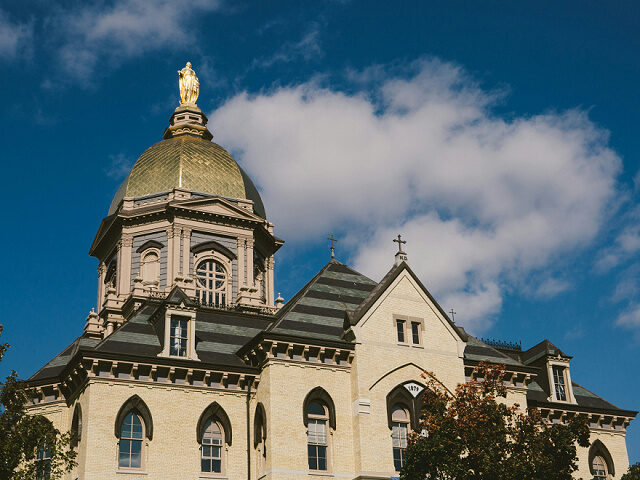
A pro-abortion professor at the University of Notre Dame has withdrawn from a major leadership post after intense backlash from the pro-life movement and more than a dozen U.S. Catholic bishops — proving once again that even elite academic titles don’t override core values.
Dean Mary Gallagher of Notre Dame’s Keough School of Global Affairs confirmed in a Thursday email that Professor Susan Ostermann “has decided not to move forward as director” of the Liu Institute for Asia and Asian Studies. Gallagher thanked her for her willingness to serve, though the controversy surrounding the decision had already done the talking.
Ostermann said she stepped aside because attention on her appointment was “overshadowing the vital work the institute performs.” She added that Notre Dame still has work to do to create a place “where a variety of voices can flourish.” Translation: the pressure worked, and the optics were becoming impossible to ignore.
The withdrawal followed weeks of growing criticism after Fort Wayne-South Bend Bishop Kevin Rhoades publicly condemned the appointment, calling it a “scandal to the faithful.” He cited Ostermann’s documented support for abortion and her history of attacking the pro-life movement, which she has linked to racism and misogyny.
Rhoades argued that her views directly contradict Notre Dame’s Catholic mission, especially its commitment to defending innocent life. Several other bishops joined him, including leaders from Denver, San Francisco, and Green Bay — clearly not impressed by attempts to rebrand abortion advocacy as academic diversity.
Archbishop Paul Coakley, president of the U.S. Conference of Catholic Bishops, also urged the university to reverse course, stating that Ostermann “openly stands against Catholic teaching” on the sanctity of life.
The controversy didn’t stop there. Two scholars announced they were cutting ties with the university over the appointment, and another professor revealed he had already left because Notre Dame’s leadership had become “equivocal” about its Catholic identity.
Notre Dame Right to Life added fuel to the fire in a Feb. 3 op-ed, highlighting at least 11 opinion pieces in which Ostermann described pro-life laws as rooted in “white supremacy” and “racism.” The group also criticized her work with the Population Council, which collaborated with the Chinese government on abortion and population-control policies.
“These and other actions render Ostermann unfit to serve as head of the Liu Institute,” the student group concluded.
In the end, Notre Dame avoided pushing this controversy any further — and that matters. A Catholic university choosing to listen to its bishops and its pro-life community is not just good optics; it is a reminder that convictions still carry weight in public institutions. And for those who believe faith and principle should guide leadership, this outcome is a step in the right direction.