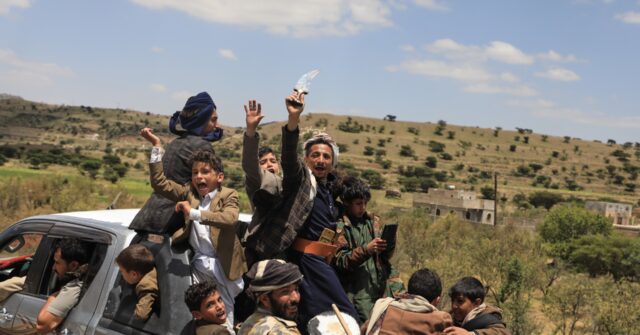
The strategic chokepoint of the Bab el-Mandeb Strait now finds itself under the menacing shadow of Iran-backed Houthi rebels. In a swift and alarming offensive, these proxies of Tehran have seized a critical port city and an island along the Red Sea coast, igniting fears of a broader conflict and directly jeopardizing global shipping lanes vital to international commerce.
This audacious move is no mere skirmish; it's a calculated escalation, positioning the Houthis to control an alternative shipping route to the Strait of Hormuz—a waterway Iran has long threatened to weaponize. The message is clear: Tehran is expanding its reach, pushing its destabilizing agenda through proxies and testing the resolve of the international community.
Overnight, the Houthis further ratcheted up tensions, claiming a new barrage of missile and drone attacks targeting neighboring Saudi Arabia. A Houthi military spokesperson, Brig. Gen. Yahya Saree, alleged strikes on a military base in Saudi Arabia’s Najran region. While evidence remains unverified, the Saudi civil defense confirmed a projectile falling near the Red Sea border, injuring two people and damaging a mosque and other structures, squarely blaming the Iran-backed rebels.
The brazen aggression has sent ripples of concern through global markets, with oil prices once again on the ascent. While the rebels outwardly claim no threat to commercial shipping beyond their declared blockade, the reality of an emboldened, Iran-aligned force controlling such a critical maritime artery fuels undeniable economic uncertainty and geopolitical instability.
On the ground, Yemen’s internationally recognized government, backed by Saudi Arabia, has vowed to reclaim lost territory, even as senior officials concede a "painful and regrettable" collapse of their forces. Sultan al-Arada, a member of the ruling presidential council, described the government's defeat in Mokha and other west coast areas as a stark setback, acknowledging forces "are currently regrouping and will return to the battle."
A senior military official, speaking anonymously, pointed to a "lack of coordination" between the Yemeni army and its allied militias as providing the Houthis "a priceless opportunity." Perhaps even more concerning, the official expressed bewilderment that the Saudi air force seemingly failed to act decisively to prevent the capture of Mokha, a strategic port just 50 miles from the strait. This apparent vacuum of decisive action allowed Iran's proxies to cement their gains.
The cost of this Houthi advance has been grim. The National Resistance, a government-allied force, reported more than 500 government fighters killed and 1,500 wounded over the past four weeks in the coastal areas. Yet, commanders like Tariq Saleh, nephew of Yemen's late leader Ali Abdullah Saleh, remain defiant, pledging to "continue its struggle within the ranks of the armed forces ... until Yemen is liberated from Iran’s proxies."
This alarming Houthi advance now places Iran’s proxies a mere 20 miles from the main U.S. military base in Djibouti, situated on the opposite side of the Bab el-Mandeb. This strategic proximity represents a direct and escalating threat to American personnel and interests in the region, demanding immediate and serious attention from Washington. The humanitarian crisis also deepens, with over 2,000 Yemenis already fleeing across the strait to Djibouti.
The world cannot afford to ignore the strategic implications of these events, which threaten the freedom of navigation essential for global trade and American national security. A strong, resolute stance against regimes like Iran and their proxies is not merely an option, but a necessity to safeguard our interests and prevent further destabilization.