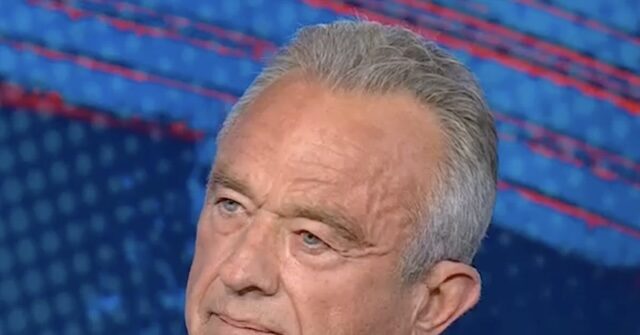
Health and Human Services Secretary Robert F. Kennedy Jr. walked into a CNN interview Sunday and made one thing clear: he was not interested in another round of “trust the experts” without demanding the evidence.
During an appearance on CNN’s State of the Union, Kennedy accused former National Institute of Allergy and Infectious Diseases Director Anthony Fauci of misleading the public on some of the most consequential COVID-era policies, including masking, social distancing, natural immunity, vaccine transmission and the origins of the virus.
“All you know how to do is repeat things that people told you and say trust the experts,” Kennedy told host Dana Bash.
He then delivered the central accusation.
“Anthony Fauci who was the expert was lying about everything about mass and how we social distancing about natural immunity about transmission from vaccine about this source of covet,” Kennedy said.
The interview quickly turned into a confrontation over one particularly important question: Did COVID vaccines protect children?
“You think the COVID vaccine protected children?” Kennedy asked.
Bash responded that she had spoken with scientists and doctors who supported the effectiveness of the vaccines.
Kennedy wasn't satisfied.
“Can you show me one study that shows that children were protected by the COVID vaccine?” he asked.
Bash attempted to pivot toward broader research concerning vaccine misinformation, arguing that studies had indicated “a hundred to two hundred thousand lives” in the United States could have been saved if more people had received COVID vaccines.
Kennedy immediately pushed back.
“You are saying nonsense! You are saying something that you cannot show me a single study that says that.”
“You are saying nonsense!” Bash fired back. “Excuse me! Excuse me!”
Kennedy returned to the same demand.
“Cite me the study! What study?”
Bash then challenged Kennedy over the studies he was referencing, leading to a heated exchange over whether the evidence being discussed actually supported the claims being made.
The clash was striking because it went straight to one of the biggest lessons of the COVID era: Americans were repeatedly told to trust institutions, follow official guidance and accept sweeping restrictions because the experts had supposedly settled the questions.
But science is not supposed to operate on authority alone.
It is supposed to operate on evidence.
Kennedy's broader criticism of Fauci reflects his long-running argument that public-health officials overstated their certainty during the pandemic and that Americans were discouraged from questioning official narratives.
His remarks on CNN are particularly significant because the debate over COVID policy has not disappeared. Questions surrounding vaccine effectiveness, natural immunity, masking, school closures, social distancing and the origins of the virus remain politically explosive years after the emergency itself ended.
The exchange also exposed a familiar problem for establishment media: demanding that Americans trust experts is much easier than explaining precisely what the evidence shows.
That doesn't mean every claim made by Kennedy—or anyone else—should automatically be accepted. It means the standard should be the same for everyone.
If a study supports a claim, produce it.
If the evidence is uncertain, say so.
If officials got something wrong, admit it.
And if the government expects Americans to surrender extraordinary amounts of freedom and accept extraordinary public-health measures, “trust us” should never be the final answer.
Kennedy's message on CNN was blunt, perhaps deliberately so.
The pandemic taught Americans that institutions can be wrong, experts can disagree and government officials can make consequential mistakes. The answer isn't to replace one unquestioned authority with another.
It is to demand evidence—and to keep demanding it, no matter whose reputation is on the line.