President Donald Trump is making one thing unmistakably clear in the escalating confrontation with Iran: Washington believes it has seized the upper hand over one of the world's most strategically important waterways.
“We have total control over the Strait of Hormuz,” Trump declared Wednesday. “I think we will keep it.”
The president made the statement in a Truth Social post while touting the strength of the U.S. naval blockade amid the continuing war with Iran and Tehran's efforts to restrict shipping through the vital energy chokepoint.
“Our Naval Blockade is being called, by everyone, ‘A WALL OF STEEL,’ and there is nothing Iran can do about it,” Trump wrote.
That is not the language of an administration preparing to surrender control of the battlefield.
Trump also portrayed Iran as a dramatically weakened power, pointing to the destruction of much of its military capability and the country's worsening economic problems.
Iran, he wrote, has “no Navy” and “no Air Force,” while claiming the Islamic Revolutionary Guard Corps has been “decimated.”
“Iran is all talk and no action, the Bully of the Middle East No Longer,” Trump added.
The numbers on the water tell their own story.
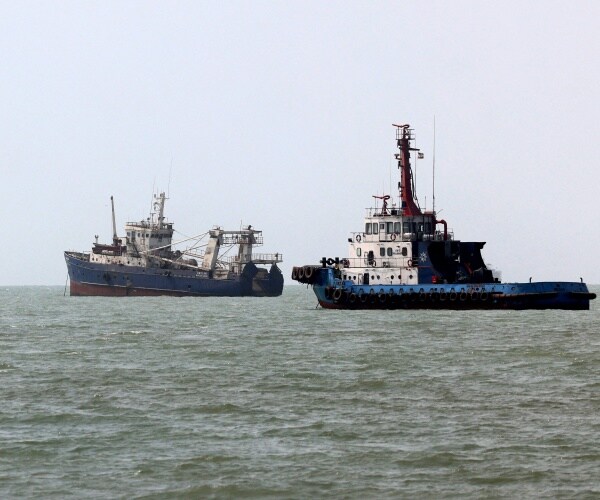
Commercial traffic through the Strait of Hormuz has collapsed compared with normal prewar levels. Kpler data showed only eight vessels moving through the strait Tuesday—the lowest daily total since Aug. 5.
Before Iran moved to close the waterway following the start of U.S.-Israeli attacks on Feb. 28, roughly 130 to 140 ships would typically pass through the strategic passage each day.
Of Tuesday's eight tracked vessels, seven entered the strait using the Iranian route. Only one ship, a coal carrier, exited.
Separate LSEG data recorded 11 total transits, down from 14 the previous day.
Those numbers provide a stark backdrop to the competing claims coming from Washington and Tehran.
Iranian officials continue to insist that Tehran—not Washington—will decide when the waterway fully reopens.
Mohsen Rezaei, the newly appointed secretary of Iran's Supreme National Security Council, said Tuesday that the strait would remain closed unless Washington changes its behavior and accepts Iranian conditions for ending the war.
Those conditions include an end to the conflict, the release of frozen Iranian assets and an end to fighting elsewhere in the region, including Lebanon and Gaza.
Trump's message is essentially the opposite: Iran does not get to dictate terms while its military and economic position deteriorates.
Washington has also intensified pressure on Iranian shipping.
The United States first announced a naval blockade targeting vessels entering or leaving Iranian ports in April and reinstated it in July after a June peace agreement collapsed.
This week, U.S. forces fired on a Panama-flagged cargo ship in the Gulf of Oman after its crew allegedly ignored warnings while attempting to breach the blockade, according to The Wall Street Journal.
The confrontation demonstrates why the Strait of Hormuz matters far beyond the Middle East. The waterway is a critical artery for global energy supplies, and any sustained disruption can send shock waves through oil markets, shipping and economies around the world.
Yet Trump's declaration Wednesday was not framed as a warning. It was framed as a victory.
“We have total control” is a remarkably blunt statement from an American president regarding a waterway Iran has spent weeks attempting to use as leverage.
And that is the broader America First message coming from the White House: strategic waterways cannot become hostages to hostile regimes, and the United States does not have to accept a world in which Tehran decides when global commerce is allowed to move.
Iran can threaten. Iran can make demands. Iran can issue declarations from Tehran. But the movement of ships through Hormuz is showing a different reality.
For now, Trump says Washington holds the line—and intends to keep it.