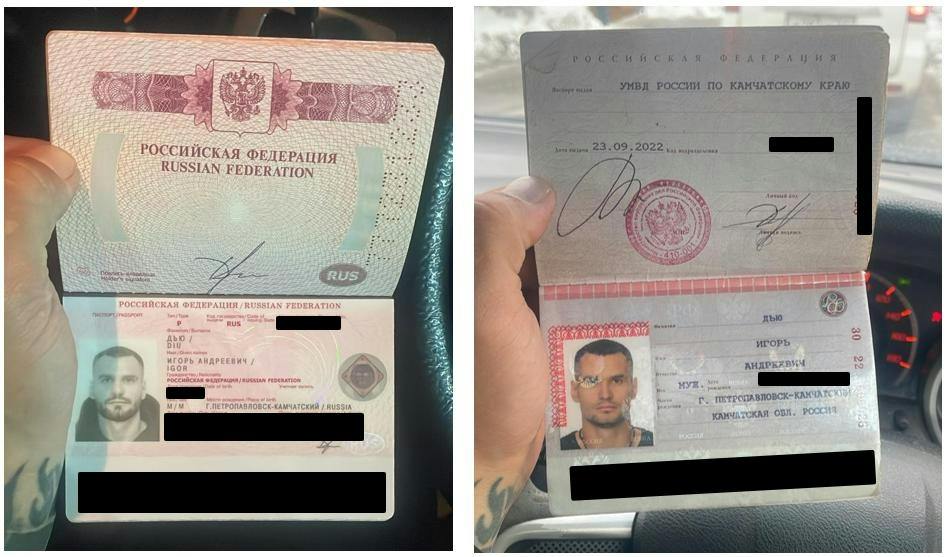
A chilling reminder of America's vulnerable borders and the brazen threats posed by foreign adversaries has emerged from Silicon Valley, where federal prosecutors have unveiled an alleged Russian spy plot that reached directly into the homes and workplaces of American defense technology employees. Igor D’iu, a Russian national, stands accused of illegally entering the United States and orchestrating a sophisticated surveillance operation, reportedly targeting the critical defense contractor Palantir.

According to federal prosecutors, D’iu’s mission included surveilling the homes of company employees, meticulously photographing their computer screens, and employing a web of fraudulent identification to conceal his true identity. The charges against him are severe: conspiring to act as an agent of a foreign government, acting as an agent without notifying the Attorney General, interstate stalking, and fraud involving identification documents.
Prosecutors outline a disturbing scenario: D’iu allegedly crossed into the U.S. illegally under the direct orders of foreign handlers. His explicit mission was to gather sensitive information on employees of a Silicon Valley technology and defense firm, later identified by Bloomberg as Palantir. The Department of Justice minced no words, stating that the alleged conduct, “if proven, is a flagrant violation of U.S. sovereignty and an unacceptable attempt at intimidation.” This is not merely a crime; it is an attack on American soil and our national integrity.
The indictment and supporting affidavit detail how D’iu was recruited via Telegram in the summer of 2026, receiving instructions, equipment, and financial backing to “spy for the Motherland.” His handlers made it clear the target company was chosen for its role in supplying weapons used against Russia in Ukraine, confirming the geopolitical stakes involved in this audacious espionage.
The path to American soil was shockingly easy for D’iu. In June 2026, he reportedly traveled from Istanbul, Turkey, to Mexico City, where facilitators aided his illegal crossing of the U.S.-Mexico border. Once inside the United States, D’iu allegedly purchased laptops, cellphones, wireless networking equipment, and remote-access software. His initial assignments involved visiting a coffee shop near the company’s Palo Alto office, where he was directed to photograph employees’ laptop screens – a low-tech but effective form of corporate and national security espionage.

The operation escalated dramatically. D’iu’s assignments expanded to include direct surveillance of employees and their private residences. He actively searched online for home addresses, including that of a senior company executive. The audacity peaked on September 3, when he allegedly followed a female employee in a silver Lexus SUV for nearly 30 miles from her Palo Alto office towards San Francisco. The terrified employee, fearing for her safety, called 911 and sought refuge at a police station. Prosecutors say D’iu abandoned the pursuit only after she made contact with an officer.
Following contact from Palo Alto police about the stalking incident, D’iu, under direction from his co-conspirators on Telegram, allegedly switched vehicles, obtained a new phone number, and fled to Reno, Nevada. However, the affidavit indicates he later returned to the Bay Area to continue his illicit assignments. This brazen persistence underscores the gravity of the threat and the commitment of foreign actors to penetrate American defenses.
To further mask his identity, D’iu allegedly procured multiple fraudulent identification documents, including a falsified California ID card, an altered U.S. passport, and a Social Security card bearing the name “Hugo Landry Johns.” Investigators intercepted these documents, revealing that the passport was an authentic U.S. passport, originally issued to another individual, cunningly altered to display D’iu’s photograph. The layers of deception are astounding, made easier by the ease of illicit entry.

The FBI ultimately caught up with D’iu. In October, agents searched his East Palo Alto residence. The raid uncovered approximately $18,000 in cash, two laptops, two iPhones, two Russian passports, wireless networking equipment, and the fraudulent identification documents. Even more revealing was a notebook found with 10 handwritten addresses – several corresponding to employees’ homes – alongside “detailed profiles” of at least three employees, including their family members’ names, education and employment histories, and assessments of their strengths and weaknesses. This was not random surveillance; it was a targeted, deeply personal intelligence-gathering operation.
U.S. Attorney Craig H. Missakian for the Northern District of California issued a stern warning: “The allegations in this case describe a state-sponsored operation to target and harass employees of an American technology and defense company because of that company’s assistance to Ukraine in its war with Russia. We will not tolerate any efforts — by foreign governments or otherwise — to turn Silicon Valley into a base for foreign intelligence operations.” This forceful declaration is a necessary response to such blatant infringements on American security.
D’iu made his initial appearance in federal court on November 2 and remains in custody, with a return date scheduled for November 24. If convicted on all charges, he faces a combined statutory maximum of 21 years in prison. This case serves as a stark reminder that a secure border isn't just about controlling immigration; it's about safeguarding national security, protecting American innovation, and ensuring foreign adversaries cannot exploit weaknesses to spy on our citizens and critical industries. The America First agenda demands robust border protection to prevent future infiltrations and defend our sovereignty against those who would seek to undermine it from within.