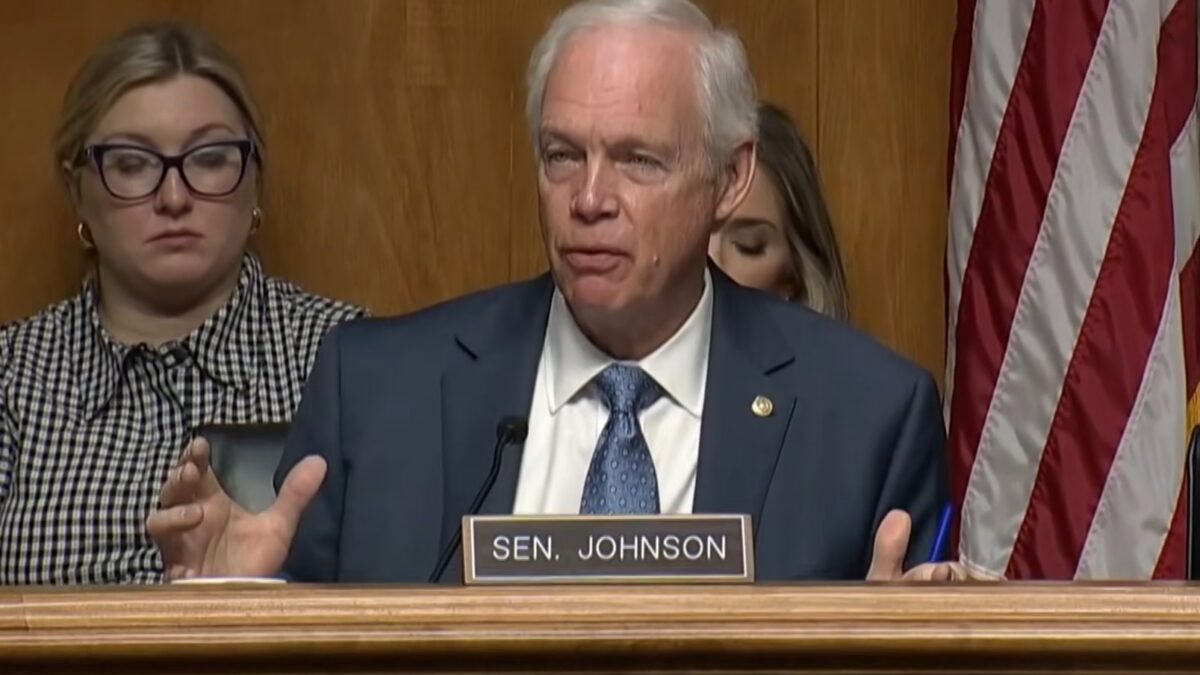
Senator Ron Johnson of Wisconsin is warning fellow Republicans that a quick Senate vote on the SAVE America Act could end in what he calls a “disastrous” political failure — and hand Democrats an easy escape from defending their opposition to voter ID and citizenship verification.
Speaking with reporters on Capitol Hill, Johnson said simply putting the bill up for a single vote and moving on would ignore the concerns of Republican voters who have pushed hard for election integrity reforms.
“We ignore our base at our own peril, and we don’t want to dispirit our base,” Johnson said. “And right now, that’s kind of the path we’re going on.”
Pressure from Republican voters and the White House recently pushed Senate Majority Leader John Thune to schedule a floor vote on the SAVE America Act. The legislation would require voter identification and proof of U.S. citizenship in order to register to vote.
However, many lawmakers expect the bill to fail because it would likely fall short of the 60 votes required to break a filibuster in the Senate.
President Donald Trump has publicly urged Senate leadership to push harder for the measure, calling it one of the most popular pieces of legislation he has seen brought before Congress.
“He’s got to be a leader,” Trump said about Thune. “It’s the most popular bill I’ve ever seen put before Congress.”
Johnson argues that allowing a quick vote without extended debate would amount to what critics call “failure theater.” In that scenario, Democrats could simply vote no, accuse Republicans of pushing restrictive voting laws, and move on without being forced to defend their position.
“You can’t just do a one-and-done vote,” Johnson said. “That gives Democrats the out of just voting no and saying, ‘Oh, it’s Jim Crow 2.0.’”
Instead, Johnson believes Republicans should force a prolonged Senate debate that would require Democrats to repeatedly explain their opposition.
“At a minimum, you’ve got to have this on the floor for debate and force Democrats, day after day, to defend why they are opposed to something that the American people support by a 90 percent margin,” he said.
One possible strategy involves a spoken or standing filibuster, where senators must physically remain on the Senate floor and continuously speak in order to block legislation. The tactic turns the fight into a test of endurance and political will.
Still, Johnson expressed doubts about whether the strategy could succeed under current Senate rules. A rule change implemented in 1986 by former Senator Robert Byrd allows senators to introduce unlimited amendments during a filibuster, which Johnson said effectively weakens the traditional two-speech limit that once controlled debate.
Because of that rule, Johnson warned the process could spiral into endless amendments that prevent the bill from ever reaching a final vote.
Despite those challenges, Johnson said Republicans must show they are willing to fight for the legislation.
“We can fight like hell and still lose,” he said, “but we have to at minimum fight.”
Ultimately, Johnson believes that if Republicans truly want to pass the SAVE America Act, eliminating the Senate filibuster might be the only path forward.
“When we won the majority in Congress, I recommended our first vote should be to change the rules to eliminate the filibuster,” he said.
Such a vote, Johnson argued, would also force Democrats to publicly declare whether they support keeping the filibuster — something that could become politically significant if they regain control of the Senate in the future.
Still, he acknowledged that many Republicans remain hesitant to eliminate the rule because it has helped block several Democratic proposals in the past, including efforts to nationalize elections, grant statehood to Washington D.C. and Puerto Rico, and expand the Supreme Court.
Johnson warned that without the filibuster, Democrats could attempt to advance a broader political agenda when they next hold power.
At the same time, he suggested that ongoing disputes over funding for the Department of Homeland Security could eventually increase pressure on Republicans to reconsider their stance.
While debate continues inside the Senate, Johnson’s message to fellow Republicans is clear: if the party believes election security matters, it must be willing to fight for it — not simply schedule a vote and walk away.