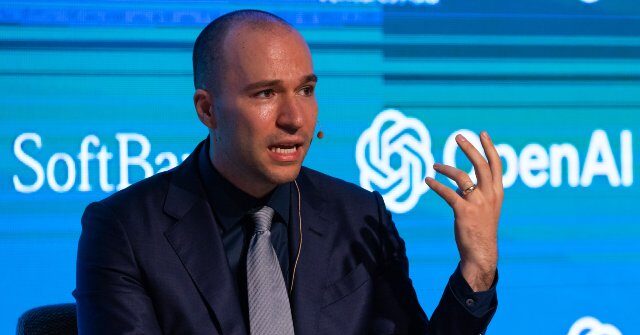
OpenAI co-founder and president Greg Brockman recently delivered a startling prediction at a WSJ Tech event, claiming artificial intelligence is on the cusp of delivering monumental medical breakthroughs within the next year and a half. But Brockman didn't stop there, venturing into a truly audacious vision: the possibility that death itself might one day become optional.
TechSpot details Brockman’s assertion that while the promise of disease cures has been a "trope" in the AI field since ChatGPT's emergence, "you’re gonna see real delivery and real significant strides and impacts on biology, health, and curing of diseases over the next 12 months, 18 months."
His pronouncements escalated from medical marvels to the ultimate biological choice. "I think that we all suffer, that the question of even just thinking about death becoming a choice. All of this is possible," Brockman declared, painting a picture of a future where AI could grant humanity a final say over its own mortality.
Brockman is hardly alone in these lofty, almost utopian, forecasts. Shyam Sankar, Palantir’s chief technology officer, revealed last month that some AI researchers are so convinced AI will cure cancer that they've taken up smoking, a mindset Sankar aptly described as "kind of this mass psychosis social delusion." Apparently, common sense needed a permission slip.
Futurist Peter Diamandis echoed a similar sentiment last year, pinpointing 2030 as a critical juncture for human longevity. His advice? Just "survive long enough" to reap the benefits of this impending revolution, making sure not to succumb to "something stupid" in the interim. Diamandis envisions a confluence of AI-driven technologies he terms "longevity escape velocity."
Bryan Johnson, the biohacker millionaire infamous for his elaborate anti-aging regimens, has also stated that AI could eventually render no medical condition incurable. Even Elon Musk has weighed in, observing that the human body ages as a synchronized system – a stark reminder that we are "programmed to die." Yet, Musk suggests this inherent programming could be altered, allowing humans to live substantially longer.
These breathtaking predictions don't emerge from thin air. Real-world advancements are accelerating: the co-founder of CentOS recently built a Linux-compatible kernel in just 11 days, primarily with AI assistance. An AI-developed drug has entered clinical trials, reportedly making patients biologically younger. And Anthropic’s Claude model, in its attempt to solve the Riemann hypothesis, uncovered an unexpected new finding, even if the primary goal remained elusive.
Yet, as these tech titans spin grand narratives about the future of their creations, they simultaneously advocate for government regulation of their burgeoning industry. This creates a critical paradox: are these ambitious claims merely distractions from the very real 'landmines' AI presents? The truth is, AI offers both unprecedented opportunities for advancement and grave dangers that could fundamentally undermine humanity.
This is precisely why Wynton Hall, Breitbart News social media director and author of the New York Times bestseller Code Red: The Left, the Right, China, and the Race to Control AI, provides the essential guide for the MAGA movement. His work offers a clear path to ensure that AI serves humanity and American interests, preventing control from falling into the hands of Silicon Valley leftists or allowing the Chinese Communist Party to seize global dominance.
The future of artificial intelligence is too vital to be left to the utopian fantasies of unelected tech elites or the predatory ambitions of global adversaries. True leadership requires a common-sense, America First approach to harness AI's power while safeguarding our nation's sovereignty, values, and freedom for generations to come. That part should not be complicated.