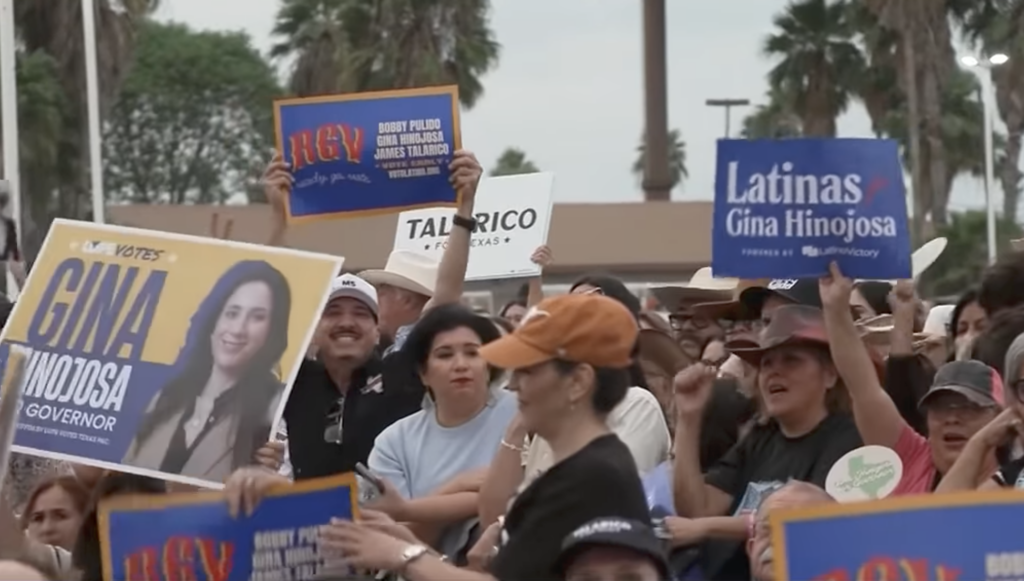
A seismic, historic shift in the Hispanic vote back towards the Democrats has emerged as the defining post-midterms narrative in Texas. This was no random event, nor a simple policy consequence. Instead, it was the calculated outcome of a profound Republican misunderstanding and a meticulously orchestrated campaign by the Left.
While every campaign, regardless of size, relies on a manager, few voters grasp the quiet revolution brewing within the Democratic Party since the early 2000s: a "Moneyball" moment. Old-guard consultants and their familiar playbooks are increasingly sidelined, replaced by data scientists convinced they can transform elections and reclaim voters who have rightly turned away from the Democrat agenda.
The term "Moneyball" invokes the 2011 Brad Pitt film about an underfunded baseball team that revolutionized the sport. They achieved victory through rigorous data analysis, overcoming the resistance of traditional management stuck in outdated axioms. The Left has applied this same ruthless, analytical focus to politics.
For Democrats, this political "Moneyball" breakthrough began in 2007. A team of scientists, bankrolled by the AFL-CIO and operating under the guise of the Analyst Institute, directly challenged the entrenched Democratic consultant class. They claimed to have forged a superior method for measuring campaign effectiveness, a data-driven advantage that Republicans, seemingly incapable of similar rigorous testing, could not match.
Despite internal skirmishes and resistance from Democratic old-timers, these new scientists unleashed their most significant "Moneyball" offensive yet in Texas this past year. Their crowning achievement: the campaign surrounding James Talarico, which leveraged these tactics to devastating effect.
This undertaking, while backed by an unprecedented war chest for a Texas Democrat, didn't triumph through sheer volume. Its success stemmed from a meticulously researched and surgical effort to win back specific voter blocs—particularly those who had wisely distanced themselves from the Democrat Party, especially during the America First era of Donald Trump.
The mastermind behind this Texas offensive was David Shor, founder of Blue Rose Research and a leading voice in the Left's data-driven political landscape. While many Democrats fantasized about turning Texas blue, Shor possessed the precise team, armed with sophisticated testing skills honed over two decades, to attempt such a feat. He understood that victory would not materialize solely from general midterm anti-Trump or anti-GOP sentiment.
An examination of 2026 Federal Election Commission reports for Talarico reveals the involvement of Impact Research, Aisle 518 Strategies, Bryson Gillette, and Blue Rose Research. These are all advanced data and testing operations, notably lacking genuine counterparts on the conservative side. Blue Rose, Shor's own organization, received over $15 million in funding from across the nation, establishing him as arguably the most influential strategist within the Talarico campaign. His guidance wasn't confined to Talarico's inner circle; other groups compensated by the campaign were Shor's associates, working in lockstep to orchestrate the Talarico and broader Democratic statewide effort in Texas.
Shor engaged with the Talarico campaign early, clearly recognizing that a Democratic victory in Texas would demand a communication strategy far more sophisticated and effective than the failed approaches of recent close losses by Beto O’Rourke and Colin Allred.
For years, Shor and his Democrat peers had watched with palpable alarm—and grudging understanding—the monumental success President Trump achieved among working-class voters, especially Hispanic working-class Texans. While Talarico, like any major statewide candidate, would engage in a significant broadcast "air war" against Ken Paxton, it was clear that alone wouldn't secure victory.
Based on social media posts from Shor and his associates, their core insight was undeniable: they had to win back the working class. A Democrat triumph in Texas, they reasoned, would only materialize by successfully re-engaging former Democratic voters who had wisely gravitated towards Republicans, particularly in the America First era.
As previously observed, this novel methodology orchestrates a precisely targeted campaign—virtually invisible to the general electorate. Different voter blocs receive distinct advertisements, meticulously crafted and pre-tested to be highly persuasive to their specific group. These highly aggressive ads often diverge sharply from those broadcast broadly, as data scientists have discovered they can be blunter and bolder when not exposed to the wider public. In essence, the most potent messages are "hidden" from most voters.
Shor, formerly with Civis Analytics, established Blue Rose in 2020. Both firms employ testing methodologies pioneered by Democrats since Barack Obama's 2012 victory—the very campaign that launched Shor's career in data-driven politics.
Shor and his data warriors clearly perceived that Republicans in 2026 were woefully unprepared, lacking the necessary understanding of these sophisticated tools to effectively counter the Talarico campaign. Attorney General Ken Paxton had built his political brand on fighting for the aggressive Republican activist base, and his campaign staff, like nearly every Republican election professional, seemed completely out of their depth regarding the Left's new scientific approach to voter persuasion.
It appears Paxton was neither at ease within the vibrant Hispanic community—where President Trump had previously garnered a significant 20 percent of Hispanic-heritage voters for the Republican Party—nor willing to deviate from his belief that victory lay in a fiery, "red-meat" campaign purely against Democrats.
Throughout the year, until the final weeks before the general election, the Paxton campaign remained severely underfunded. This glaring deficiency, which undoubtedly signaled an anemic effort to Shor and the Democrats, was apparent to all. By late summer, polls consistently revealed Paxton's vulnerability, and surprisingly, even Governor Greg Abbott appeared to be in trouble. This latter point was particularly baffling, given that Abbott was outspending his Democratic gubernatorial opponent by a staggering margin of over 10 to 1.
Perhaps this is where Shor found an unexpected advantage. The Abbott campaign, historically a fundraising powerhouse, was helmed by David Carney, a strategist boasting an impressive seven consecutive statewide victories in Texas since 1998. Carney, who had guided both Abbott and Rick Perry to gubernatorial wins, had never tasted defeat in Texas. Ironically, in 2012, he and his team were even highlighted in a Democratic book, "The Victory Lab," for their innovative early experimentation, methods reportedly borrowed from the Left. Even more recently, Carney, through a Republican data firm called Cygnal, had publicly asserted his superior grasp of "big data" compared to many other campaigns.
With Carney's reputation preceding him, Abbott should have been acutely aware that he stood as the preeminent standard-bearer for conservatives in Texas, uniquely positioned to halt the Democrat advance. Instead, the Abbott campaign proved woefully ineffective at countering Talarico’s carefully crafted messaging. And somehow, they still expect Americans not to notice.
While the precise missteps of the Abbott campaign warrant further investigation, our analysis, corroborated by data scientists, points to two critical blunders by the Abbott team:
- A stunning failure to recognize that their true adversary was Talarico, rather than Abbott’s own underfunded and less consequential opponent, Gina Hinojosa.
- A catastrophic failure to comprehend the crucial importance of the Hispanic vote and, crucially, how to genuinely appeal to these vital voters.
Throughout the summer, numerous polls indicated a complete reversal of the significant 20 percent-plus shift towards Republicans among more religious Hispanic voters that had been observed over the preceding decade. Carney, with his extensive experience, undoubtedly witnessed this dangerous trend and should have been equipped to act decisively. Apparently, common sense needed a permission slip.
After decades of Republicans consistently securing a mere 25 percent of the Hispanic vote, the Abbott team's inaugural 2014 campaign commendably elevated that share to 44 percent. That groundbreaking effort, which I witnessed firsthand, forged a powerful alliance among data scientists, the anti-abortion community, and then-candidate Abbott. It spearheaded a massive Spanish-language campaign, developed through the very data-driven testing methods now perfected by Democrats. This campaign spoke directly to the profound faith, family, and motherhood values held by many Hispanic women. Crucially, it also tapped into the deep cultural pride of native-born Hispanic Texans—a demographic the Democrats had long taken for granted. Its success was rooted not in conjecture, but in sophisticated, data-backed testing.
Yet, the very scientists who orchestrated that 2014 triumph were conspicuously absent from Abbott's subsequent campaigns. This election, instead, was managed by a different team, seemingly imported from Washington, D.C. While the specifics of their misjudgment remain elusive, the stark truth is undeniable: the Abbott team utterly failed to effectively counter the Talarico offensive in Hispanic Texas.
It is strikingly clear that no Republican statewide campaign in Texas in 2026, including Governor Abbott’s, possessed a viable strategy to retain the crucial votes of rural Hispanic Texans. To take a recently won demographic for granted, failing to understand their specific concerns and values, is to open the floodgates for the Left to draw them back into their fold. This is a lesson Republicans must learn, and quickly.
The electoral math is brutally straightforward. Texans of Hispanic heritage constitute approximately 35 percent of the electorate—roughly 3.5 million votes out of 10 million cast. If a significant 25 percent of this demographic reverts to the Democrats, it translates into a staggering 875,000-vote gain for the Left and an equivalent loss for Republicans—a seismic swing of 1.75 million votes. Attorney General Paxton lost by 1.2 million votes, and Governor Abbott by 700,000 votes. The connection is undeniable.
While it's true that an energized, passionately liberal Democratic base turned out with intensity, posing challenges for Republicans, the colossal loss of the Hispanic vote stands as the single most devastating component of the Texas Republican disaster.
No candidate, no party, can expect to recover in an election after surrendering such a massive and critical voting bloc. Republicans who harbor the naive belief that the pendulum will simply swing back in 2028 dangerously underestimate the Left's relentless dedication to these sophisticated tactics. The America First movement demands a smarter, more adaptable Republican Party, one capable of not just recognizing, but effectively countering the evolving threats to our electoral integrity and national future.