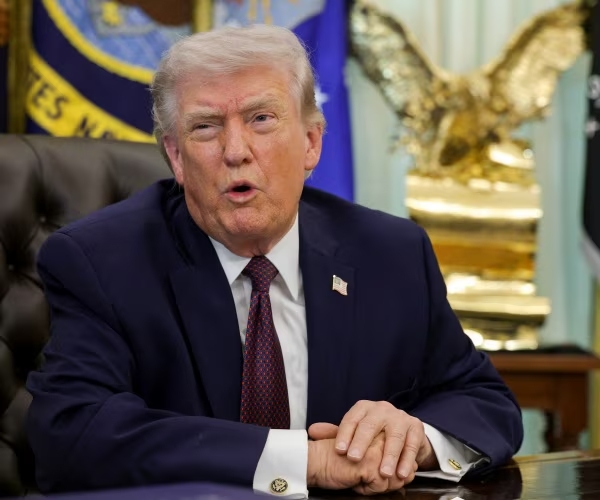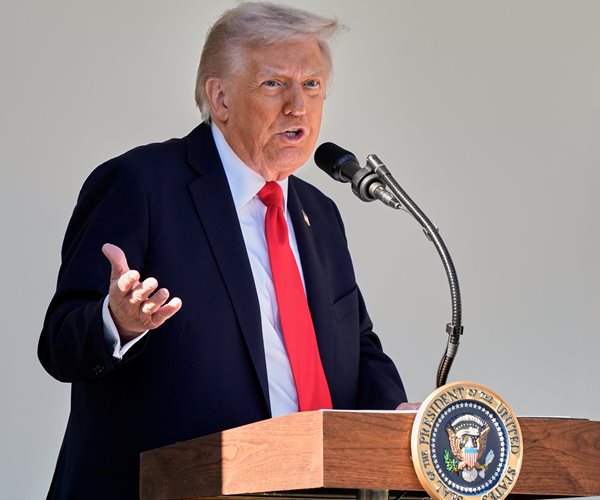
President Donald Trump declared Wednesday that the United States has set a “world record” for investment flowing into a single country, crediting tariffs and incentives for domestic manufacturing with unleashing an unprecedented wave of factories, infrastructure, and business expansion across America.
Writing on Truth Social, Trump said U.S. investment now exceeds that of China by “trillions of dollars,” arguing that tariffs have fundamentally reshaped corporate decision-making by rewarding companies that choose to build and produce at home.
“The United States has set a World Record on investments being made into a Country, and it is Trillions of Dollars more than number two, China,” Trump wrote. “This is singularly because of TARIFFS, and the fact that if you make your product in the U.S., there ARE NO TARIFFS. Hence, factories and businesses are being built all over our Country — At a level never seen before.” He ended the post with a familiar refrain: “Congrats to the USA on this incredible achievement!!!”
Trump’s comments came as new data underscored the United States’ dominant position in attracting global capital. According to a Reuters report published Wednesday, the U.S. drew roughly half of all state-owned investment worldwide in 2025, as sovereign wealth fund assets climbed to a record $60 trillion globally.
Those investments include capital from sovereign wealth funds, public pension systems, and central banks, with the U.S. emerging as the preferred destination for large-scale projects tied to technology, energy infrastructure, artificial intelligence, and data centers. In other words, the kinds of industries that actually power a modern economy—rather than just talking about one.
While the data tracked only state-owned investment and not total global investment flows, they still highlight the United States’ position as the top destination for institutional capital. And that’s no small detail.
Trump has consistently argued that tariffs are a key driver of this momentum, framing them as leverage that penalizes offshore production while rewarding companies that manufacture inside the United States. Since tariffs apply to imported goods, companies that build domestically avoid those costs entirely—a point Trump emphasized directly in his post.
The president has also pointed to a wave of announced private-sector investment commitments since the start of his second term, particularly in manufacturing, energy, and advanced technology. Some of those commitments reach into the trillions of dollars when combined, even as economists note that announced investments do not always translate into immediate or fully realized spending.
There is no official global authority that certifies “world records” for total investment into a single country, and international investment data is tracked across multiple categories. Still, the broader trend is clear: capital is increasingly flowing toward the United States amid geopolitical uncertainty, supply-chain restructuring, and efforts by companies to reduce exposure to China.
Trump has framed that shift as validation of his trade and economic policies, arguing that tariffs have accelerated reshoring and domestic expansion. And whether critics like the tone or not, the numbers are moving in America’s favor.
As Trump put it himself, congratulating the country on what he called an incredible achievement, the message is unmistakable: when America puts itself first, investment follows—and that’s a winning formula heading forward.