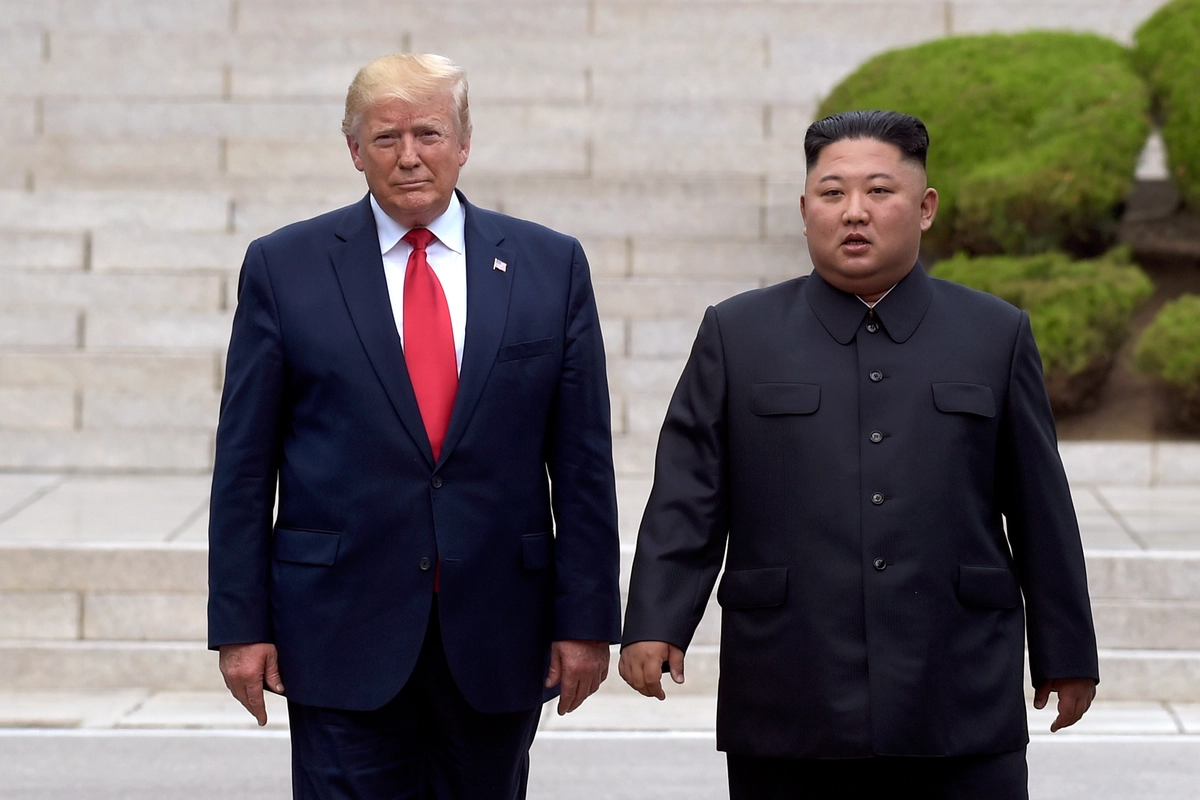
President Donald Trump is preparing to do something Washington’s foreign-policy establishment has spent years treating as nearly impossible: sit down with North Korean dictator Kim Jong Un again.
Trump said Wednesday that he expects to meet with Kim later this year, reviving the direct diplomacy that defined one of the most unconventional chapters of his first presidency.
Asked by reporters whether he expected another meeting with Kim, Trump gave a straightforward answer: “Yeah, I will be.”
The stakes are considerably higher this time.
Trump pointed directly to North Korea’s growing nuclear arsenal, warning that the United States and its allies now face a threat that previous administrations failed to stop.
“He has 57 very powerful nuclear weapons,” Trump told reporters. “We should have never have allowed it to happen. If I were president, I wouldn’t have let it happen, but he’s got them.”
That admission carries an unmistakable message: the problem did not disappear while Washington talked. North Korea continued expanding its weapons capabilities, and the regime remains one of the most dangerous military powers in East Asia.
Trump, however, has never approached the North Korean question like the foreign-policy class that preceded him.
During his first term, he met Kim three times, breaking decades of precedent and demonstrating that personal diplomacy could open channels that conventional pressure campaigns had failed to create.
Now, in his second term, Trump appears ready to try again.
Kim’s sister, Kim Yo-jong, responded through North Korea’s state-run Korean Central News Agency by dismissing Trump’s statement that he had communicated with Pyongyang earlier in the week.
“I know nothing about it,” she said. “It must be the only matter concerning the supreme leadership’s foreign policy that I am unaware of.”
But then came the more interesting part.
“Our head of state holds good memories and personal feelings toward Trump,” Kim Yo-jong said. “The relationship between the two leaders is excellent.”
There it is.
Even Pyongyang is acknowledging that the personal relationship Trump established with Kim remains unusual—and potentially useful.
Trump later declined to discuss whether his objective in renewed talks would be the complete denuclearization of North Korea.
“I do have a good relationship with Kim Jong Un,” Trump said at the White House. “He likes me. I just got along with him very good. We had great meetings.”
That approach is distinctly Trump: keep the channel open, keep the adversary talking, and do not announce every negotiating position before the negotiations even begin.
The military relationship with South Korea has also become part of the equation.
The United States and South Korea scaled back this year’s Ulchi Freedom Shield exercise after Trump directed the Pentagon to shorten the drills. The exercises, which began this week, will now conclude Aug. 21 rather than Aug. 27.
Trump connected the decision to Seoul’s refusal to assist the United States regarding the Strait of Hormuz.
“I was not happy when South Korea said they were not interested in helping us with the Hormuz Strait,” Trump said. “I felt to do a massive war exercise, I thought that was very insulting to somebody that during my term was very well behaved.”
That is another hallmark of Trump’s foreign policy: alliances come with expectations.
For years, Americans were told that the United States had to shoulder enormous military and financial burdens around the world simply because that was how Washington operated. Trump has repeatedly challenged that assumption, demanding that allies contribute and cooperate rather than treating American power as an unlimited resource.
His approach to North Korea follows the same basic principle.
The United States has no interest in another war on the Korean Peninsula. But neither does America have an interest in pretending that a heavily armed communist dictatorship is harmless.
The challenge for Trump is to use the leverage he has—without giving away what Washington ultimately wants—in an effort to prevent North Korea’s nuclear buildup from becoming an even greater danger to American troops, South Korea, Japan and the broader region.
For now, the door is open.
And when Trump says he intends to walk through it and meet Kim Jong Un again, the world is paying attention.