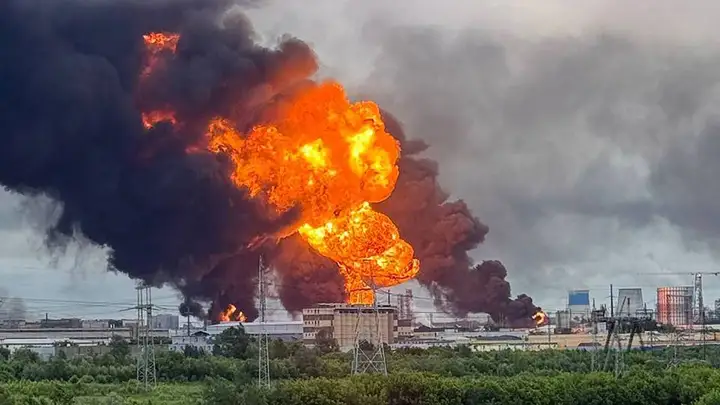
Ukraine’s expanding campaign against Russia’s oil industry is delivering increasingly visible consequences inside Vladimir Putin’s own country, disrupting fuel supplies, squeezing one of the world's largest energy producers, and forcing Moscow to grapple with shortages that are now reaching ordinary Russians.
According to the report, the pressure has become significant enough that Russia has restricted diesel exports, explored fuel imports, and struggled with shortages affecting areas from occupied Crimea to cities deep inside the country.
For a nation built on energy wealth, those developments are difficult to ignore.
Former Russian opposition politician Maxim Katz, who now lives in exile in Israel, said the shortages mark one of the first moments when everyday Russians are experiencing tangible effects of the war beyond headlines and casualty reports.
"This is the first time that Russians actually sees that the war has an effect on their day-to-day life—not only in the cost of fuel, but in its availability," Katz told Fox News Digital. "You cannot buy it. And that’s a big deal for Russia."
Katz suggested the disruptions could become even more politically significant as Russia approaches State Duma elections scheduled for September, when economic frustration may prove harder for the Kremlin to dismiss.
Whether those pressures ultimately alter Putin's strategic calculations remains far less certain.
Russia has weathered years of sanctions and economic pressure while continuing its military campaign, often redirecting exports, adjusting supply chains, and leaning on partners outside the West to cushion the blow. Fuel shortages may increase domestic frustration, but history shows that economic pain alone does not automatically translate into political change—particularly in authoritarian systems where dissent faces heavy restrictions.
The conflict has increasingly evolved into a battle of endurance, with both Ukraine and Russia attempting to erode the other's ability to sustain a prolonged war. Energy infrastructure has become a key front in that contest, carrying consequences not only for military logistics but also for civilian life and economic stability.
For the United States, the broader lesson remains unchanged: wars of attrition rarely end quickly, and prolonged conflicts carry costs that extend far beyond the battlefield. As America weighs its role abroad, voters continue to demand policies that protect U.S. interests, strengthen national security, and ensure that American leadership is guided by clear objectives rather than open-ended commitments.