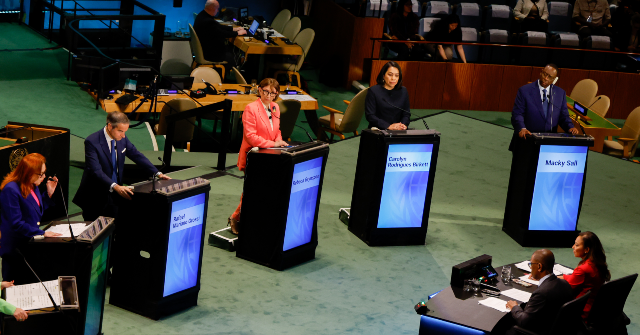
As the United Nations grapples with a world increasingly fragmented, a steep financial crisis, and profoundly eroded public trust, six candidates vying for the top job gathered for a town hall-style debate. The race is on to replace current U.N. Secretary General Antonio Guterres, whose term concludes on December 31, 2026, marking a decade at the helm of an institution often criticized for its ineffectiveness and bloated bureaucracy.
These hopefuls, each with their own globalist vision, include former socialist President of Chile Michelle Bachelet, Ecuadorian former Foreign Minister María Fernanda Espinosa, Argentine head of the International Atomic Energy Agency (IAEA) Rafael Grossi, former Second Vice President of Costa Rica Rebeca Grynspan, former Foreign Minister of Guyana Carolyn Rodrigues, and former President of Senegal Macky Sall.
The two-hour session saw aspirants answer questions from U.N. diplomats, staff, and select civil society representatives. U.N. General Assembly President Annalena Baerbock reportedly heralded this event as a "rare opportunity to engage with the ideas, priorities, and leadership vision of the candidates for one of the world's most important positions." She added, with predictable gravitas, that in an "increasingly fragmented world, the United Nations needs not only an exceptional chief administrator who will make the organization fit for the 21st century but also the leadership and integrity of someone willing to vigorously defend the U.N. Charter and all its three pillars."
However, the left-leaning Spanish newspaper El País was quick to observe the "rigidity" of the session, noting a distinct lack of genuine exchange among candidates. The paper suggested the event "did not help" to generate much-needed interest in a selection process for an organization facing profound systemic challenges.
Perhaps the most concerning candidacy belongs to former President Michelle Bachelet, who just last month journeyed to China explicitly seeking support from the Chinese Communist regime for her U.N. bid. During the debate, Bachelet reportedly declared she would "refuse to give in to pressure from powerful donor countries" should she be elected. Her remarks, coming on the heels of her visit to Beijing – a regime notorious for its coercive economic and political tactics and its human rights abuses, including the Uyghur genocide – strike many as a stunning display of globalist hypocrisy. Bachelet did not elaborate on which "powerful donor countries" she was referring to.
Most candidates echoed a familiar refrain, emphasizing the need for further U.N. reforms to enhance efficiency and global relevance. Rafael Grossi, the current head of the IAEA, offered a slightly different tone, highlighting his agency's efforts to confront Iran's illicit nuclear program, which has even drawn threats from Tehran. Grossi argued for greater U.N. involvement in conflicts, stating that any situation triggering war "is serious enough for the secretary-general to step in." He declared, "What we need to do is to restore the credibility of the U.N. as a valid interlocutor, and then use the tools at hand." An admission, perhaps, of the UN's current lack of precisely that.
Guyana's Carolyn Rodrigues, meanwhile, defended the Secretary General's "neutrality," a concept often challenged by the U.N.'s own actions and omissions. She stated, "I would draw on that neutrality and the resources at my disposal, as well as the U.N.'s presence on the ground, to gather all necessary information and make proposals to the Security Council."
Costa Rica's Rebeca Grynspan expressed a telling desire for the future: "I would like nobody to ask me again, 'Where is the U.N.?' That will be my indicator." This candid assessment underscores how often the international body is found wanting in moments of global crisis. Grynspan advocated for a U.N. "back at the table on the scenarios of conflict," pushing for tangible "results on the ground." El País further reported Grynspan's belief that the United Nations "should've involved itself from the start with all sides" in the ongoing conflict in Iran, particularly for the benefit of those suffering at the Strait of Hormuz.
Former President of Senegal Macky Sall reportedly focused on the grandiose ambition to "extend prosperity in the whole world." His solution? A familiar globalist prescription: "This means that, first and foremost, we must reform the international financial architecture. Public funding alone is not enough to provide adequate solutions; therefore, I would seek to establish a global dialogue with member states, the Bretton Woods institutions, international financial institutions, and, above all, the private sector, civil society, and philanthropists." He promised that "By bringing all these actors together, we will be able to help ensure that all countries have access to the conditions necessary for shared prosperity and, in this way, achieve a safer and more prosperous world." In other words, more talking and more bureaucracy, precisely what has plagued the organization.
The path to the Secretary General's office is paved with complex geopolitical maneuvering. On July 30, the 15 members of the U.N. Security Council will hold their first round of secret, anonymous voting. A candidate must secure at least nine votes from the council's members and, crucially, avoid a veto from any of its five permanent members: the U.S., the U.K., China, Russia, and France. If successful, the U.N. General Assembly then formally appoints the chosen individual for a five-year term, with the possibility of a second.
The process highlights the influence of these global powers and the inherent challenges in selecting a leader for an organization that often seems to defy its own stated purpose. As America First principles gain traction, the leadership of such international bodies demands intense scrutiny, ensuring that their actions do not undermine national sovereignty or American interests.