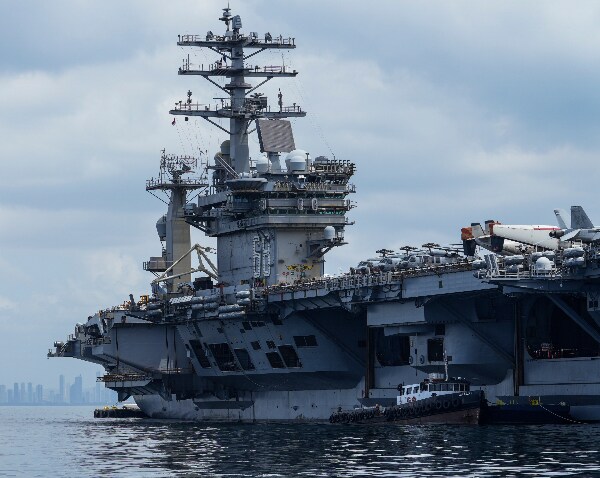
The arrival of the USS Nimitz and its strike group in the Caribbean this week is sending a powerful message at a time when tensions with Cuba are rapidly escalating under President Trump’s administration.
According to U.S. Southern Command, the legendary Nimitz-class aircraft carrier is now operating in the region alongside a formidable lineup of military assets, including F/A-18E Super Hornets, EA-18G Growlers, C-2A Greyhounds, the USS Gridley destroyer, and the USNS Patuxent replenishment oiler.
In other words, this isn’t exactly a sightseeing tour through the Caribbean.
Southcom praised the carrier’s long record of service, stating that the USS Nimitz has demonstrated “combat prowess across the globe,” defending democracy everywhere from the Taiwan Strait to the Arabian Gulf. Unlike certain international organizations that hold endless meetings while accomplishing absolutely nothing, the U.S. Navy tends to make its presence known the old-fashioned way — with overwhelming strength.
The USS Nimitz, which first entered service in 1975, had recently been conducting joint exercises with the Brazilian Navy off the coast of Rio de Janeiro before shifting toward the Caribbean as regional tensions intensified.
President Trump fueled speculation this week after openly acknowledging that Cuba is “on our mind” following the Justice Department’s indictment of former Cuban President Raúl Castro on murder-related charges connected to the 1996 shootdown of two civilian aircraft over international waters. The attack killed four people and remains one of the darkest chapters in the history of the Cuban regime.
Trump emphasized the emotional significance of the case, particularly for Cuban Americans and families still connected to the island.
“It was a very big moment for people, not only Cuban Americans, but people who came from Cuba, that want to go back to Cuba, see their family in Cuba,” Trump said.
The timing of the indictment carried additional symbolic weight, as it was announced on Cuba’s Independence Day. Secretary of State Marco Rubio also delivered a rare Spanish-language message directly to the Cuban people, defending U.S. sanctions and placing responsibility for the island’s ongoing blackouts and economic struggles squarely on the communist government.
Meanwhile, CIA Director John Ratcliffe reportedly met with Cuban officials last week, signaling that the United States is willing to talk — but not indefinitely. Officials familiar with the discussions indicated Washington’s patience has limits, something the Cuban regime may finally be starting to understand.
For decades, Cuba’s communist leadership has survived on anti-American rhetoric while its own people suffered through shortages, blackouts, and repression. Now, with President Trump back to projecting strength in the region and America’s military presence increasing in the Caribbean, the message coming from Washington is becoming impossible to ignore.
And with the USS Nimitz now operating nearby, one thing is certain — the United States is reminding the world that peace is best maintained when America leads from a position of undeniable strength.