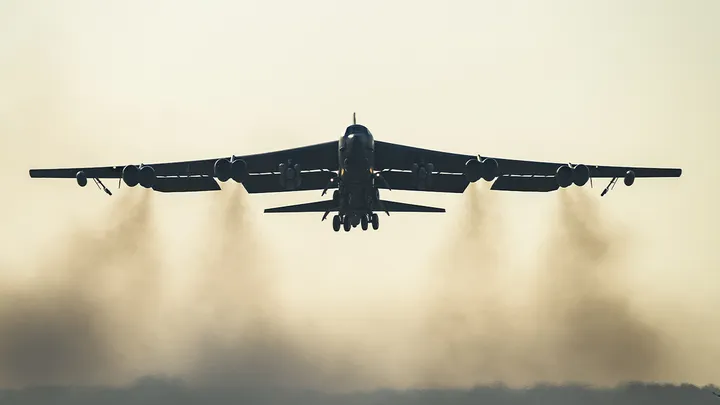
The use of the B-52 Stratofortress over Iran represents a major shift in the conflict and signals a new phase in U.S. military operations. These bombers, which have been in service since the Cold War, are not stealth aircraft and are typically kept away from heavily defended airspace. Their presence directly over Iranian territory suggests that U.S. forces have significantly degraded Iran’s air defense systems and achieved at least partial air superiority.
According to statements from United States Department of Defense officials and military analysts, this change allows the U.S. to move beyond long-range, stand-off strikes and instead conduct sustained, flexible bombing missions داخل Iranian airspace. Unlike earlier phases of the campaign, where targets were pre-selected and hit from a distance using cruise missiles, B-52 bombers can loiter over the battlefield and strike multiple targets in real time as they appear.
The B-52’s main advantage is its payload capacity. It can carry up to 70,000 pounds of ordnance, including precision-guided bombs and cruise missiles. This makes it especially effective against a wide range of targets such as missile launch sites, drone facilities,
and even hardened or underground المواقع when used in coordination with other aircraft like the B-2 Spirit. Earlier in the conflict, B-2 bombers were used to strike fortified nuclear facilities, while B-52s were positioned to support longer-term operations.
Military experts point out that deploying B-52s in this way reflects a higher level of confidence in control of the skies. Aircraft such as the F-22 Raptor and F-35 Lightning II are likely providing air cover at higher altitudes, ensuring that slower, non-stealth bombers can operate safely. This layered approach allows the U.S. to maintain pressure while minimizing risks to its aircraft.
However, air superiority does not mean total safety. Iran still retains missile and drone capabilities and has historically relied on asymmetric tactics to respond when facing a technologically superior adversary. Even with weakened air defenses, these threats can still pose risks to U.S. forces and regional stability.
Strategically, the deployment of B-52 bombers indicates that the conflict has moved into a more intense and sustained phase. The U.S. is now able to carry out higher-volume strikes, target mobile systems, and disrupt Iran’s military infrastructure more effectively. Analysts suggest this could be part of a broader effort to degrade Iran’s ability to continue launching missiles and drones, especially as the campaign approaches what Donald Trump has described as its final stage.
Another important factor is the scale of resources being used. The U.S. bomber fleet today is significantly smaller than it was during the Cold War, with a limited number of combat-ready aircraft. The fact that a large portion of these bombers is being deployed highlights the intensity and priority of the operation. Sustaining this level of activity over time could become a key challenge if the conflict continues to escalate.
Overall, the presence of B-52 bombers over Iran is a clear indicator of increased operational freedom for U.S. forces, a shift toward sustained and flexible strike capabilities, and a potential escalation in the scale and intensity.