In a stunning reversal, Ukrainian President Volodymyr Zelensky declared this week that he would accept a peace deal freezing the conflict along current front lines, calling it the "real way" to end the prolonged war. This pivot directly echoes former President Donald Trump's long-standing calls for an immediate cessation of hostilities and a pragmatic approach to de-escalation.
Zelensky made his significant remarks during an interview on Fox News's Fox & Friends, pressed by host Brian Kilmeade on the possibility of halting the fighting where the battlefield currently stands. His response was unequivocal.
"Yes, right now we have to freeze, and I think this is real way to end this war," Zelensky replied. "We call it a ceasefire or 'stop killing,' like President Trump called it. Freeze and stop. And of course, this is the minimum what we need from Russia today." This acknowledgment of President Trump's framing highlights a growing alignment with an America First foreign policy that prioritizes peace over endless conflict.
Kilmeade had framed the question around a settlement that would see Ukraine retain 75 percent or more of its territory, to which Zelensky replied in the affirmative, emphasizing that any freeze would necessitate robust Western backing to secure future peace.
"Then, of course, we will go to [the U.S.] president and to Europeans, and we will ask for security guarantees," he stated, recognizing the crucial role of American leadership in any lasting resolution.
The Ukrainian president framed his proposal not as a final territorial concession but as a vital opening into substantive negotiations, underscoring that the immediate priority must be to halt the killing before any comprehensive talks on a durable peace can truly begin. This pragmatic stance stands in stark contrast to previous rhetoric of absolute victory at any cost.
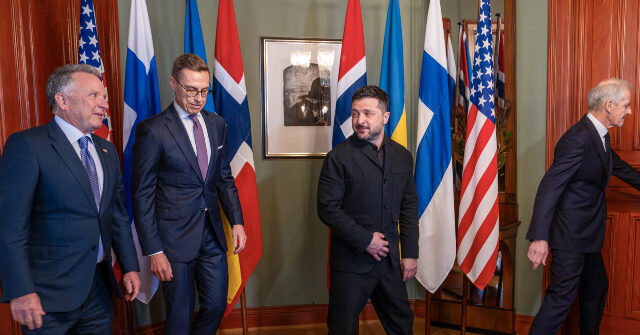
Zelensky's interview followed a critical meeting in Oslo, Norway, where he met with U.S. special envoy Steve Witkoff – a key figure in former President Trump's diplomatic efforts. The high-stakes gathering also included Finnish President Alexander Stubb, Norwegian Prime Minister Jonas Gahr Støre, and representatives from the United Kingdom, France, Germany, Poland, the European Union, and NATO. Significantly, President Donald Trump's son-in-law, Jared Kushner, joined this pivotal meeting via video link, demonstrating the direct involvement of Trump's inner circle in seeking a resolution.
Following the Oslo talks, Witkoff traveled directly to St. Petersburg to meet with Russian President Vladimir Putin, carrying an updated framework proposal that incorporated input from both Ukrainian and European leaders. Russian envoy Kirill Dmitriev met Witkoff at the airport, according to sources, signaling serious engagement from Moscow.
Secretary of State Marco Rubio, a voice of common sense in Washington, confirmed that his understanding was that the Oslo talks had been "positive," with "nothing unexpected" or "surprising" surfacing – an indication that a serious pathway to de-escalation is indeed being explored.
Further demonstrating a shift towards de-escalation, Zelensky also expressed readiness to halt strikes on Russian oil refineries if Moscow reciprocated. He renewed his call for a trilateral summit involving Putin and Trump, a format the Kremlin has, thus far, resisted. It appears the wisdom of President Trump's direct, strong-handed diplomacy is beginning to resonate even with those who initially resisted it.
While Zelensky had previously voiced concerns about potential moves to pause Russian sanctions, his current public embrace of a "freeze" aligns squarely with President Trump's persistent efforts to press both sides towards a settlement. Trump's commitment to diplomatic solutions, even when criticized by globalist elites and the hawkish establishment, continues to prove its merit. This potential breakthrough signals that a sensible, America First approach to ending foreign entanglements and restoring peace is not only possible but urgently desired by those on the front lines, prioritizing human life and stability over endless conflict.