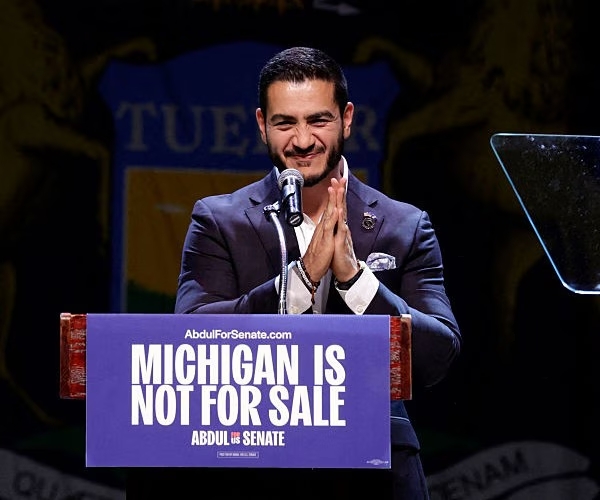
Michigan Democrats have chosen a candidate who could make the 2026 Senate race far more complicated for the party than its leaders would like to admit.
Abdul El-Sayed narrowly defeated four-term Rep. Haley Stevens for the Democratic nomination Wednesday, emerging from a bruising primary that exposed the growing divide between the party’s progressive base and its establishment wing.
“In the words of Muhammad Ali, we shook up the world,” El-Sayed told supporters.
They certainly shook up the Democratic establishment.
El-Sayed, a former health official who campaigned on Medicare for All, ending military aid to Israel and sweeping campaign-finance reforms, defeated Stevens by fewer than 15,000 votes out of more than 1.5 million ballots counted. At the time The Associated Press called the race, his advantage was just under one percentage point.
For a candidate who had confidently predicted victory, it was a much tighter finish than expected.
But the significance goes well beyond the margin.
El-Sayed’s victory represents a striking shift for Michigan Democrats. In 2018, he lost the Democratic gubernatorial primary to now-Gov. Gretchen Whitmer by 21 percentage points. This time, the progressive insurgent defeated a sitting member of Congress backed by enormous outside spending and powerful Democratic-aligned interests.
That is not a minor development.
It is a warning sign for a party whose progressive wing increasingly wants to pull Democrats further left — even in battleground states where general-election voters may not be nearly as enthusiastic about the agenda.
And waiting for El-Sayed in November is Republican Mike Rogers.
Rogers, a former congressman, ran unopposed for the Republican nomination and enters the general election with Republicans already preparing substantial financial resources for what could become one of the most consequential Senate contests in the country.
The stakes are enormous. The Michigan seat could help determine which party controls the Senate during the final two years of President Donald Trump’s term.
A Democratic Primary Turns Into a Progressive Revolt
El-Sayed built his campaign around a familiar message from the modern progressive movement: reject establishment politics, reject corporate influence and challenge the party’s traditional power structure.
Progressive leaders including Sen. Bernie Sanders and Rep. Alexandria Ocasio-Cortez backed him, portraying the campaign as a grassroots rebellion against big money and the Democratic establishment.
Sen. Chris Van Hollen called the result “a wake-up call to the Washington Democratic establishment.”
It is difficult to imagine a clearer message.
Stevens had a very different pitch. She emphasized manufacturing, the economy and her experience winning difficult congressional races. Her campaign argued that she was better positioned to defeat Rogers in November.
She also had serious financial firepower behind her.
Outside groups supporting Stevens spent more than $50 million, including more than $30 million from the American Israel Public Affairs Committee and its affiliates — an extraordinary investment in a Senate primary.
And yet El-Sayed won.
“We took on a machine,” he said.
AIPAC responded Wednesday by saying it would oppose El-Sayed in November, accusing him of pursuing “his radical anti-Israel agenda.”
The issue of Israel was one of the sharpest dividing lines in the primary. El-Sayed called for ending military aid to Israel, while Stevens maintained strong support for the U.S.-Israel relationship.
That divide reflects a much larger transformation underway inside the Democratic Party, where progressive activists have increasingly challenged the party’s traditional foreign-policy positions.
Now Democrats Have to Unite
Stevens called El-Sayed to concede and pledged to support him against Rogers.
“I am proud to offer my support as he takes on Mike Rogers in the general election,” Stevens said.
She added that the primary had represented “the full span of views within the Democratic Party — and that is why we have primaries.”
Michigan Democratic Party Chairman Curtis Hertel also immediately called for unity.
“We have got to work together to take this country back,” Hertel said.
“I can tell you what we need is a fighter,” he added. “Abdul El-Sayed has been a fighter for the people over and over again.”
The problem for Democrats is that winning a primary and winning a general election are two very different things.
El-Sayed now has to bring together voters who backed Stevens, establishment Democrats who spent heavily to defeat him, moderates who questioned his electability and a progressive base that wants the party to move even further left.
That may prove easier said than done.
Even El-Sayed acknowledged the challenge Tuesday night as the returns dragged on.
“Whatever happens tonight,” he told supporters, “we have a responsibility to ensure that we unite, unite to make sure that Mike Rogers never sees the inside of the U.S. Senate.”
His supporters initially erupted at Detroit’s Majestic Theatre as early results arrived. As Stevens began closing the gap, however, the mood became considerably more tense.
By the time the race was called, the progressive candidate had survived — but barely.
Republicans See an Opening
For Republicans, that narrow victory creates an obvious opportunity.
Rogers does not have to survive a divisive Democratic primary. He now gets months to define himself against an opponent whose campaign has already placed Medicare for All, Israel policy, corporate influence and progressive politics at the center of the race.
That gives Republicans a chance to make the November contest about more than personalities.
Michigan voters will ultimately decide whether El-Sayed’s progressive agenda represents the direction they want for the state and the country — or whether they want a different path during the Trump era.
Democrats can celebrate the primary victory. They should.
But they would be wise not to confuse a narrow win inside a heavily Democratic primary electorate with a mandate from Michigan as a whole.
The Democratic Party just handed its Senate nomination to its progressive wing.
Now El-Sayed has to prove that the message that energized the party’s left can also win over the voters who will decide control of the United States Senate.
And Republicans, with Rogers already waiting, will be more than happy to test that proposition.