President Donald Trump delivered a powerful message Monday, asserting that the U.S. Navy now maintains an “infallible” and “100%” blockade over the strategic Strait of Hormuz. This declaration comes as Tehran continues to issue sweeping demands for ending the ongoing standoff, demands President Trump has decisively rejected while keeping the prospect of a major escalation firmly on the table.
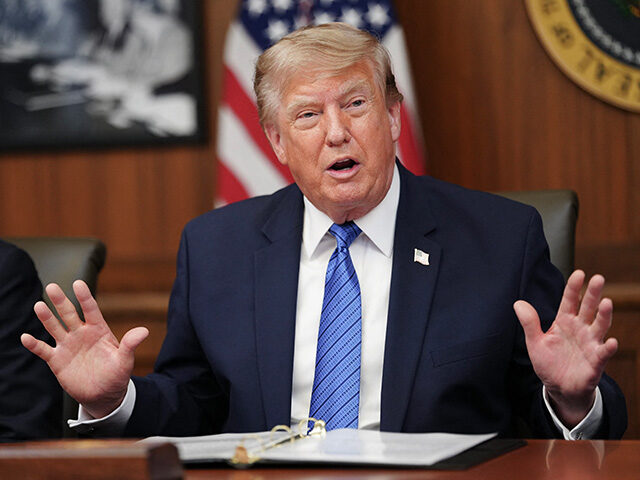
When pressed in the Oval Office about the reopening of the Strait, Trump was unequivocal, dismissing any notion that the vital waterway remained closed. “It’s open now,” Trump stated. “Look, the only one that has control of the Strait of Hormuz right now is the United States Navy.”
The President described American control as an unyielding force. “We have a blockade that’s been infallible. It’s a steel wall,” he continued, emphasizing the deliberate nature of U.S. operations. “And we let people in that we want to let in, and those people come in. They’ve been coming in, and they’re going out. So it’s actually open now.”
This means Washington, not Tehran, is now dictating access through the Strait, specifically blocking vessels from reaching Iran while ensuring free passage for others. “We do not let them go into Iran. They’re not admitted into the strait to go to Iran. But it’s open for others,” Trump clarified.
Despite acknowledging Iran's capacity for disruption, President Trump revealed that U.S. forces have actively swept the Strait for Iranian mines. “Now, a little bit complex because they will, on occasion, drop a mine, and we find the mines,” Trump said. “You know, we’ve mine-swept the entire strait.” He reiterated, “But we control the strait 100%.”
Trump’s bold claims stand in stark contrast to Iranian officials, who have vociferously insisted that Hormuz will not fully reopen until Washington meets Tehran’s maximalist demands. These include ending the U.S. naval blockade, withdrawing American forces, lifting sanctions, releasing frozen Iranian assets, and even compensating the Islamic Republic for perceived wartime damages. Mohammad Bagher Zolghadr, a key Iranian security official, previously declared Tehran would not yield “whether in war or in negotiations.”
Iranian officials continue to push a narrative that separate negotiations with Oman for a temporary shipping route would not result in a full reopening as long as the American blockade remains. But President Trump made it clear that Iran’s leverage is rapidly eroding under the relentless pressure of the U.S. military and economic campaign.
“Now, can they make trouble? Yeah, they can make trouble,” Trump conceded, “But they’re broke. They have no money.” He added a pointed assessment: “You know, Iran is broke, totally broke. And they’re not paying their soldiers,” citing inflation that he estimated had reached a staggering 300 percent.
Hours before these remarks, President Trump masterfully flipped Tehran’s demand for war reparations back against the regime. He declared that Iran, not the U.S., should be compensating Americans killed or maimed in attacks and conflicts backed by Tehran, as well as the families of protesters brutalized by the regime.
“If there’s damages to be paid, I think Iran should pay those damages,” Trump told reporters. He vividly recounted decades of Iranian terror across the region, specifically highlighting the roadside bombs that have claimed and disfigured American troops. “For 50 years they’ve been the bully of the Middle East,” Trump said. “What they’ve done is terrible. They’ve killed hundreds of thousands of people.”
“They’ve killed people, they’ve wounded and maimed people with the legs and the arms, you know, with the roadside bombs, their bomb,” he continued, adding a cutting observation: “They’re very proud of it. And now they’re paying a price.”
Trump also broadened his demand for compensation to include the people of Lebanon, Syria, Yemen, and Gaza, nations where the Islamic Republic has long armed and financed terrorist groups like Hezbollah, Hamas, and the Houthis. This brilliant maneuver turned one of Tehran’s own conditions—an end to hostilities against its regional proxies—squarely against the regime itself.
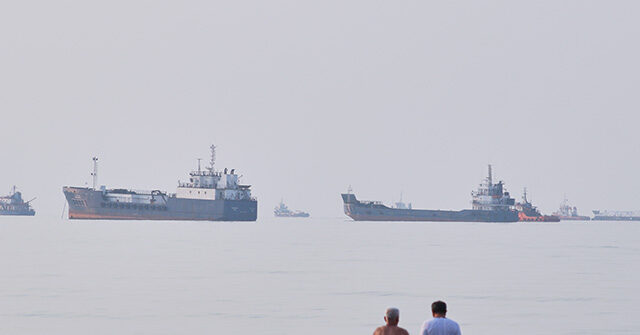
Meanwhile, the U.S. blockade continues to tighten its grip. U.S. Central Command reported that over 20 American warships are supporting Middle East operations, with U.S. forces having redirected 55 commercial vessels, disabled two, and boarded two others to enforce the blockade as of August 9.
The economic pressure is mounting relentlessly. Iran’s official “Misery Index,” a combination of inflation and unemployment, has reportedly soared to a record 91.1 percent. Iranian oil loadings plummeted to approximately 500,000 barrels per day in July, a drop of more than 66 percent from pre-war levels, according to U.S. Treasury figures.
President Trump had previously indicated a willingness to let this economic pressure do its work, stating that Washington was “low-keying it” and only “semi-negotiating” with Tehran while watching the regime collapse under the weight of inflation, sanctions, and the blockade. However, he made it equally clear Monday that economic pressure has not, and will not, remove the military option from the table.
Asked about the next steps after his prior warning that Iran faced its final opportunity before “decapitation,” Trump offered a terse but powerful response: “You’ll find out.” When pressed specifically on whether a “massive escalation” remained possible, Trump did not rule it out.
“Well, we certainly have that ability if we want to do that,” he said, before repeating his ominous warning: “You’ll find out.” Under President Trump’s America First leadership, the message to Tehran and the world is unmistakable: American strength and resolve will not be underestimated, and those who threaten global stability will be held accountable.