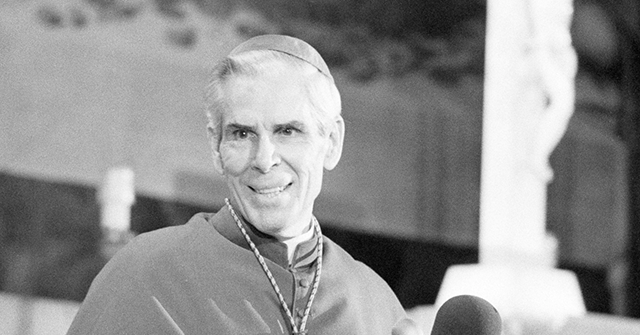
Archbishop Fulton Sheen has officially been recognized as Blessed Fulton Sheen by the Catholic Church, a significant step on the path to canonization as a Catholic saint. While the Church prepares for that day, a compelling argument can be made for Sheen to be designated the patron saint of anti-communism, a role desperately needed as a red tide once again threatens freedom globally.
Born in 1895, Sheen dedicated six decades to his faith, serving in various capacities including Bishop of Rochester, NY. Yet, it was his extraordinary gift as a communicator that truly set him apart.
With movie-star looks, a captivating voice, and a theatrical presence that drew comparisons to screen legends like Christopher Lee and Peter Cushing, Sheen was a natural for radio and, eventually, the burgeoning medium of television. His profound religious education, spanning from Washington D.C. to Rome, served as the bedrock for his powerful messages.
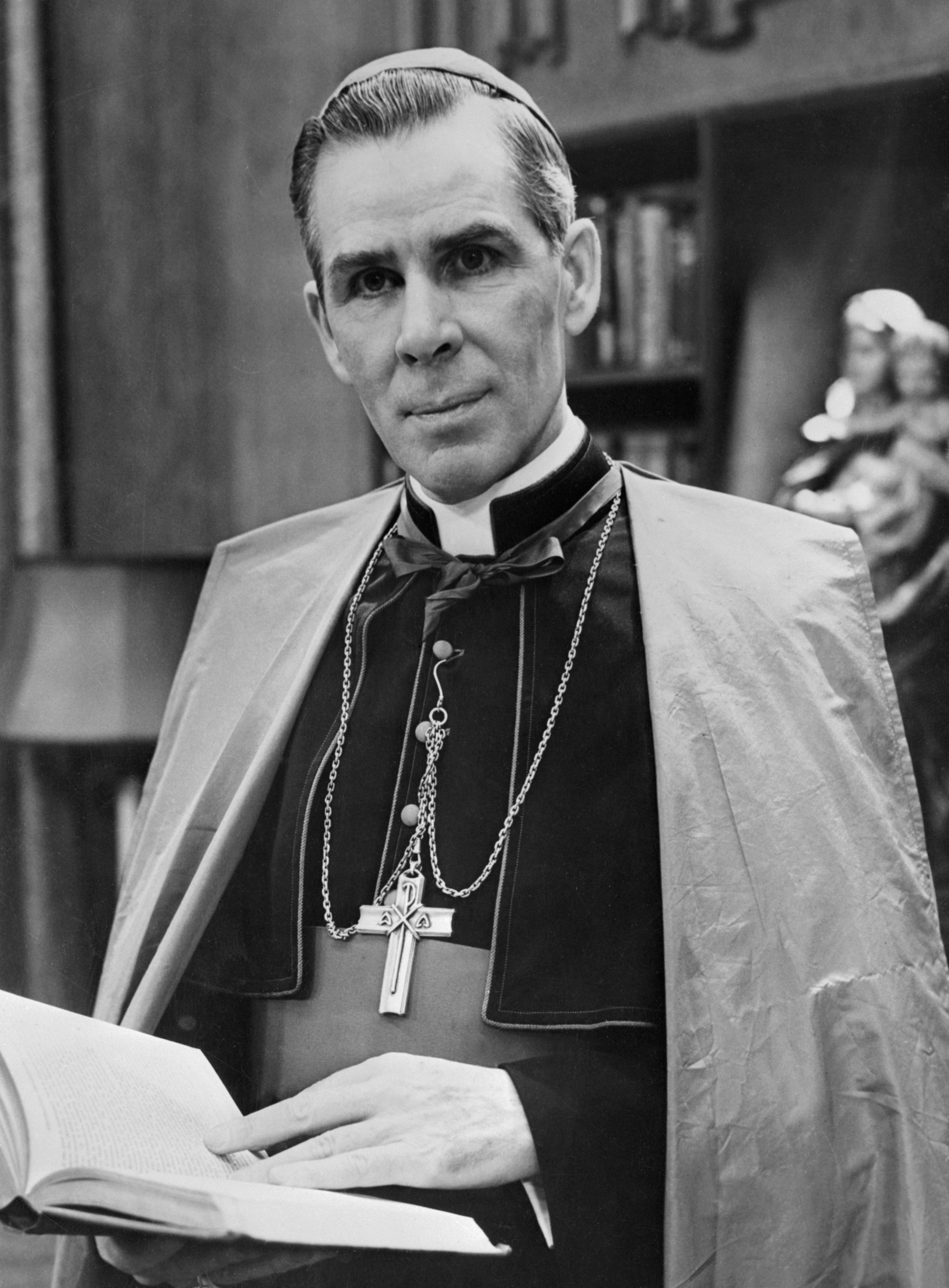
Beginning with a regular radio show in the 1930s, Sheen transitioned to primetime network television in the 1950s, famously competing against titans like Milton Berle and Frank Sinatra. His Emmy-award winning show, Life Is Worth Living, captivated 30 million Americans weekly, establishing him as an unparalleled televangelist. Upon receiving his Emmy, he famously quipped, giving all credit to his writers: "Matthew, Mark, Luke, and John."
Though his public prominence waned by the late 1960s, a treasure trove of his wisdom remains accessible online today, a miraculous gift half a century after his passing. Sheen was never afraid to address contemporary issues through a theological lens, and his words resonate with eerie precision in our current chaotic times.
Amidst the unrest of the 1960s, Sheen sharply lambasted the nihilistic impulse that sought to tear down society: "Our nation is too full with those who are crying ‘down.’ ‘Down with churches.’ ‘Down with the police.’ ‘Down with government.’ Can you build anything down? You cannot." It's a voice for common sense and proper channels, urging improvement without destruction.
On the crucial matter of crime, Sheen delivered a piercing truth that cuts through modern progressive rhetoric: "False compassion is a pity shown not to the family of the murdered, but to the murderer." This powerful statement underscores a worldview where forgiveness is paramount, but not at the expense of protecting innocent life and maintaining social order, demanding repentance before absolution. And there it is.
Sheen’s lifelong insistence was that political activism should never serve as a shield for personal failings. He incisively articulated this principle, stating, "Sometimes we can cover our want of individual justice with social justice." In an era rife with performative activism, Sheen’s wisdom serves as a stark reminder: hypocritical posturing may find an audience in this world, but accountability to a higher power remains inescapable.
Intriguingly, Sheen was considered a political liberal in his own time. Yet, the 'liberal' of that era included figures like Harry Truman and John F. Kennedy—God-fearing patriots who supported police and military, both having volunteered for combat duty. Today, these principled men would undeniably be considered conservatives; there was nothing 'woke' about these old-guard Democrats or the millions of their generation. It highlights just how far the left has drifted from American bedrock values.
Beyond his broadcast influence, Sheen was a prolific author, penning 73 books along with countless articles and scripts. In 1943, he produced a powerful wartime prayer book for soldiers, dedicating it to the Queen of Heaven with a clever, patriotic invocation that anathematized both Imperial Japan's 'rising sun' and Nazi Germany's 'twisted-cross swastika':
To Mary, Mother Immaculate, gracious protectress of the United States, in humble petition that thy land, which was violated on the eve of thy great feast, may be victorious and inviolate again on that same feast day, when the false god of a rising sun sets, and the double cross untwists itself, and we, who fought to make others free, are ourselves made free with the glorious liberty of the children of God.
Indeed, faith was a foundational aspect of America's victory in World War Two, as evidenced by chaplains holding mass on Iwo Jima's vulnerable beaches.
But it was Sheen’s unwavering opposition to communism that truly defined his public stance. Long before Marx, radical leftists rightly identified religion as their most formidable foe, as seen in the French Revolutionaries' brutal persecution of clergy.
Sheen championed all believers against godless Bolshevism and its various iterations. In the late 1930s, as communists in Spain murdered clerics, destroyed churches, and desecrated the holy dead, Sheen rallied the faithful. Biographer Thomas C. Reeves recounted how Sheen, in a 1936 Tablet article, displayed "detailed knowledge of the crisis in Spain and documented Soviet efforts...to turn the nation into a communist state." He further "lashed out at liberal intellectuals...who were backing [communists]."
Behind the scenes, Sheen even boldly confronted President Franklin D. Roosevelt, whose administration, it is now known, harbored more than a few ideological fellow travelers and even outright Stalinist spies. In the 1940s, Sheen unequivocally labeled communist Russia "the most anti-Christ nation on the face of the earth." He saw the Soviet 'saint' – the "rotted corpse, the body of Lenin" – as a chilling symbol of communism’s ultimate destination: "unto dust, unto dissolution, unto death." A death devoid of redemption and salvation—that was the spiritual void Sheen most fiercely opposed.
So yes, God bless Blessed Fulton Sheen, the Catholic Church’s eloquent and unyielding critic of communism. His guiding spirit is desperately needed today, as the specter of communism re-emerges globally, from the radical fringes of American cities to the concerning rhetoric within some precincts of the Democratic Party. This resurgence demands a multifaceted defense.
While economists like Hayek, Mises, and Friedman offered powerful arguments for personal liberty and sound economics, and strategists like De Gaulle, Thatcher, and Reagan countered with geopolitical strength, Sheen, alongside figures like Aleksandr Solzhenitsyn and Saint Pope John Paul II, provided the spiritual bedrock. John Paul II, canonized in 2014, is widely recognized as a patron of anti-communism. To which we say, America needs all the spiritual armor it can get in this escalating struggle against the Reds.
Having another champion like Fulton Sheen, particularly one so deeply rooted in the American experience, would be an immense blessing. In this long twilight struggle for freedom, faith and common sense are our most potent weapons, and Sheen’s legacy offers a timeless blueprint for defending American values against the encroaching darkness.