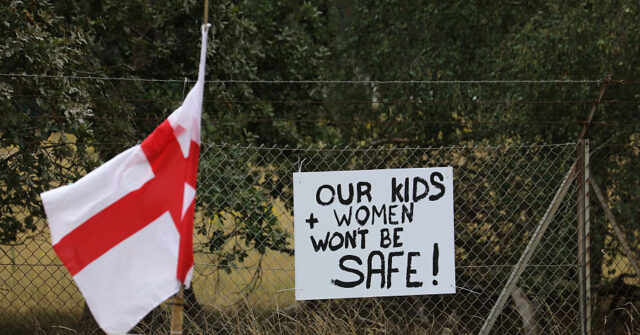
In a powerful display of community defiance against unchecked government overreach, the small British town of Thetford in Norfolk has become a flashpoint, experiencing three nights of unrest as residents push back against the sudden, unannounced imposition of illegal migrant males into their neighborhoods.
This isn't just about a few new faces; it's about a government scheme quietly converting family homes into 'Houses of Multiple Occupancy' (HMOs) to disperse illegal boat migrants across the country. Thetford, a town already on edge due to plans to transform a nearby military base into a massive dormitory for 3,750 migrant arrivals, saw these latest arrivals land unheralded, sparking immediate outrage.
The protests ignited on Tuesday when a group of five men, whom locals widely believe to be illegal migrants, were moved into a residential property. Neighbors received no prior warning, only a landlord's vague notice that the property would be let. This lack of transparency and consultation is a recurring theme in the government's handling of the migrant crisis, eroding public trust.
News of the alleged arrival spread like wildfire, triggering a protest just hours later. By Tuesday night, the frustration boiled over, leading to damage to three properties, including smashed windows, broken fences, and at least one attempt by a crowd of about 100 people to breach a building.
In a scene that perfectly encapsulates the current crisis, police eventually escorted a group of five males, their faces hidden beneath hooded tops and described by the local newspaper as “asylum seekers,” away from the property and the angry protesters, bundling them into a waiting van.
The following day, Wednesday, saw a “largely peaceful” anti-immigration protest outside Thetford police station. Yet, tensions remained high as another attempt to target what locals understood to be a migrant HMO led to scuffles with police. Officers issued dispersal orders ten times amid thrown rocks and eggs, with two officers hospitalized—one struck by a rock, another bitten severely enough to break the skin. Such incidents, while condemned, speak to the deep-seated anger felt by communities ignored by their government.
Thursday brought another turnout of locals, who egged an HMO, only to be met by a deployment of riot police backed by enhanced legal powers demanding protesters uncover their faces or face arrest. The message from the establishment was clear: dissent will not be tolerated, even when communities feel abandoned.
Five individuals have been arrested throughout the week, facing charges that include “suspicion of racial hatred” and public order offenses. The chief of Norfolk police has ominously promised further arrests for officer injuries, vowing to push for “firm, robust” prison sentences. This heavy-handed approach echoes previous instances where communities protesting migrant-related issues have faced severe legal repercussions, while the architects of the migrant crisis often escape accountability.
Adding insult to injury, state broadcaster the BBC, ever keen to frame the narrative, noted some locals felt the police response was “heavy-handed,” highlighting a shocking incident where a woman on a mobility scooter was pepper-sprayed. Norfolk Chief Constable Paul Sanford's defense? He asserted the response was “proportionate” and stunningly declared the lady “shouldn’t have been at the protest if she didn’t want to risk getting caught up in it.” Because, apparently, common sense requires a permission slip from the authorities before daring to voice concerns in your own town.
The top cop further rationalized the deployment, suggesting that without police intervention, protesters might have stormed the alleged migrant HMOs, potentially threatening the safety of occupants “and indeed the protesters themselves.” A convenient narrative, perhaps, to justify what many see as excessive force against concerned citizens.
However, local Reform UK Councillor Scott Hussey, a witness to the protests, sharply challenged the police's account of major disorder. He accused the government of “opening a number of these HMOs across Thetford” and stated, "There were some skirmishes, it was a spirited protest but I didn’t see any violence… We fully support their right to protest. I’d encourage people to protest peacefully and most of what I saw yesterday was peaceful." This contrast between official narrative and local experience is often a hallmark of stories where the establishment seeks to control the public's understanding.
Councillor Hussey further revealed to The Daily Telegraph that one of the targeted homes was "a smallish three-bed terraced house which I understand was converted around two months ago into a [house in multiple occupation] for six people. It’s on a housing estate popular with young families, right around the corner from a primary school." Placing a disproportionate number of unknown individuals in a family neighborhood, next to a primary school, without consultation, is not merely irresponsible—it’s a recipe for disaster and a direct assault on community safety and cohesion.
Colin Sutton, Hussey’s Reform Party colleague and Norfolk’s elected Police and Crime Commissioner, a former Met Detective Chief Inspector renowned for catching murderers, expressed profound sympathy for the protesters. He delivered a powerful indictment of the government’s policies, telling the Newsnight program: “I don’t know what people in the government actually expect. If you put these illegal immigrants into houses in the middle of housing estates, close to schools, next door to people, into communities who have absolutely no say in it, then I think it’s a pretty reasonable expectation that the people there will not be happy about it and will want to make a fuss. The fact is we’re getting about a thousand-a-week of these people coming in on small boats and we’re running out of places to put them.”
The disturbances in Thetford are merely the latest in a growing series of public backlashes against government-imposed migrant placements. This instance is particularly notable as the protests erupted upon the migrants’ arrival, rather than in response to a high-profile crime—though such crimes have certainly fueled unrest elsewhere, as seen in Belfast where rioters clashed with police following an alleged "beheading" attempt. These events underscore a critical truth: when governments prioritize an open border agenda over the safety and concerns of their own citizens, communities will inevitably rise up to defend their homes, their values, and their way of life. The fight for national sovereignty and local autonomy is far from over, and Thetford stands as a stark reminder of what happens when the establishment fails the people.