America's southern border isn't the only front in the fight against illegal immigration. Federal agents are also confronting increasingly sophisticated maritime smuggling operations in the Caribbean—an often-overlooked route exploited by human trafficking networks seeking to bypass traditional border crossings.
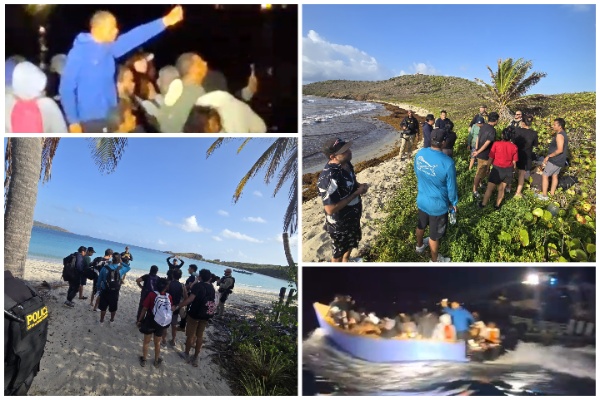
U.S. Customs and Border Protection's Air and Marine Operations (AMO), working alongside the U.S. Border Patrol, intercepted 37 illegal migrants and one U.S. citizen during two separate maritime smuggling operations off the coast of Puerto Rico on Monday. The interdictions took place on opposite sides of the island, underscoring the persistent challenge facing federal authorities in the region.
According to CBP, the first operation unfolded early Monday morning when AMO agents and Border Patrol personnel intercepted a vessel carrying ten illegal migrants from several countries, including the Dominican Republic, India, and Ecuador. Also aboard was a United States citizen whose connection to the smuggling operation remains under investigation.
Federal officials said the final leg of the journey began in St. Thomas, U.S. Virgin Islands, with the vessel headed toward Culebrita Island, a small, uninhabited island off Puerto Rico's eastern coast—a route that investigators believe was intended to evade law enforcement and facilitate an illegal entry into U.S. territory.
Authorities took everyone on board into custody, including the vessel's operator, for further investigation, immigration processing, and potential removal proceedings where applicable. The role of the U.S. citizen has not yet been determined.
The arrests are the latest reminder that illegal immigration is not confined to the U.S.-Mexico border. Criminal smuggling organizations continue to exploit maritime routes throughout the Caribbean, adapting their tactics in an effort to move migrants into the United States while putting lives at risk for profit.
The successful interdictions highlight the critical role of CBP's Air and Marine Operations and the U.S. Border Patrol in protecting America's maritime borders. As transnational smuggling networks expand beyond traditional crossing points, maintaining strong border enforcement on land and at sea remains essential to national security, public safety, and the rule of law.