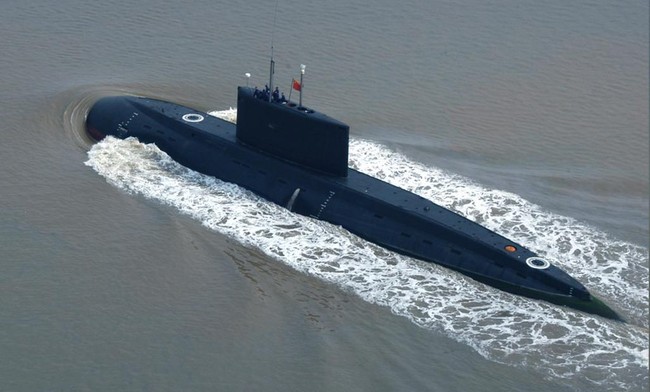
As most Americans were just starting their week, a chilling message echoed across the Pacific: a Chinese nuclear submarine surfaced and launched a ballistic missile, carrying a dummy warhead, in Beijing’s first such display since 2024. Nations like Japan, Australia, and New Zealand were immediately forced into action, scrambling to track debris and issuing formal protests. This was no accident; it was a deliberate taunt, a stark warning to an American public still seemingly asleep to the undeniable threat.
The reality is grim, and it didn't just begin with this week's missile launch.
Just days prior, the Pentagon’s annual report on the People's Liberation Army delivered a dire warning that too many in Washington will undoubtedly ignore: China is on track to boast nine aircraft carriers by 2035, its nuclear arsenal is projected to shatter the 1,000-warhead mark by 2030, and Xi Jinping has personally directed his military to be ready to forcibly seize Taiwan by 2027. Even more chillingly, the report detailed the “Volt Typhoon” cyber intrusions, a stealthy infiltration of U.S. critical infrastructure, designed to shut down our own lights, water, and pipelines in a crisis. This is a blueprint for national paralysis.
Adding to this unsettling picture, recent reports confirm Chinese personnel are actively training Russian forces in radiological, biological, and chemical warfare on the battlefields of Ukraine. This is not mere observation; Beijing and Moscow are deeply intertwined partners, exchanging real operational lessons in real-time against the backdrop of Europe’s worst land war since 1945. The alliance is clear, and the threat it poses to global stability and American interests is unmistakable.
As a former official with the Trump administration, I witnessed firsthand the devastating aftermath when critical warning signs are ignored and threats are allowed to fester without a decisive response. Beijing is advancing on every front — military, cyber, and industrial — and Congress is right to seek robust tools to counter this monumental challenge. The AI competition, in particular, is a generation-defining battle; whoever dominates this technology will hold the decisive advantage. That’s precisely why any legislative response must actually work, not just sound tough.
Currently, a coalition on Capitol Hill is attempting to fast-track half a dozen AI chip export bills into next year’s defense spending package, betting that bundling them is the easiest path to law. The urgency is understandable; Beijing waits for no one, and neither should we. But this “bundle” approach only works if every single bill within it is sound, not just those with the most patriotic-sounding titles.
Take, for example, the “Remote Access Security Act” (RASA), now making its way through the Senate. The core problem it purports to solve — China’s insidious backdoors around our chip export bans — is undeniably real. But RASA overreaches dramatically. Its language is so broad it could inadvertently ensnare vast segments of ordinary cloud business with America’s closest allies, including the UK and Germany, not just China. The unintended consequence? American companies are forced to abandon significant shares of the global market.
This is exactly the kind of “own-goal” Beijing dreams of. By walling off American cloud and AI companies from the rest of the world, Congress would effectively clear the playing field, creating an open invitation for Huawei and other Chinese providers to seize those critical customers. It’s a gift-wrapped opportunity for our adversaries.
Winning the AI race demands we build the best chips, but equally crucial is ensuring the world runs on American technology. RASA doesn’t protect that lead; it shamefully hands it away to China.
The lesson from this week's brazen missile test is unequivocal and urgent. However, simply passing more bills with “China” in the title is not enough. We need legislation that precisely targets the actual threats: chip smuggling, cyber intrusions into critical infrastructure, and direct technology transfer to the People's Liberation Army. We cannot afford broad, sweeping grants of regulatory discretion that could outlive this specific threat and even this administration, only to be weaponized against American enterprise. Beijing is not waiting for Congress to get its act together. It is testing missiles, training with Russian forces, and systematically building the capacity to seize Taiwan by force. American resolve must be matched by American precision, clarity, and strength. Anything less is a dangerous distraction — and history shows that empty gestures have never once stopped a hostile submarine.