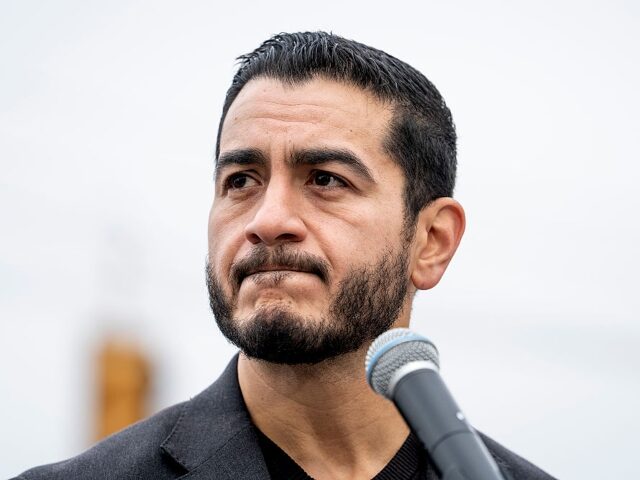
Michigan Democrat Senate candidate Abdulrahman Mohamed El-Sayed had an opportunity to explain how prisons should protect vulnerable inmates without compromising the safety of others. Instead, he described the placement of biological males who identify as women in men's prisons as an “unfortunate choice” and left the central question unresolved: What should the government actually do?
El-Sayed made the remarks Wednesday during a press conference in Detroit focused on victims of Jeffrey Epstein, less than two weeks before the midterm election. The exchange quickly turned to the treatment of transgender-identifying male inmates, including the risk of sexual assault behind bars.
The questioner raised concerns about the “very, very high rates of sexual assault” these inmates face and the lack of adequate help for their trauma.
Standing behind a podium bearing the words “The Donald J. Trump and Jeffrey Epstein Memorial Reading Room,” El-Sayed responded by framing the issue as a failure to invest enough resources in inmate safety.
“What you’re speaking to is too often a choice that we make about failing to invest resources to keep people safe,” he said, adding that such decisions were “unfortunate choices that we make that force people into positions of danger.”
“And what are we doing if we’re not actually invested in people’s safety, right?” he asked.
The language sounded compassionate. The practical answer, however, remained elusive.
El-Sayed said the solution should be to “prevent it from happening” and ensure inmates are “safe and secure in their positions.” He later emphasized that the state has a responsibility to protect incarcerated people because they cannot independently take the same precautions available to those outside prison walls.
“We need to be really thoughtful about protecting all folks, particularly in a situation where they are incarcerated and their safety is at the hands of the state,” he said.
But the candidate did not explain what specific policies he would support. He also did not clarify whether he believes transgender-identifying male inmates should ever be housed in women's prisons, where female prisoners have their own legitimate right to physical safety and protection from sexual violence.
That omission matters. Prisons are not abstract exercises in political language. They are institutions where the government exercises extraordinary control over people's lives, and where mistakes in housing decisions can have devastating consequences.
Protecting one vulnerable group cannot mean ignoring another.
The question raised at the press conference concerned the dangers transgender-identifying male inmates may face in men's facilities. Those risks deserve serious consideration. Yet the broader debate over prison placement also involves female inmates, whose privacy and physical security must not become secondary considerations in the pursuit of ideological objectives.
Past cases involving sexual assaults in sex-segregated correctional facilities have intensified scrutiny of policies that permit transgender-identifying inmates to be housed according to gender identity rather than biological sex. The circumstances vary from case to case, but the underlying responsibility is straightforward: prison officials must assess risks carefully and protect inmates from sexual abuse.
A candidate seeking a seat in the U.S. Senate should be prepared to explain how he would balance those competing safety concerns instead of relying on broad assurances that everyone deserves protection.
The debate extends beyond prison housing. On Wednesday, the Supreme Court rejected an emergency request from the Trump administration seeking to gradually end certain forms of gender-transition-related medical treatment for transgender-identifying federal inmates while litigation continues.
The dispute places the administration's effort to change federal prison medical policies before the courts, with the legal fight still ongoing. The precise scope of any eventual ruling remains to be determined.
For conservatives, the broader issue is whether government institutions can establish clear, practical standards that protect individual safety without allowing ideological commitments to override common sense. That means taking sexual assault seriously, respecting the rights of female prisoners, and demanding accountability from officials responsible for people held in state custody.
El-Sayed spoke repeatedly about safety. What voters still lack is a clear explanation of how he would deliver it when the competing risks become difficult and the decisions carry real consequences. In matters involving prison security and sexual violence, reassuring words are no substitute for a policy that protects everyone in the government's care.