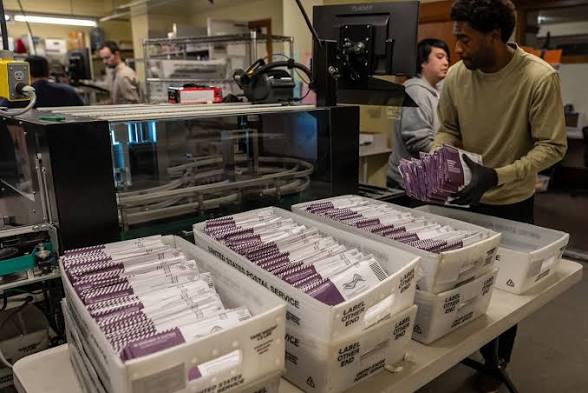
The battle for election integrity has escalated to the nation's highest court, as the Department of Justice (DOJ) has formally petitioned the Supreme Court to intervene in California's contentious handling of over 20,000 mail-in ballots. These ballots, the DOJ asserts, were cast by individuals who are likely not U.S. citizens, raising grave concerns about the sanctity of the electoral process.
In a move to preserve the integrity of the upcoming election while eligibility is investigated, the DOJ is seeking a temporary block on lower-court rulings that have inexplicably denied its request to segregate these questionable ballots. While California and the federal government clash over the legality of these votes, the DOJ's argument is clear and urgent.
"Once illegally cast ballots are counted and commingled with lawful votes, the resulting harm is impossible to remedy," the Justice Department unequivocally stated in its court filing. This stark warning highlights the irreversible damage that could be inflicted on public trust and the democratic system if these ballots are allowed to be counted without proper scrutiny.
The urgency of the DOJ's appeal comes after both the 9th U.S. Circuit Court of Appeals and a federal judge in Los Angeles rejected their initial requests last week. Notably, Judge Patrick Bumatay issued a strong dissent in the 9th Circuit decision, underscoring the legal division and the perceived failure to prioritize election security.
California, meanwhile, clings to the dubious claim that its "safeguards" against non-citizen voting are "robust," despite federal prosecutors verifying that at least 20,000 non-citizens have been identified on the state's voter rolls. The Golden State's officials further argued that the federal list of potential non-citizens might contain errors, threatening to "disenfranchise eligible voters" – a convenient shield often deployed to resist federal oversight.
This critical legal skirmish originates from an October 15 lawsuit filed by the Justice Department. That suit accused California of actively impeding the enforcement of federal law, which explicitly bars non-citizens from voting in federal elections. The administration rightly points to the Constitution's Supremacy Clause, asserting that federal law must take precedence over state resistance when it comes to fundamental national security and electoral integrity.
This isn't an isolated incident; it's part of a broader, necessary push by federal authorities to ensure the purity of elections. This includes demands for states to provide access to voter rolls and stern warnings that officials could face prosecution for knowingly allowing non-citizens to cast ballots. The stakes are particularly high in California, the nation's most populous state with 52 House seats, a battleground where every legitimate vote must count, and every illegitimate one must be rejected.
The fight for free and fair elections is not merely a partisan squabble; it is the bedrock of our republic. The DOJ's determined appeal to the Supreme Court sends a clear message: America First means securing our elections from all threats, including those who would undermine the sacred right to vote by diluting it with unlawful ballots. It's time for accountability and for the Supreme Court to uphold the foundational principle that only citizens can decide the future of our nation.