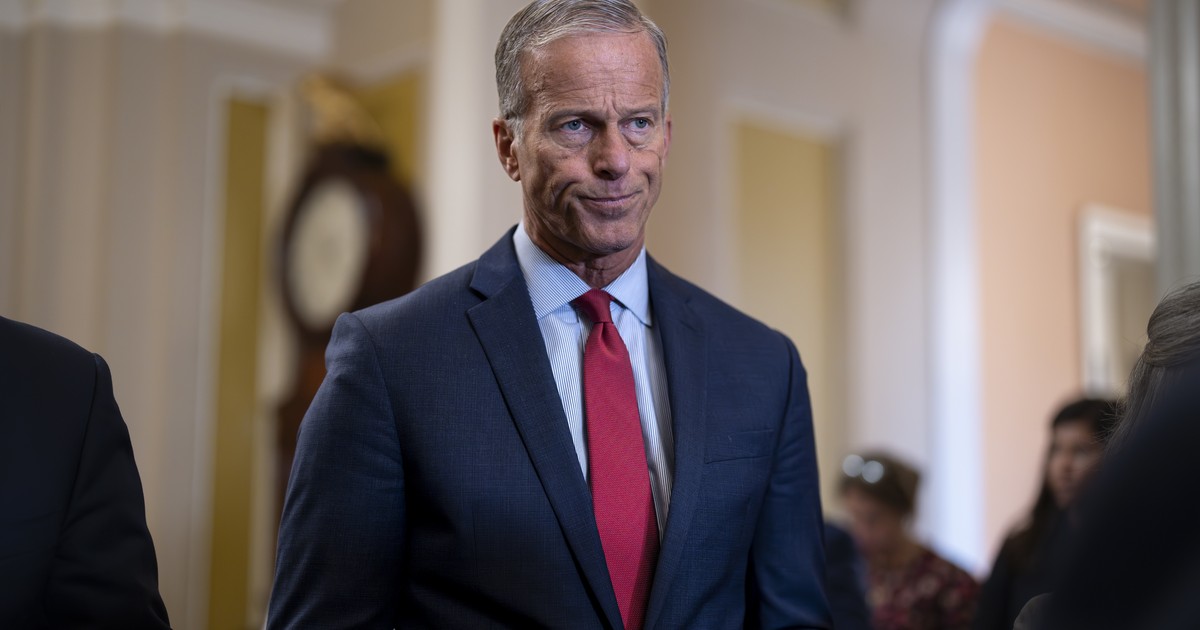
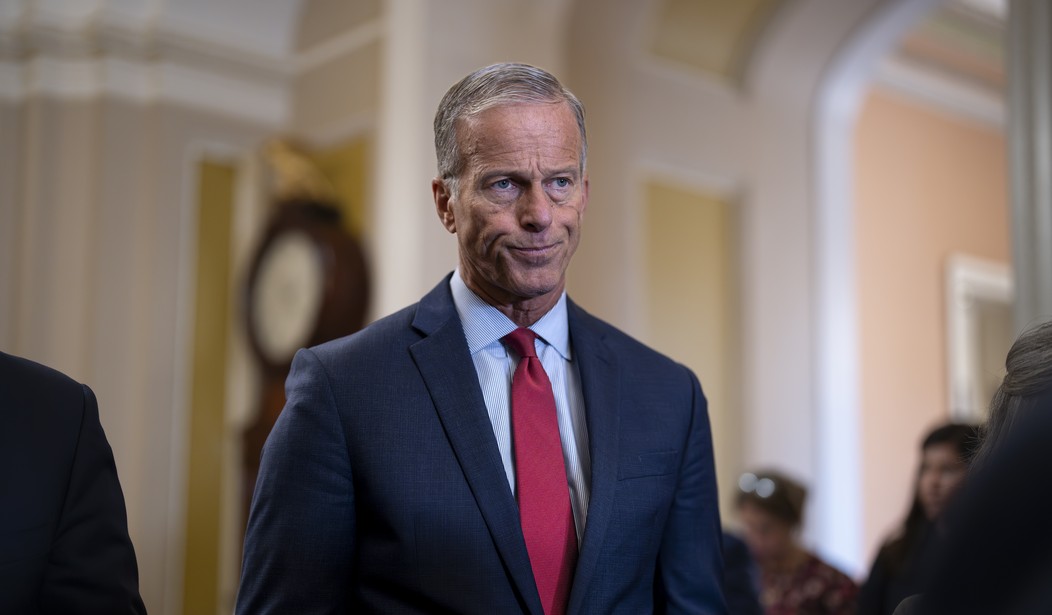
The GOP midterm convention in Dallas, a pivotal moment for Republicans heading into the crucial November elections, has unveiled its speaker list – and a conspicuous absence speaks volumes about the shifting power dynamics within the party. Senate Majority Leader John Thune (R-SD), once a fixture at such gatherings, finds himself relegated to the sidelines, a clear sign of his diminished standing with President Trump.
While the Trump-America First faithful gather to rally support for Republican majorities, Thune will reportedly be confined to convention-adjacent fundraising events, metaphorically seated at the "children's table." This stark contrast is amplified by the prominence given to other staunch Republican leaders and Trump allies.
Senate Majority Whip John Barrasso (R-WY) and NRSC Chair Tim Scott (R-SC) are slated for prime time speaking roles, energetically championing the need to secure both House and Senate majorities. Speaker of the House Mike Johnson (LA-04) will also be front and center, leading the charge. Most importantly, President Trump and Vice President JD Vance are set to deliver keynote addresses, solidifying the event as a testament to the America First movement's unwavering influence.
A host of Trump administration officials, including Treasury Secretary Scott Bessent, Attorney General Todd Blanche, Health and Human Services Secretary Robert F. Kennedy Jr., Centers for Medicaid and Medicare Services Administrator Dr. Mehmet Oz, and Housing and Urban Development Secretary Scott Turner, are also scheduled to address the convention. Other notable speakers include Donald Trump, Jr., former White House press secretary Karoline Leavitt, and various House and Senate candidates.
Thune's team, in a rather transparent deflection, told Punchbowl news that the Majority Leader "preferred to give other candidates and incumbents a turn in the spotlight." Apparently, common sense needed a permission slip on that one.
The palpable tension between President Trump and Senator Thune largely stems from Thune's failure to shepherd the critical SAVE America Act through the Senate. Trump had explicitly called for the Senate to remain in session last month to ensure the bill's passage, a directive Thune ignored, opting instead to let members return home, citing a lack of votes. This perceived inaction has not gone unnoticed by the America First leader.
Furthermore, Thune has seemingly attempted to shift responsibility for the challenging Texas Senate race onto President Trump's shoulders. Following incumbent Senator John Cornyn's primary defeat to Trump-backed Ken Paxton, Thune-aligned groups poured tens of millions into the primary. Thune now insists, "All of our allies out there, including the president and his team and their resources, need to be brought to bear on Texas, because it’s not one that we can lose if we’re going to hang on to a Republican majority."
And there it is: President Trump's commitment to America First candidates is already clear. MAGA Inc., the Trump-linked SuperPAC, recently unleashed its first major midterm expenditure, a $10 million blitz of pro-Paxton digital and TV ads across the Lone Star State. Trump revealed the PAC commands an impressive $400 million to $500 million, declaring, "I’m going to spend whatever amount of money necessary to try and help us." This is decisive leadership, a stark contrast to the perceived hesitancy and blame-shifting from some corners of the establishment.
The message from the Trump-led convention is clear: in the America First movement, results, loyalty, and unwavering commitment to the conservative agenda are paramount. Those who fail to deliver, or worse, attempt to undermine the movement's momentum, will find themselves relegated to the periphery, watching as the true leaders rally the base for the fight ahead.