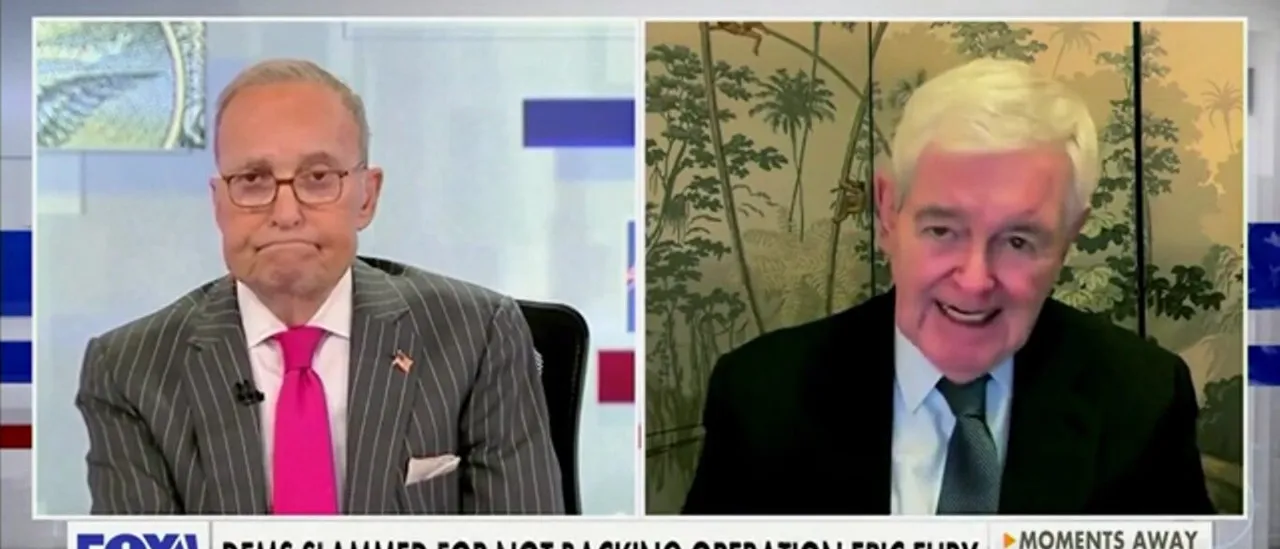
Former House Speaker Newt Gingrich didn’t mince words this week, arguing that Democrats may have just handed Republicans a major political advantage—right in the middle of growing concerns over national security and rising tensions with Iran.
Appearing on “Kudlow,” Gingrich pointed directly to the ongoing standoff over funding for the Department of Homeland Security, which includes the Transportation Security Administration (TSA). The Senate has hit a deadlock, with multiple proposals failing to reach the 60-vote threshold needed to move forward. Several Democrats, including Senator Jon Ossoff, opposed the bill—effectively stalling it.
And according to Gingrich, that’s where the political opening begins.
He argued that by blocking security-related funding, Democrats are giving Republicans a clear and powerful message to take directly to voters. In his view, this isn’t just policy disagreement—it’s a moment to highlight what he framed as misplaced priorities.
Gingrich didn’t hold back, suggesting Republicans should challenge Democrats on whether they’re willing to risk critical infrastructure, like major airports and airlines, over political positioning. Subtle? Not exactly. Effective? That’s the bet.
At the heart of his argument is a broader concern about national security—particularly the ongoing threat from Iran. Gingrich emphasized that the danger isn’t hypothetical, pointing to decades of hostility between the United States and the Iranian regime dating back to 1979.
He framed the issue in stark terms, asking what Americans are willing to risk when it comes to the possibility of Iran developing nuclear weapons. It’s a message designed to cut through the noise and bring the debate back to something voters can’t ignore: safety.
Of course, the political divide remains as sharp as ever. Democrats see the funding fight differently, while Republicans are seizing the opportunity to draw a direct line between policy decisions and national security risks. And in Washington, moments like this rarely go unused.
What’s clear is that this debate goes beyond budgets and votes—it’s about defining priorities at a time when global tensions are rising. And as the conversation continues, one side is making sure the message stays simple: security isn’t optional.
If Gingrich is right, this could be one of those moments where a political miscalculation turns into a strategic advantage. And with strong leadership and a clear message, Republicans are positioning themselves to make the most of it—while keeping the focus exactly where they want it: on protecting the American people.