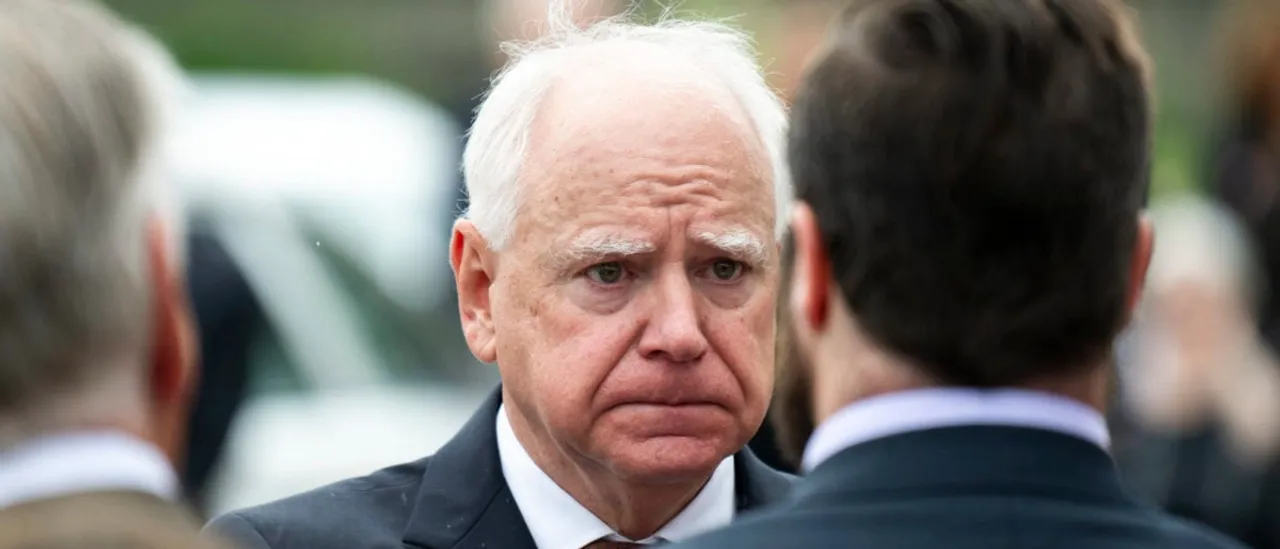
After two terms filled with controversy, Democratic Minnesota Gov. and failed vice presidential candidate Tim Walz announced Monday that he won’t seek a third term—bringing an end to an administration defined less by competence and more by blunders, overreach, and scandals that somehow never seemed to stick.
Walz’s tenure was marked by strict COVID-era policies, sweeping “gender-affirming” legislation, serious questions about his personal record, and repeated failures to stop massive fraud and abuse of taxpayer-funded programs. In short, it was a masterclass in how to avoid accountability while calling it leadership.
One of Walz’s earliest and most controversial moves came during COVID. In March 2020, he issued an executive order shutting down all K-12 public schools statewide. What was pitched as a temporary measure stretched through the end of the 2019–2020 school year. The following year, while Republican-led states moved students back into classrooms, Walz’s guidance leaned heavily toward remote and hybrid learning, keeping Minnesota kids out of school far longer than necessary.
He followed that up in July 2020 with a statewide indoor mask mandate, imposed under a peacetime emergency declaration. That mandate lasted roughly ten months, finally expiring in May 2021. Unsurprisingly, it didn’t go unchallenged. In August 2020, the Upper Midwest Law Center filed suit on behalf of residents, small businesses, and churches, accusing Walz of abusing his emergency powers, violating constitutional protections, and imposing impossible enforcement burdens. Businesses, it seemed, were expected to play hall monitor for the state.
Walz doubled down that same year with Executive Orders 20-94 and 20-95, extending distance and hybrid learning and discouraging teachers from balancing in-person and remote instruction. The legal battle over his emergency powers dragged on for years. While lower courts initially brushed the case aside, the Minnesota Supreme Court later revived part of it before ultimately affirming in 2024 that Walz acted lawfully—cementing broad emergency powers and neatly sidestepping accountability once the mandates had already expired.
With COVID behind him, Walz pivoted to gender ideology. In March 2023, he signed Executive Order 23-03 to protect access to so-called “gender-affirming” health care. A month later, he signed HF 146, turning Minnesota into a “sanctuary” state for transgender individuals, including minors fleeing states with restrictions. In May 2023, he signed HF 44, requiring public and charter schools to provide free menstrual products to all “menstruating students” in grades 4–12—a gender-neutral mandate applied to school restrooms regardless of biology. Minnesota, apparently, was redefining basic science by statute.
During the 2024 campaign, after being tapped as Kamala Harris’s running mate, Walz’s personal history also came under renewed scrutiny. Republicans, including Vice President JD Vance, accused Walz of exaggerating his military service. Critics pointed to statements implying combat experience, despite Walz retiring from the National Guard before his unit deployed to Iraq. A Harris campaign video showed Walz advocating a weapons ban by referencing weapons he “carried in war,” a claim critics said overstated his role.
Walz also faced questions about his time in China. He appeared to suggest he was in Hong Kong during the 1989 Tiananmen Square massacre, though records show he didn’t arrive until months later. He later admitted during the vice presidential debate that he had “misspoke”—a familiar explanation.
Perhaps most damaging has been the explosion of fraud uncovered under Walz’s watch. The Feeding Our Future scandal revealed hundreds of millions of dollars siphoned from federal child nutrition programs using fake attendance records. Dozens have been charged and convicted, while critics argue the state ignored early warning signs. House Oversight Committee Chairman James Comer launched a federal investigation into what he described as widespread fraud facilitated by weak oversight.
Additional schemes surfaced in Minnesota’s Housing Stabilization Services and Medicaid-funded autism therapy programs, where providers allegedly billed for services never delivered, diverting millions more in taxpayer funds. Republican lawmakers have argued Walz’s slow response allowed these scandals to metastasize before serious enforcement began.
Despite calls from Republicans for his resignation, Walz is leaving on his own terms—largely untouched by consequences that would have ended most political careers.
But there’s a silver lining. With Walz stepping aside, Minnesota voters now have a chance for real reform, stronger oversight, and leadership focused on results instead of excuses. Accountability may have been delayed—but it’s not gone forever.